ExploreSpeaker directory
Comedian · Writer · Film producer

D.B. Frick

Host and executive producer of Saving Ferris Butler, a documentary exploring overlooked comedy history.

D.B. Frick wearing a dark shirt in a close-up portrait
Photo source
"Comedy history shouldn't disappear just because somebody forgot to label the videotape."
- D.B. Frick · D.B. Frick's Saving Ferris Butler update

Last updated

D.B. Frick · Short bio

D.B. Frick, also known as Daniel Frick, is a comedian, writer and film producer. He hosts and executive produces Saving Ferris Butler, a documentary investigating the life of a former Saturday Night Live writer and his claim that he inspired Ferris Bueller. Daniel's background includes working with Tony Hendra on National Lampoon comedy, teaching improvisation and producing the variety show Welcome Back To America. He contributed Survival Is the Real Skill to Results on Repeat, connecting comedy with resilience and audience awareness. He can discuss overlooked comedy history, independent filmmaking, creative collaboration and continuing to work through rejection.

Current film
Saving Ferris Butler - host and executive producer
Comedy work
Writing, performance and improvisation
Book contribution
Survival Is the Real Skill in Results on Repeat

About D.B. Frick

D.B. Frick is a comedian, writer and producer whose work spans sketch comedy, live performance, interviews and independent film. Also known as Daniel Frick, he is the host and executive producer of Saving Ferris Butler. The documentary follows Ferris Butler, the creator of Waste Meat News and a former Saturday Night Live writer, while investigating his claim that he helped inspire Ferris Bueller.

Daniel's connection to Ferris began at a New York comedy open mic. A friendship and mentoring relationship developed over 15 years before the documentary took shape. It brought together Daniel's interest in comedy, the archives surrounding Ferris's work and director Julius Olivas's experience with another documentary, Inky. Daniel's current production updates describe the goal as helping audiences discover creative work that has slipped out of public view.

His own comedy background includes an internship at Late Night with Conan O'Brien in 1999-2000 and years writing, producing and performing material with Tony Hendra at National Lampoon. Daniel describes working on sketches and songs as a collaborative process: an idea becomes stronger when other writers and performers help develop it. He favors absurdity and satire and pays attention to how an audience anticipates a joke before its payoff.

Daniel has taught improvisation and storytelling in programs at UCLA and Cambridge. In his conversation with Robert Plank, he describes teaching students from several countries, including students who did not speak English. A short story told without dialogue becomes a practical test of whether action, timing and physical choices communicate clearly. His audience-first approach asks writers to understand reactions beyond their own taste.

That approach also appears in his One Laugh Rule: a genuine laugh tells him that the material reached someone. His chapter Survival Is the Real Skill in Results on Repeat connects his comedy experience with rejection, emotional flexibility and continuing to create. He brings those ideas to conversations for writers, performers and business owners who need to present their work and respond to an unpredictable room.

Daniel hosted Welcome Back To America as a variety show with sketches, interviews and field segments. He recalls using an otherwise quiet studio during the pandemic to keep producing it. The surviving recordings include conversations with comedy writers, performers and podcast journalists. His recent work focuses on bringing Saving Ferris Butler to audiences and drawing attention to the people and recordings behind its story.

Saving Ferris Butler: The Documentary

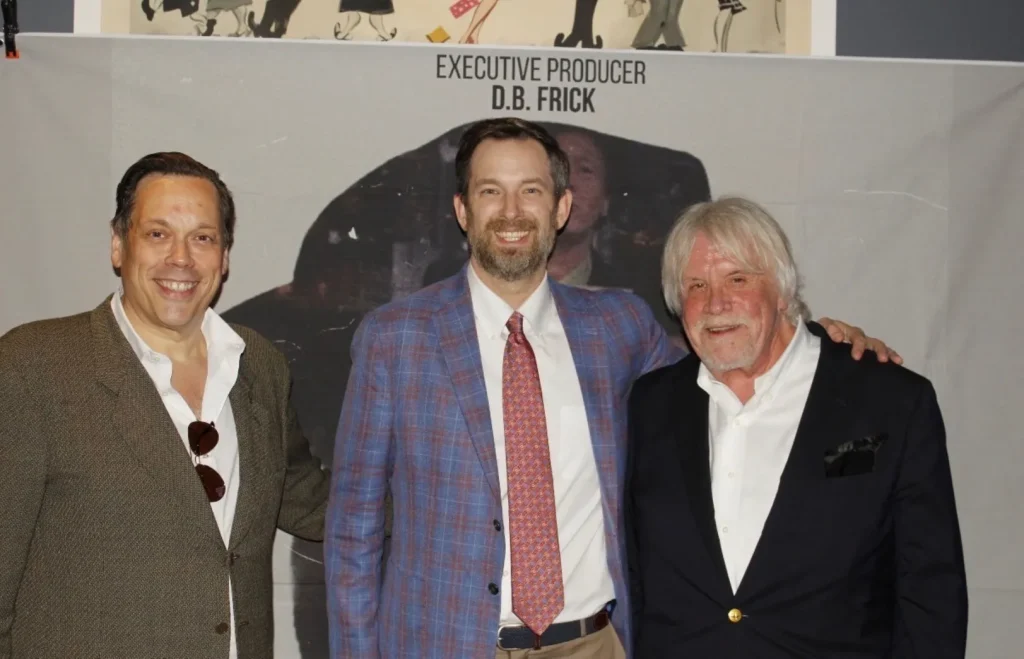
D.B. Frick at left with Andy Hoglund and Patrick Weathers at the New York premiere of Saving Ferris Butler
D.B. Frick at left with Andy Hoglund and Patrick Weathers. Photo credited to Enrique Guzman and Aikel Franks.

D.B. Frick is the executive producer and host of Saving Ferris Butler, a documentary about comedy writer Ferris Butler. Julius Olivas directs the film. It follows Ferris's cable-access work, his time at Saturday Night Live and his claim that he helped inspire the character Ferris Bueller.

The story moves between the freedom of public-access television and the pressure of a network comedy institution. Ferris Butler's Waste Meat News predates his 1980-81 SNL work. The film brings those recordings into conversation with people who worked in comedy, television and music, rather than relying on the similarity between two names.

Before Saturday Night Live
The film returns to Waste Meat News, Ferris's New York cable-access sketch show from the 1970s. The official synopsis describes interviews and archival footage that place his do-it-yourself television work alongside his later network career. It also examines Leather Weather, the sketch featuring Denny Dillon and Charlie Rocket.
A question of creative influence
Ferris believes his name, personality and connections to the improvisational comedy world influenced Ferris Bueller. In his StageBiz interview, D.B. explains that the film weighs relationships, testimony and circumstantial evidence. He says they found no document in which John Hughes confirms that connection; viewers are invited to judge the case.
The people behind the history
The film's participant list includes Denny Dillon, Patrick Weathers, Hugh Fink, Jeff Richards and people who knew Ferris through comedy and television. Beverly Ross, Ferris's wife and the songwriter associated with Lollipop, is also part of the story. Music from Neil Levy, Jeff Richards and Patrick Weathers connects the film with its comedy subjects.
Building an independent documentary
On The Projection Booth podcast, D.B. describes meeting Ferris at a New York open mic 15 years earlier. He and Julius explain how Julius's documentary Inky brought their team together, and how they worked through a large archive of cable-access material, television appearances and interviews. Their account covers selecting usable scenes, arranging interviews through Andy Hoglund and producing the film on a small independent budget.

The project also asks what happens to a creative person's work when public recognition fades. The filmmakers' stated purpose is to preserve Ferris's story and the independent communities around it. That gives a host material beyond the Ferris Bueller question: authorship, overlooked artists, oral history, mentorship and the practical decisions involved in preserving old recordings.

D.B. organized the June 11, 2026 screening at New York's Quad Cinema; he later described it as a sold-out premiere in his StageBiz interview. The Chicago-area engagement was announced for September 18-24, 2026 at the Pickwick Theatre in Park Ridge, Illinois, with discussions and comedy-related events.

The Bluebird Film Festival's January-April 2026 results list Saving Ferris Butler among its award winners in the Documentary category, naming director Julius Austin Olivas.

The official credits identify D.B. as executive producer and Julius as director, with Enrique Guzman and Aikel Franks among the producing team. For viewing, trailer and screening inquiries, use the official film website.

D.B. Frick's One Laugh Rule and Audience Awareness

In his announcement of his Results on Repeat chapter, D.B. calls one of his comedy survival tactics the One Laugh Rule. In his conversation with Robert Plank, he explains the idea through a room of 1,000 people: one person laughing still tells him that the material connected with someone.

Notice who responds
D.B. uses one genuine laugh as evidence of a connection. He is interested in why that person found the material funny, even when the response differs from his own taste.
Write for the audience
His practical challenge is to understand humor beyond what he personally enjoys. He describes sitcom and stand-up writing as work for an audience, requiring a writer to recognize different reactions rather than assuming everyone shares the same preferences.
Practice within a constraint
D.B. also describes a storytelling exercise from his UCLA work: tell a short story without dialogue. Taking speech away forces the storyteller to communicate through action and physical choices.

His classroom example makes the problem concrete. At Cambridge, he says he taught young people from several countries, including students who did not speak English. He had to find a shared point of understanding rather than rely entirely on familiar references or spoken jokes.

For a podcast, writing group or creative workshop, those examples support a conversation about adapting a message, reading a room and continuing to practice after rejection.

D.B. Frick and Welcome Back To America

D.B. Frick hosted Welcome Back To America as a variety and interview show, combining conversations, sketches and visits outside the studio. Millie Micheals appears alongside him as a regular cohost. In his Marketer of the Day interview, D.B. says he produced five seasons and 53 episodes over three years, using a studio that had otherwise gone quiet during the pandemic.

The surviving creator uploads show the range of those conversations. Comedy writer and producer Jeff Astrof discusses Shining Vale; actor and social-media consultant Mesa Kronhaus talks with D.B.; Joshua Dudley joins a holiday episode to discuss podcasts. Other interviews include Todd Montesi on PN & Friends and performer Alexandra Petrullo on her one-woman musical Crave. These are historical recordings from 2021, separate from the later videos promoting Saving Ferris Butler.

Topics to discuss with D.B. Frick

Preserving overlooked comedy history

Researching performers and writers whose recordings, relationships and influence have fallen out of public view.

A question to ask: How do you investigate a story when its surviving evidence is scattered across archives and personal memories?

Writing for the audience

Recognizing different senses of humor and testing whether action, timing and a clear setup communicate.

A question to ask: What can one genuine laugh teach a writer about the person listening?

Creating through rejection

Using practice, collaboration and direct personal connections to keep developing work after an unsuccessful performance or pitch.

A question to ask: How do you keep experimenting without losing interest in the work?

Books Featuring D.B. Frick

Cover of Results on Repeat: The Playbook For Predictable Growth Through Capacity, Delegation, Structure, And Trust

Results on Repeat: The Playbook For Predictable Growth Through Capacity, Delegation, Structure, And Trust

D.B. contributes Survival Is the Real Skill to this multi-author collection for founders and leaders building a business that can function without their constant intervention. His chapter applies experiences from comedy to rejection, emotional flexibility and connecting with an audience under pressure. In his own chapter announcement, he highlights the One Laugh Rule and failing safely as practical ideas for founders and creators. The wider collection covers capacity, delegation, business structure and trust.

Media appearances

Selected public appearances · Sources checked October 20, 2026
DateTypeShow / event / publisherTopicLink
September 14, 2026News appearanceChicago TribuneSaving Ferris Butler: comedy history, the film's investigation and the Pickwick Theatre engagementOpen ↗
August 25, 2026News appearanceStageBiz - written interviewProducing Saving Ferris Butler, preserving an overlooked comedy career and investigating the Ferris Bueller claimOpen ↗
August 25, 2026Podcast appearanceThe Projection Booth podcastD.B. Frick and Julius Olivas discuss Saving Ferris Butler, archival research and independent documentary productionOpen ↗
August 8, 2026Podcast appearanceOutside the Loop RADIO podcast - WGN RadioD.B. Frick discusses the Saving Ferris Butler documentary with Mike StephenOpen ↗
June 11, 2026Film screeningQuad Cinema, New YorkSaving Ferris Butler: Is Ferris Butler the Real Ferris Bueller?Open ↗
March 15, 2024Podcast appearanceMarketer of the DayComedy, Creative Collaboration and Learning to Read an AudienceOpen
November 29, 2022Podcast appearanceXStreamed Chat podcast from Extreme ImprovComedy writing, sitcoms, improv and D.B. Frick's comedy mentorsOpen ↗

D.B. Frick on Marketer of the Day

Daniel's conversation with Robert Plank focuses on how a comedian develops material, reads an audience and keeps creating. He also discusses the early Saving Ferris project, before the documentary's 2026 release.

Stories from the conversations

D.B. Frick makes a quiet studio the home of his variety show

Daniel used a studio that was largely empty during the pandemic to produce Welcome Back To America. He describes how continuing to make the show gave him a place to interview, perform and develop new material.

Explore the story

D.B. Frick recalls a missed introduction at Conan

During his internship, Daniel was so focused on his assigned work that he walked past a producer's offered handshake. He reflects on the small interactions that can open a professional relationship.

Explore the story

D.B. Frick in photos

Contact D.B. Frick

Daniel Frick - maintained professional profile ↗ · Saving Ferris Butler - public film inquiry details ↗ · Checked October 20, 2026

Questions about D.B. Frick

Which audiences fit D.B. Frick's work?

His comedy and storytelling experience is relevant to writers, performers, creative teams and people presenting their work to an audience. The documentary offers film groups, comedy-history audiences and interviewers material on archival research, oral history and independent production.

D.B. Frick with Robert Plank - Complete archived interview · Daniel Frick - Survival Is the Real Skill chapter announcement ↗ · Saving Ferris Butler - Official film website ↗

How did D.B. Frick begin working on the documentary?

Daniel met Ferris Butler at a New York comedy open mic and developed a friendship and mentoring relationship with him. Years of conversations led to questions about Ferris's career and the material that could preserve it. Daniel connected with Julius Olivas through the documentary Inky.

D.B. Frick and Julius Olivas - The Projection Booth podcast ↗

Who appears in Saving Ferris Butler?

The film's published participant list includes Ferris Butler, Denny Dillon, Patrick Weathers, Hugh Fink, Jeff Richards and people from his creative circle. Songwriter Beverly Ross is part of the story, and music from SNL alumni connects the film with the community it documents.

Saving Ferris Butler - Official film website ↗

Where can I watch D.B. Frick with Robert Plank?

The With Robert Plank section includes the full interview video and a link to its episode page and show notes. Daniel discusses pitching, audience awareness, physical storytelling, his variety show and the persistence involved in creative work.

D.B. Frick with Robert Plank - Complete archived interview

Sources & research notes · October 20, 2026
Copy this text

Essential features — always available
Forms, spam protection, and podcast playback.

Optional Google Analytics runs only after you accept Analytics. Advertising tags stay off. Change your Analytics choice on the Privacy page.

How these choices work. You can change them anytime from the footer.