Making a fundraising request tangible
Connecting a donation with a specific need and something the donor can picture.
A question to ask: What could this donor understand, see or imagine their gift making possible?
Direct response, donor storytelling and fundraising design for charities.

"A good newsletter makes the donor proud of who they are, not impressed by who you are."
Last updated
John Lepp is a partner and creative director at Agents of Good, where he works with charities on direct response, storytelling and donor communications. He helps fundraising teams connect a specific request with the people receiving it, then plan the thanks and updates that follow a gift. His work combines fundraising strategy with copy, design and the practical details of mail and digital campaigns. John teaches through conference sessions, team training, one-to-one coaching and books including Creative Deviations and the two Fundraising Designs for Donors volumes. He can speak on readable appeals, donor-focused storytelling, decision science and recognizing everyday supporters.
John Lepp is a partner and creative director at Agents of Good. He works with nonprofit fundraising teams on the strategy, stories, copy and design that shape a donor's experience. His work includes direct-mail appeals, digital campaigns, newsletters and gratitude reports, with attention to what happens before a gift and how the relationship continues afterward.
John starts with the person receiving the message: their connection to the cause, previous giving and the request that would make sense to them now. In his conversation with Robert Plank, he explains why sending everyone the same appeal can miss those differences. He also asks charities to make the request specific enough for someone to understand what their money could do. His examples include a food-rescue truck and a children's bandage used to explain the comfort a donor's gift made possible.
For John, design includes the decisions a reader makes while opening an envelope, scanning a letter and completing a reply form. Typography, images, white space and a clear next action all contribute to that experience. His books encourage fundraisers to examine the piece from the donor's point of view, then test the choices they make. A gratitude report or newsletter receives the same attention as an appeal: it can show a supporter that their gift was noticed and mattered.
John teaches R.A.I.S.E. as a way to review fundraising communications through decision science. The five headings are Relevant, Appealing, Intuitive, Social and Easy. In his DonorSearch workshop, he applies those ideas to choices such as donation-amount framing, images, social proof and the ease of responding. A fundraising team can use the headings to examine an appeal, envelope, story or donation page.
Creative Deviations brings together storytelling, graphic design and examples of donor communications. Direct Response & Direct Mail 101: A Field Guide for Small-Shop Fundraisers follows the parts of a direct-mail appeal, while Your Practical Playbook for Fundraising Appeals gives small teams a shorter guide to planning their communications. The connected Fundraising Designs for Donors volumes examine design foundations, visual choices and communications across a donor relationship. Part 1 and Part 2 are separate books, also available together. John is also a contributing author to Next Level Self, compiled by Robert Plank, with material on emotional, human communication in fundraising.
John's teaching is aimed at fundraisers and the people writing, designing and leading their communications. He speaks at conferences and works with teams on storytelling, creative design, direct response and decision science. Through one-to-one coaching, he helps fundraisers work through the needs of a particular appeal. Agents of Good can also provide campaign strategy and implementation or copy and design for a team that already has its plan.
John Lepp teaches R.A.I.S.E. as a way to examine the decisions a donor faces while reading an appeal or using a donation page. His DonorSearch workshop applies decision science to the words, images and choices within fundraising communications.
R.A.I.S.E. stands for Relevant, Appealing, Intuitive, Social and Easy.
The five headings focus attention on what helps someone understand and respond to a request. John's workshop considers donation-amount framing, human-like imagery, social proof and making choices easier. He applies the review to appeals, ask strings, envelopes, stories and donation pages.
In Creative Deviations, John Lepp asks fundraisers to consider how the complete piece feels to the person receiving it. The work connects the envelope, readable copy, a clear request and the experience of being thanked.
John looks at what the person receiving the piece cares about, the communications they have already received and whether the current message gives them a specific reason to act. The envelope, letter and response form are parts of the same encounter.
In his conversation with Robert Plank, John illustrates a tangible request with a truck used to rescue food and a hospital report connecting a cupcake-patterned bandage with a child's comfort. Each example gives the donor something understandable to connect with their gift.
For an Alzheimer Society of Nova Scotia gratitude report, John designed a family-photo-album treatment around Colina's story, with taped edges, personal photographs and hand-coloured financial information. The publisher's illustrated sample shows how the format carries the story instead of simply decorating it.
His attention continues after the donation: how quickly the donor is thanked, what that thanks feels like and what they later learn about the gift. An appeal, gratitude report and newsletter can each recognize the person supporting the work.
Connecting a donation with a specific need and something the donor can picture.
A question to ask: What could this donor understand, see or imagine their gift making possible?
Examining the envelope, story, typography, images and reply form through the reader's experience.
A question to ask: What does the person need to notice and understand before they can respond?
Planning thanks, updates and future requests as part of a continuing donor relationship.
A question to ask: What will the donor hear from the charity after giving?
For fundraising teams with an existing strategy but limited creative capacity, AOG Creatives supplies copy, design or both for a specific project. Deliverables include direct-mail packages, donor newsletters, gratitude and impact reports, legacy materials, digital campaigns and case-for-support documents. The agency works from the client's brief and scopes each project individually, without requiring a long-term commitment.
See the offer ↗Agents of Good partners with nonprofit fundraising teams to plan and deliver individual-giving programs across mail, digital and legacy giving. Packages range from a donor-strategy assessment, campaign recommendation and training calls to data audits, campaign execution and annual retention plans with stewardship and performance tracking. Work can address acquisition, second gifts, monthly giving, lapsed donors or legacy prospects, with the scope tailored to the organization's program and capacity.
See the offer ↗John and the Agents of Good team deliver conference sessions, keynotes, panels and tailored workshops for fundraising staff. Topics include donor psychology and decision science, direct-response offers, storytelling, design, gratitude and connected donor journeys, using fundraising examples and practical communication changes. John also accepts speaking inquiries through his personal site, which presents his direct-mail and creative-fundraising teaching.
See the offer ↗John coaches fundraisers who need to diagnose an underperforming appeal or develop their next campaign. His personal site offers a focused session and four- or eight-session packages, customized around the campaign's needs and questions such as whom to approach, what to ask for and how to present the request. The work covers direct-response implementation, creativity, storytelling and donor communications.
See the offer ↗John sells recorded training for fundraisers developing donor communications, including lessons on creative rule-breaking and decision science. The longer sessions use fundraising examples to examine framing, emotion, identity, social proof and design, while shorter direct-mail clinics cover marketing fundamentals, envelopes and donor decision-making. The first three clinics can be purchased individually or as a bundle through his official store.
See the offer ↗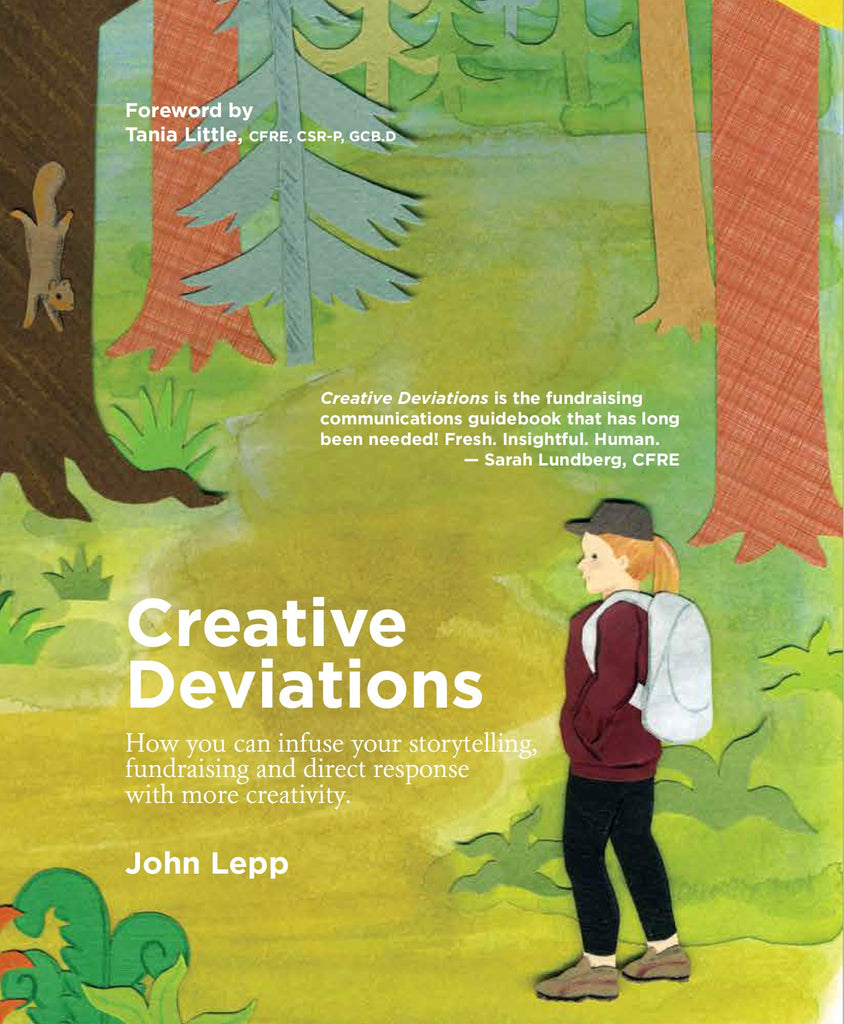
John Lepp's illustrated guide brings together graphic design, storytelling and fundraising strategy for people responsible for donor communications. Its examples examine the whole mail pack: the envelope that gets opened, the letter's voice, a specific reason to give, the reply form and the gratitude that follows.
The book challenges decisions made mainly to satisfy internal branding preferences. Its publisher-provided sample shows how an Alzheimer Society of Nova Scotia gratitude report took the form of a family photo album to suit the personal story it told. Chapters also explore segmentation, human touches, donor involvement and newsletters. John is the author, with a foreword by Tania Little.

John Lepp wrote this field guide for fundraisers in small organizations who handle strategy, copy and production without a large agency behind them. It follows a direct-mail appeal from understanding the donor to choosing an envelope, writing the letter, building the reply form and deciding whom to mail.
The public preview includes an exercise in writing to one specific donor and a prompt to examine which pieces of personal mail earn attention. The contents extend to inserts, audience selection, decision science and getting the work done with limited resources. It is a practical companion to Creative Deviations, with a narrower focus on planning and producing direct-mail appeals.

The first Design for Donors volume explains how a fundraiser's visual choices affect what a donor notices, understands and can act on. John Lepp covers donor-focused design foundations, design thinking and decision science before moving into typography, colour, images, white space and the components of a mail pack.
Its public preview shows how to design for people who skim, bring one specific request into view and make a reply form comfortable to use. The volume is aimed at fundraisers and designers who need to judge a piece by the donor's experience as well as its appearance. It is the first of two connected volumes, also sold together as a bundle.

The second Design for Donors volume extends John Lepp's approach beyond an individual appeal to the communications that maintain a donor relationship. Its contents cover newsletters, gratitude, stewardship, email and digital design, coordinated campaigns, testing and the organization's donor experience.
In the public preview, John explains how a newsletter can combine an emotional photograph, a donor-framed headline, one central story, gratitude and a respectful invitation to help again. He also gives a review test for whether a stewardship piece makes the donor feel appreciated and clearly shows what the gift made possible. This volume continues the first book and is available separately or in their combined bundle.

This shorter guide is written for small fundraising teams balancing letters, emails and graphics with limited time and budget. John Lepp uses a football playbook comparison to explain how a clear message, one specific request and a sequence of donor communications work together.
The preview includes exercises for finding the request in an appeal, removing internal branding clutter, translating an abstract need into a human story and checking the balance of requests, thanks and updates. The contents also cover print and digital essentials, design, decision science and templates. It offers a compact starting point for planning an appeal rather than a substitute for the longer design volumes.

Next Level Self is a collection compiled by Robert Plank with contributions from ten entrepreneurs and practitioners. It covers confidence, productivity, leadership, marketing and content, connecting changes in the contributors' working lives with lessons for business owners.
John Lepp's contribution addresses emotional, human communication in fundraising. The publisher introduces his material as an alternative to robotic marketing, making it relevant to readers trying to connect a message with the people receiving it. John is a contributing author; Robert compiled the collection.
| Date | Type | Show / event / publisher | Topic | Link |
|---|---|---|---|---|
| October 26-27, 2026 | Speaking appearanceScheduled | Nonprofit Storytelling Conference | Be Curious, Not Clever (October 26); Your Charitable OS and the Donor Experience System (October 27) | Open ↗ |
| July 1, 2026 | Podcast appearance | The Fundraising Elevator podcast | Creative Deviations: donor empathy, human communication and creativity | Open ↗ |
| June 24, 2026 | Speaking appearance | SOFII Foundation | Individual Giving Mini-Masterclass - organizer listing | Open ↗ |
| March 11, 2026 | Podcast appearance | Passion, Purpose, and Possibilities podcast | Leading with humanity, storytelling and heart | Open ↗ |
| September 25, 2025 | Podcast appearance | The Influential Nonprofit podcast | Building meaningful donor relationships | Open ↗ |
| May 20, 2025 | News appearance | Fargo INC! | WellTold conference preview: John Lepp on creative donor storytelling | Open ↗ |
| May 10, 2025 | Podcast appearance | Marketer of the Day | Donor relationships, direct mail and the request that makes sense | Open |
| September 2023 | Podcast appearance | Nonprofit Nation podcast | Getting More Creative in Your Fundraising | Open ↗ |
John discusses the donor relationships behind his approach to direct response, storytelling and design.
Marketer of the Day · Episode 1308
John Lepp talks with Robert Plank about the person behind a donation and the choices that make an appeal feel relevant. They discuss donor segmentation, a specific reason to give, direct mail's connection with online giving, and the thanks and updates that should follow a gift. John uses a food-rescue truck and a children's bandage to show how a charity can make an abstract need tangible. He also explains why choosing the right story and voice matters, and why donor relationships need continuing care.
Agents of Good - John Lepp, Partner and Creative Director ↗ · Agents of Good - public business inquiry route and mailing address ↗ · Checked October 20, 2026
John Lepp is a partner and creative director at Agents of Good. He works with charities on direct response, donor storytelling and fundraising design, and teaches those subjects through speaking, coaching and books.
Agents of Good - John Lepp, Partner and Creative Director ↗ · Agents of Good - fundraising services ↗
John's subjects are relevant to nonprofit fundraisers, fundraising communications teams and the writers and designers creating donor appeals. He can discuss direct mail, creative storytelling, donor-focused design and decision science through conference sessions, workshops and team training.
John Lepp - speaking and training ↗ · Agents of Good - speaking topics and actual speaking photographs ↗ · DonorSearch - John Lepp explains R.A.I.S.E. and decision science ↗
John begins with differences between donors, including their previous giving, connection to the cause and interests. In his interview with Robert Plank, he recommends using that understanding to shape the audience, voice and request in an appeal. He challenges the habit of mailing everyone the same generic message.
John Lepp with Robert Plank - fundraising, direct mail and donor relationships
A tangible request helps someone picture what their gift will make possible. John illustrates this with a food-rescue truck and with a children's bandage that helped explain comfort and care in a hospital. He asks fundraisers to explain what they need and who a gift will help.
John Lepp with Robert Plank - fundraising, direct mail and donor relationships
John describes mail as a possible starting point for a gift that is later made online. At Agents of Good, campaign planning can connect direct mail with email, donation pages and later stewardship messages.
John Lepp with Robert Plank - fundraising, direct mail and donor relationships · Agents of Good - Work and approach ↗
The design needs to help a person notice the message, understand the request and respond. John examines readable type, visual hierarchy, images, white space and reply forms from that perspective. He asks fundraisers to judge those choices through the recipient's experience and to test their ideas.
John Lepp - Fundraising Designs for Donors, Part 1 ↗ · John Lepp - Fundraising Designs for Donors, Part 2 ↗
John treats the response to a gift as part of an ongoing relationship. He asks how quickly the donor is thanked, how the thanks feels and what they subsequently learn about their support. Gratitude reports and newsletters give an organization ways to show what a gift made possible.
John Lepp with Robert Plank - fundraising, direct mail and donor relationships · Agents of Good - Strategic fundraising ↗
R.A.I.S.E. stands for Relevant, Appealing, Intuitive, Social and Easy. John uses those headings to review the decisions a donor faces in fundraising communications. His DonorSearch workshop considers donation-amount framing, images, social proof and simpler choices, with applications to appeals, envelopes, stories and donation pages.
DonorSearch - John Lepp explains R.A.I.S.E. and decision science ↗ · John Lepp - recorded R.A.I.S.E. workshop on DonorSearch ↗
John's one-to-one coaching can focus on a specific direct-response or marketing problem, or follow a campaign through four or eight sessions. The work is tailored to the appeal's needs, including whom to approach, what to ask for and how to communicate the request.
AOG Creatives provides copywriting, design or both for teams that have a campaign plan and need help producing the work. Its projects include appeals, newsletters, gratitude reports, legacy materials, emails and case-for-support documents. Strategic Fundraising is the broader option for donor-program assessment, campaign planning and execution.
AOG Creatives - Copy and design ↗ · Agents of Good - Strategic fundraising ↗
John's authored books include Creative Deviations; Direct Response & Direct Mail 101: A Field Guide for Small-Shop Fundraisers; Your Practical Playbook for Fundraising Appeals; and the two Fundraising Designs for Donors volumes. They cover storytelling, appeal planning and the visual and practical choices within donor communications.
Civil Sector Press - Creative Deviations by John Lepp ↗ · John Lepp - Direct Response & Direct Mail 101 ↗ · John Lepp - Your Practical Playbook for Fundraising Appeals ↗ · John Lepp - Fundraising Designs for Donors, Part 1 ↗ · John Lepp - Fundraising Designs for Donors, Part 2 ↗
Part 1 covers design foundations, design thinking, typography, color, images and the components of a mail pack. Part 2 extends the discussion to newsletters, gratitude, digital communications, coordinated campaigns and testing. They are separate connected volumes, offered individually or together as a bundle.
John Lepp - Fundraising Designs for Donors, Part 1 ↗ · John Lepp - Fundraising Designs for Donors, Part 2 ↗ · John Lepp - Fundraising Designs for Donors combined bundle ↗
John is a contributing author to Next Level Self, a collection compiled by Robert Plank. The publisher describes John's material as using emotion and human communication in fundraising. His contribution sits alongside other entrepreneurs' and practitioners' perspectives on confidence, leadership, productivity and business.
Next Level Self - Robert Plank book page · Next Level Self - public publisher chapter subjects and credits ↗
John's Your Giving Tree catalog includes recorded training on creative rule-breaking and decision science, along with direct-mail clinics. The sessions examine donor communications through examples, fundraising principles and practical copy and design choices. They provide a self-directed option alongside his live speaking and individual coaching.
Your Giving Tree - John Lepp's official book and training catalog ↗ · John Lepp - Creative Rule Breaking training ↗ · John Lepp - Decision Science training ↗ · John Lepp - Campaign coaching ↗ · John Lepp - speaking and training ↗
John and Robert Plank discussed donor segmentation, specific fundraising requests, direct mail and the attention a donor receives after giving. John shared examples of making a need tangible and explained how story, voice, design and gratitude can work together. The full episode includes their conversation on creativity and building donor relationships over time.
John Lepp with Robert Plank - fundraising, direct mail and donor relationships
Agents of Good publishes John's email as john@agentsofgood.org. You can contact him directly for an interview or speaking inquiry, or use the agency's contact form to discuss fundraising strategy, copy and design support.
Agents of Good - John Lepp, Partner and Creative Director ↗ · Agents of Good - public business inquiry route and mailing address ↗ · John Lepp - speaking and training ↗