ExploreSpeaker directory
Environmental engineering professor · Author · Clean-energy researcher

Dr. Mark Z. Jacobson, PhD

Stanford professor explaining how electrification, renewable energy and storage can address air pollution, climate change and energy security.

Mark Z. Jacobson outdoors in a blue polo shirt
Photo source ↗
"The obstacles to powering the world with wind, water, and sunshine are primarily social and political, not technical or economic."
- Mark Z. Jacobson and Mark A. Delucchi · Bulletin of the Atomic Scientists ↗

Last updated

Mark Z. Jacobson · Short bio

Dr. Mark Z. Jacobson, PhD, is a professor of civil and environmental engineering at Stanford University and director of its Atmosphere/Energy Program. His research connects air-pollution and climate modeling with plans for running transportation, buildings, industry and electricity systems on renewable energy. He earned his PhD in atmospheric sciences at UCLA in 1994 and has taught at Stanford since that year. His books include Still No Miracles Needed and 100% Clean, Renewable Energy and Storage for Everything. Mark speaks on electrification, energy storage, grid reliability and evaluating energy choices across health, climate and cost.

Mark Z. Jacobson keynote presentation

Watch keynote presentation ↗
Academic role
Professor of Civil and Environmental Engineering, Stanford University
Program
Director, Atmosphere/Energy Program, since 2004
Doctorate
PhD in Atmospheric Sciences, UCLA, 1994
Research
Air pollution, climate modeling and renewable-energy systems

About Mark Z. Jacobson

Dr. Mark Z. Jacobson, PhD, studies two connected questions: how pollution changes the atmosphere, and how energy systems could operate without the fuels producing it. At Stanford University, he is a professor of civil and environmental engineering, director of the Atmosphere/Energy Program, and a senior fellow at the Woods Institute for the Environment and the Precourt Institute for Energy. His work includes atmospheric computer models and wind-water-solar transition plans for countries, states and cities.

Mark traces that direction to playing tennis in Southern California as a teenager. In his conversation with Robert Plank, he recalls the smog around San Diego and Los Angeles and deciding that understanding air pollution would become his life's work. Graduate research at UCLA let him build computer models and compare their results with observations. He earned an MS in atmospheric sciences in 1991 and a PhD in the same field in 1994. Earlier, he completed a BS in civil engineering, a BA in economics and an MS in environmental engineering at Stanford in 1988.

His atmospheric work examines interactions among gases, particles, clouds, sunlight, weather and climate. That includes research on black carbon, the light-absorbing component of soot. The American Geophysical Union recognized his modeling of black carbon's climate effects with its 2013 Ascent Award. His later energy work asks how renewable generation, storage and electricity use can be planned together rather than treating power stations, cars, buildings and factories as separate problems.

In Still No Miracles Needed, Mark makes the case for deploying existing technologies instead of waiting for a breakthrough. He examines electric vehicles, heat pumps, renewable generation and storage, while challenging alternatives he considers less effective when pollution, energy use and cost are counted across a whole system. His 100% Clean, Renewable Energy and Storage for Everything develops the engineering and policy questions in a textbook format. The books draw on his research, but serve different readers: a general audience weighing energy choices and students or practitioners examining how a transition would be designed.

Mark cofounded The Solutions Project, which connects clean-energy advocacy with community leadership. He also teaches Clean, Renewable Energy & Storage for a Sustainable Future through Stanford Online. For a podcast, conference or university event, useful discussion areas include flexible electricity demand, the assumptions inside grid simulations, replacing fossil-fuel uses beyond power generation, and explaining energy research without losing its practical consequences. His interview with Robert Plank includes the example of his own all-electric home and why he believes deployment deserves more attention than waiting for new inventions.

Mark Z. Jacobson's Wind-Water-Solar Roadmaps

Mark uses wind-water-solar roadmaps to examine how a place could replace fossil-fuel energy across electricity, transportation, buildings and industry. In his explanation to Robert Plank, electrification changes both the equipment people use and the energy a place needs to supply.

Electrify the end uses
Identify which vehicles, heating systems, cooking equipment and industrial processes can use electricity, then estimate the resulting demand.
Combine renewable sources and storage
Study wind, solar, geothermal and existing hydropower together with electricity and thermal storage.
Match the timing of supply and demand
Test flexible uses such as vehicle charging, changes in demand, and different combinations of generation and storage across weather conditions.

The flexible-load example makes the idea concrete: an electric car needs enough energy before its next trip, but its charging can often move within that window. Mark uses that flexibility to explain why linking transport and other energy uses changes the grid-planning problem. His team's published studies evaluate specified mixes of technologies, demand, weather and storage.

Mark Z. Jacobson's GATOR-GCMOM and LOADMATCH Models

GATOR-GCMOM is the atmosphere-ocean model Mark developed to study interactions among air pollution, weather and climate. It connects gas chemistry, airborne particles, clouds, radiation, winds and surface processes, allowing changes in one part of the system to affect the others.

For his clean-energy studies, GATOR-GCMOM also estimates changing wind and solar generation and building heating and cooling needs. Those time series feed LOADMATCH, which tests whether generation, storage and demand response can meet electricity, heat, cooling and hydrogen needs at each time step.

If a simulated demand is unmet, LOADMATCH stops. The researcher examines the mismatch, adjusts generation capacity, storage capacity or demand-response settings, and runs the simulation again. Mark uses these repeated simulations to identify combinations that meet demand and compare their cost.

In a 2026 study, Mark and his coauthors used this sequence to examine 150 countries grouped into 29 regions. They simulated 2050-2052 at 30-second intervals and compared systems with and without enhanced geothermal electricity. That gives an energy or policy audience a specific question to explore: how a proposed mix performs through changing conditions, beyond its annual energy total.

Topics to discuss with Mark Z. Jacobson

A renewable system beyond the electricity grid

Electrifying transport, buildings and industry changes both the amount and timing of energy demand.

A question to ask: Which fossil-fuel uses are straightforward to electrify, and which remain difficult?

What a grid simulation actually tests

How weather, generation, storage and flexible demand interact in renewable-energy scenarios.

A question to ask: Which assumptions matter most when evaluating a claim that a grid can run on renewables?

Air pollution and climate in the same decision

Why Mark evaluates health, emissions, energy requirements and cost together when comparing technologies.

A question to ask: What can an analysis miss when it measures carbon dioxide alone?

Work with Mark Z. Jacobson

Training

Stanford Online clean-energy and storage course

Stanford Online's self-paced course with Mark Z. Jacobson serves professionals and other learners exploring clean energy, storage, and energy policy. It covers renewable technologies, grid reliability, environmental effects, and transition strategies for businesses, governments, and nonprofits. The current listing specifies twelve hours of material, sixty days of access, short videos and exercises, a knowledge check, and a record of completion, with support through a Stanford teaching assistant.

See the offer ↗

Books and editions by Mark Z. Jacobson

Cover of Still No Miracles Needed: How Today's Technology Can Save Our Climate and Clean Our Air

Still No Miracles Needed: How Today's Technology Can Save Our Climate and Clean Our Air

Mark explains how wind, water and solar generation, electrification, storage and transmission can be combined to address climate change, air pollution and energy security. Written for general readers and policymakers, this revised edition adds technologies, case studies and references to the argument in No Miracles Needed, while examining the economic, health and land-use implications of a transition. It revises No Miracles Needed (2023) and includes a foreword by Bill McKibben.

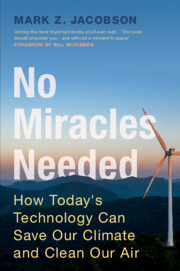
Cover of No Miracles Needed: How Today's Technology Can Save Our Climate and Clean Our Air

No Miracles Needed: How Today's Technology Can Save Our Climate and Clean Our Air

This general-audience book sets out Mark's case for replacing fossil-fuel energy with existing renewable generation and storage technologies. It explains energy uses in transport, buildings and industry, discusses choices he argues should be excluded from a clean-energy transition, and considers actions available to individuals, communities and governments. The original edition was revised as Still No Miracles Needed in 2026. Bill McKibben wrote the foreword.

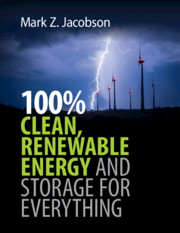
Cover of 100% Clean, Renewable Energy and Storage for Everything

100% Clean, Renewable Energy and Storage for Everything

A multidisciplinary textbook for students and professionals studying a transition across electricity, transport, buildings and industry. Mark covers renewable generation, electricity and thermal storage, hydrogen, efficiency, country and city roadmaps, and matching energy demand with supply; worked examples and chapter exercises connect the science to engineering and policy decisions.

Cover of Air Pollution and Global Warming: History, Science, and Solutions

Air Pollution and Global Warming: History, Science, and Solutions

An introductory text connecting the history and chemistry of the atmosphere with urban and indoor pollution, acid deposition, ozone depletion and global warming. The second edition updates the earlier Atmospheric Pollution textbook and adds a chapter on large-scale energy solutions, supported by illustrations, examples and exercises for environmental science, engineering and policy courses. This is the second edition of Atmospheric Pollution: History, Science, and Regulation (2002), with a foreword by John H. Seinfeld.

Cover of Atmospheric Pollution: History, Science, and Regulation

Atmospheric Pollution: History, Science, and Regulation

Mark introduces the discovery of atmospheric chemicals and the development of the Earth's atmosphere before examining outdoor and indoor pollution, acid deposition, stratospheric ozone loss and climate change. Intended as an introductory textbook and reference, it combines historical and regulatory context with scientific explanations, student problems and color illustrations. The revised second edition is Air Pollution and Global Warming (2012).

Cover of Fundamentals of Atmospheric Modeling, Second Edition

Fundamentals of Atmospheric Modeling, Second Edition

A technical reference for researchers and advanced students building or using air-pollution and weather models. This revised edition combines atmospheric physics, dynamics, chemistry, radiation, aerosols and clouds with numerical techniques, including expanded treatments of cloud microphysics, ocean-atmosphere exchange and atmospheric radiative properties.

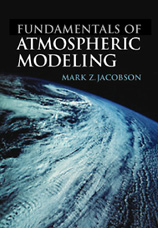
Cover of Fundamentals of Atmospheric Modeling

Fundamentals of Atmospheric Modeling

Mark's original technical textbook brings atmospheric processes and the computational methods used to simulate them into one volume. Its chapters cover fluid dynamics, radiation, gas chemistry, aerosol and cloud behavior, and model design and testing, giving students and researchers the equations and numerical context behind air-pollution and meteorological models. The original edition was reprinted with corrections in 2000 and followed by the second edition in 2005.

Official book catalog ↗

More video with Mark Z. Jacobson

Media appearances

Selected public appearances · Sources checked October 19, 2026
DateTypeShow / event / publisherTopicLink
June 9, 2026Speaking appearanceAlphabet modeling talksHow modeling helps the renewable-energy transitionOpen ↗
April 20, 2026Speaking appearanceAccelerating the Transition, SF Climate WeekRenewable energy and storage across all energy usesOpen ↗
April 11, 2026Podcast appearanceMarketer of the DayElectrification, energy storage and a practical renewable-energy roadmapOpen
March 20, 2026Speaking appearanceCambridge FestivalStill No Miracles Needed: existing technologies and energy choicesOpen ↗
February 26, 2026Podcast appearanceThe Clean Energy Edge podcastElectrification, storage and the case for deploying clean energyOpen ↗
October 15, 2013News appearanceStanford EngineeringCoverage of Mark's October 9 conversation with David Letterman on renewable energyOpen ↗

Mark Z. Jacobson on Marketer of the Day

Mark explains his path from studying smog to modeling renewable-energy systems, then discusses the technologies and deployment choices in Still No Miracles Needed.

Stories from the conversations

Mark Z. Jacobson finds a research direction on the tennis court

Mark recalls how Southern California smog led him toward studying air pollution, then to graduate modeling research.

Explore the story

Mark Z. Jacobson's all-electric home

Mark describes his own home as a practical example of combining electric equipment, solar generation and storage.

Explore the story

Testing a renewable grid across changing weather

Mark explains why his team combines generation, storage and flexible demand in simulations across multiple years.

Explore the story

Mark Z. Jacobson in photos

Contact Mark Z. Jacobson

Mark Z. Jacobson - Stanford faculty website ↗ · Checked October 19, 2026

Questions about Mark Z. Jacobson

Which audiences and events fit Mark Z. Jacobson's expertise?

His work is relevant to energy and sustainability conferences, universities, climate-policy discussions and podcasts that can examine technical choices in depth. Useful subjects include electrifying transport and buildings, storing energy, grid reliability and the relationship between air pollution and climate. His Stanford Online course also serves professionals without an engineering or energy background.

Mark Z. Jacobson - Accelerating the Transition keynote ↗ · Cambridge Festival - Still No Miracles Needed ↗ · Stanford Online - Clean, Renewable Energy & Storage for a Sustainable Future ↗

What does wind-water-solar mean in Mark Z. Jacobson's work?

Wind-water-solar, or WWS, is the shorthand Mark uses for his renewable-energy roadmaps. The studies address energy for electricity, transport, buildings and industry, combining renewable generation with electrification, storage and changes in when electricity is used.

Mark Z. Jacobson with Robert Plank · Mark Z. Jacobson - Stanford faculty website ↗

How does Mark Z. Jacobson address periods without wind or sunlight?

Mark studies a combination of sources, storage, grid connections and flexible demand. In his conversation with Robert Plank, he explains that a vehicle does not need to charge at every moment: shifting charging and other flexible uses can help a grid match supply with demand. His research tests such combinations under specified scenarios.

Mark Z. Jacobson with Robert Plank

Why does Mark Z. Jacobson compare air pollution and climate effects together?

Mark argues that evaluating carbon dioxide alone can miss other pollution, energy requirements and health effects associated with an energy technology. His research and books compare proposed energy choices across those connected problems. On Marketer of the Day, he uses carbon capture as an example of why he wants the full energy system examined.

Mark Z. Jacobson with Robert Plank · Mark Z. Jacobson - Still No Miracles Needed and teaching videos ↗

What can professionals learn through Mark Z. Jacobson's Stanford Online course?

Clean, Renewable Energy & Storage for a Sustainable Future is a self-paced Stanford Online course covering clean-energy technologies, storage, energy policy and the wider impacts of energy choices. The current listing specifies twelve hours of material, sixty days of access, short videos and exercises, a knowledge check and a record of completion. It is offered through Stanford Online, with Stanford teaching-assistant support.

Stanford Online - Clean, Renewable Energy & Storage for a Sustainable Future ↗

What did Mark Z. Jacobson discuss with Robert Plank?

Mark described the smog that shaped his research direction, his all-electric home and his team's renewable-grid studies. The conversation also covers flexible electricity demand, his criticism of carbon capture, and why he believes the available technologies should be deployed faster. The complete episode and video are linked on this page.

Mark Z. Jacobson with Robert Plank

How does Mark Z. Jacobson use his home to explain electrification?

Mark describes an all-electric home that combines insulation, heat pumps, induction cooking, rooftop solar, batteries and electric vehicles. In his conversation with Robert Plank, he uses that personal example to show how available equipment can work together, then connects the same electrification idea with larger energy systems.

Mark Z. Jacobson with Robert Plank

What are Mark Z. Jacobson's GATOR-GCMOM and LOADMATCH models?

GATOR-GCMOM simulates linked atmospheric processes and provides time-varying weather, renewable-generation and building-energy information. LOADMATCH uses those inputs to test whether generation, storage and flexible demand can supply electricity, heat, cooling and hydrogen over time. Mark and his coauthors used that sequence in a 2026 study of 150 countries, comparing renewable systems with and without enhanced geothermal electricity.

Mark Z. Jacobson - GATOR-GCMOM history and processes ↗ · Mark Z. Jacobson and coauthors - 2026 enhanced-geothermal and renewable-grid study ↗

What recognition has Mark Z. Jacobson's research received?

Mark received the American Meteorological Society's Henry G. Houghton Award in 2005 and the American Geophysical Union's Ascent Award in 2013. He also coauthored the renewable-grid paper selected for the 2015 Cozzarelli Prize, announced by PNAS in 2016. That prize recognized the paper by Mark Z. Jacobson, Mark A. Delucchi, Mary A. Cameron and Bethany A. Frew.

NASA The Earth Observer - 2005 AMS award recipients ↗ · American Geophysical Union - Ascent Award recipients ↗ · PNAS - 2015 Cozzarelli Prize recipients, announced March 1, 2016 ↗

Sources & research notes · October 19, 2026
Copy this text

Essential features — always available
Forms, spam protection, and podcast playback.

Optional Google Analytics runs only after you accept Analytics. Advertising tags stay off. Change your Analytics choice on the Privacy page.

How these choices work. You can change them anytime from the footer.