"When a customer is confused, they're going to do the only thing they really understand: buy the lowest price. If you're not clear, you're a price tag."
Maury Rogow is a marketing strategist, author and founder of Rip Media Group. He brings enterprise sales and film production experience to helping companies explain their value through stories, sales content and AI-supported workflows. He is the author of Why Buyers Say No and Rise of the Entrepreneur, and teaches the EPIC, STUFF and SAM approaches to clearer marketing.
About Maury Rogow
Maury Rogow is a marketing strategist, author and founder of Rip Media Group who helps companies make their value easier for buyers to understand. His work connects enterprise sales, film production and AI-supported marketing systems, with a recurring question at the center: can a customer explain why this company is different?
Maury's early career was in technology sales and business development, including work with GeoTel, Cisco, Lucent and Avaya. Selling complex products taught him to ask questions before building a pitch. He brings that habit into his current work with founders, sales leaders and marketing teams, where a long list of features can obscure the problem a buyer wants solved.
His move into entertainment added another way to think about attention and emotion. His production background includes Bedrooms and Enter the Dangerous Mind, and his work with Rip Media Group has extended into brand films, product explainers and sales campaigns. In his conversation with Robert Plank, Maury describes the connection between a movie's transformation and a customer's movement from a problem toward a desired result.
Rip Media Group combines strategy, training and delivery. A leadership team can work on positioning and a go-to-market plan, train its own people to use a shared narrative, or engage the agency to produce content and implement the systems that carry it. The work includes sales assets, CRM configuration, integrations and AI-supported research and follow-up.
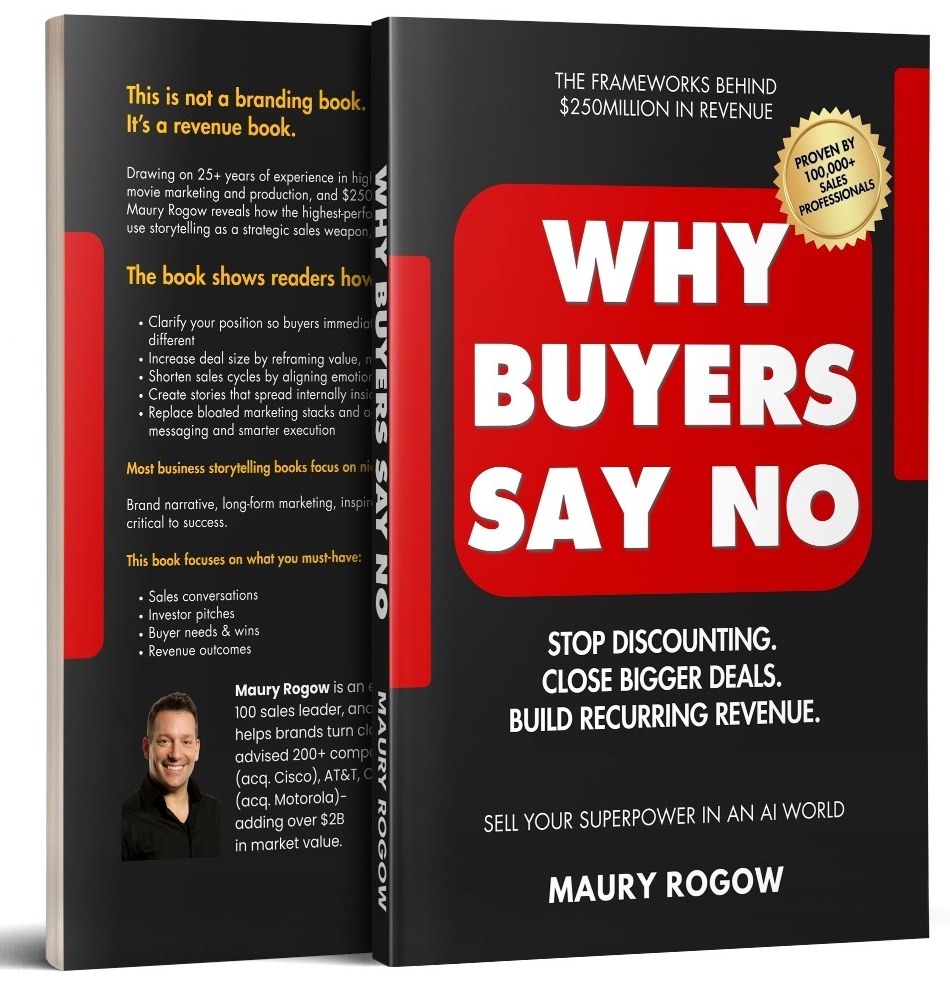
Maury's book Why Buyers Say No examines the confusion that can turn a capable company into an interchangeable option. It asks readers to look beyond features and generic promises, understand the buyer's situation, and build a story the buyer can repeat. Its companion toolkit adds worksheets, pitch practice, a self-assessment and interactive exercises for applying the ideas to a real deal.
One of his simplest exercises is to compare a company's website with one or two competitors while ignoring the logos, colors and fonts. If the language could belong to any of them, the visual identity is doing more work than the message. Maury uses the exercise to open a discussion of what a buyer can actually recognize as different.
He explains sales stories through EPIC: Empathy, Problem, Impact and Change. The sequence begins with understanding the customer, makes the problem and its consequences concrete, and then shows a useful transformation. His STUFF framework adds a separate creative lens, asking whether a story has sizzle, touches an emotion, offers something unexpected, uses humor or addresses a fear.
His current SAM System connects Story, Assets and Machine. The story establishes the positioning, the assets demonstrate it, and the machine is the sales and marketing workflow that delivers it. Maury argues that automation should follow a clear message, because producing more of an unclear message does not resolve the confusion.
Maury also teaches business storytelling and AI adoption. His team's live training uses participants' own work, while the standard AI program covers prompting, role-specific workflows, documents and data, judgment and a continuing adoption plan. He is available for business talks, workshops and fractional marketing leadership, with published speaking and interview samples for organizers to review.
On Marketer of the Day, he connects those professional ideas with a personal memory of shoveling coal to heat his childhood home in Pittsburgh. The experience became part of the reason he wanted to build a different life. He uses the story to distinguish a founder's private motivation from the part that helps a customer: why the work matters, who it serves and what can change for them.
Maury Rogow Speaking on Bold Leadership
Maury features this recording in his current press kit. His company channel identifies the filming date as October 5, 2016.
EPIC gives a sales story a sequence built around the customer. Maury explains it as a movement from the current problem toward a meaningful change.
Empathy
Begin by understanding the customer's situation. Ask questions before deciding which story to tell. Maury first asks customers and prospects questions so the story fits the audience, instead of assuming that a pitch which worked elsewhere will work here.
Problem
Name the problem in language the buyer recognizes, rather than beginning with a list of product features. His website comparison tests this point: claims such as best service or highest quality could belong to several competitors. The story needs a problem the buyer actually recognizes.
Impact
Explore what the problem means for the buyer and the people affected by it. Maury asks where the customer is now and where they want to be. Understanding that gap gives the story a reason to matter beyond a list of specifications.
Change
Show the transformation the customer wants and the role a suitable solution can play. In his explanation, the solution fills the gap between the current situation and the desired result. He also connects this stage with the action or transformation the story should lead toward.
In his interview with Robert Plank, Maury connects the structure with asking the right questions at the right point in a sale. The aim is to understand the gap between where the buyer is and where the buyer wants to be, so the story has a purpose beyond describing the seller.
STUFF is a separate way to consider the emotional tone of a story. Maury offers five creative directions and explains how two can work together.
S - Sexy or Sizzling
Give the idea energy and appeal that suit the audience and the brand. Maury uses sizzle as one possible direction for a memorable story. The choice starts with what the audience should feel, rather than a safe tagline that sounds like every competitor.
T - Touching
Connect with care, family, nostalgia or another feeling that matters to the person watching. His examples include nostalgia, caring and family. The point is to recognize a feeling in the story that the audience can relate to.
U - Unexpected
Find a turn the audience does not expect instead of repeating the same category language. Maury looks for something outside the usual pattern in an industry. In his account, that surprise helps a brand stand apart from interchangeable category messages.
F - Funny
Use humor to make an idea more engaging and memorable when it fits the situation. His insurance-advertising example combines humor with a risk the viewer already understands. The funny element changes how the audience pays attention to a serious subject.
F - Fear
Recognize a risk or worry the buyer is already trying to address. In the interview, his examples include missing out and a lack of security. He shows how fear can be combined with humor in one story rather than treating each creative direction as a separate formula.
Maury points to insurance advertising to explain combining fear and humor. The subject remains a risk people recognize, while the creative approach changes how they pay attention. He presents STUFF as a working storytelling lens.
Maury connects the message with the materials and workflow that carry it. His current system uses three parts in a deliberate order.
Story
Clarify the positioning and the reason a buyer should see this company as different.
Assets
Build the films, presentations and sales content that demonstrate that story.
Machine
Connect research, outreach, follow-up and reporting through the sales and marketing workflow.
For a channel program, Rip Media Group applies that sequence to partner messaging, co-branded assets and outbound systems. The ordering matters in Maury's explanation: automation can distribute a message, while the team still has to decide what that message should mean to the buyer.
Open your website and one or two competitors. Ignore the logos, colors and fonts. What is left for a buyer to tell apart?
Maury uses this exercise to challenge claims such as best service, highest quality and white-glove treatment. If several companies could say the same thing, the words give a buyer little help choosing between them.
The next step is a conversation with customers and colleagues: what problem do you solve, what experience makes you distinct, and which part would a buyer remember? The exercise starts a positioning discussion without treating a different visual design as proof of a different offer.
Rip Media Group works with leadership teams whose buyers struggle to understand their product's value or difference. The advisory develops positioning, a target-audience definition, pitch structure, and an aligned narrative for executives and sales teams. It combines those decisions with a funnel and content plan that the client's team can implement or use to commission further production.
Rip Media Group produces content for companies that need to explain an offer, support a launch, or equip buyers and sales teams. Its advertised production scope includes brand films, product explainers, launch videos, pitch and investor decks, and campaign assets. The work is developed around a common sales narrative, with channel-partner packages adding case-study videos, one-pagers, and email sequences.
Rip Media Group builds sales and marketing systems for businesses that need their tools, content, and follow-up to work together. The team configures CRM stages and fields, connects systems, and develops AI-supported prospect research, personalized outbound, call analysis, and interactive lead tools. Its Delivery service includes deployment and campaign measurement, with systems handed over to the client's team.
Rip Media Group trains sales and marketing teams to explain a company's value consistently across buyer conversations. Workshops cover story and messaging, repeatable sales narratives, customer targeting, and the use of video across the customer journey. Teams keep written playbooks, worksheets, and assets that support continuing use and help new employees learn the same approach.
Maury Rogow's team trains organizations that have AI tools but need useful working habits across their staff. The standard program uses five live sessions over four to six weeks, covering prompting, role-specific workflows, documents and data, judgment and data handling, and a continuing adoption plan. On-site and virtual delivery use the team's actual work, with programs for Claude, Microsoft Copilot, and broader AI workflows.
Rip Media Group works with technology vendors and channel partners that need distinct messaging within a shared vendor brand. Its advertised twelve-week pilot audits partner positioning, runs EPIC story workshops, produces co-branded video and pitch materials, and activates personalized outbound workflows with pipeline reporting. The sequence gives channel leaders a way to connect the partner story with the vendor solution.
Maury Rogow offers part-time CMO leadership for B2B technology, SaaS, manufacturing, and professional-services companies. He directs marketing strategy and the team, participates in revenue meetings, and coordinates messaging, creative assets, pipeline automation, and reporting. His current page also invites a full-time in-house engagement when that level of involvement is appropriate.
Maury Rogow is available for conferences, webinars, and business audiences discussing how companies communicate value and use AI in sales and marketing. His current speaker material connects brand storytelling, the EPIC Framework, sales messaging, and the systems used to deliver that message. Organizers can review published stage and interview samples and contact him through the official press kit.
Voice AI Studio is advertised as a software pipeline for producing voice for videos, advertising, training, and sales content. Maury's team describes a production workflow powered by ElevenLabs, paired with its free Script Timer AI scriptwriting tool. The official press kit presents it separately from custom consulting and campaign-production engagements.
Membership Benefits Club gives associations and community operators a branded portal for software and service offers. The site describes API, spreadsheet or embedded connections, membership verification, and options for a job board and event feed. Plans distinguish individual access, small communities and larger white-label arrangements that can include the community's own offers.
A guide for founders, revenue leaders and sales teams whose buyers struggle to see a meaningful difference. Maury connects customer questions, clear positioning and sales-story frameworks with the moments when deals stall or default to price. The companion toolkit adds a deal workbook, pitch practice, self-assessment and interactive exercises, turning the reading into work on a real buyer conversation.
Maury's earlier story-based business guide addresses the work of launching and marketing a company. The author page presents its lessons through a fictionalized narrative, giving entrepreneurs and sales professionals a way to consider communication, customer engagement and a clearer route to market. It connects with the question that continues through his later work: how will a buyer understand the value of this business?
Written by John J. Lee, Jr. and Anne Marie Gillen, this handbook explains the business relationships, financing and operations behind independent film production. The third-edition introduction thanks Maury Rogow and Kelly Yee of RipMedia Group for information on new media and internet marketing used in Chapter 4. Maury's role is an acknowledged specialist contribution, alongside Kelly, rather than coauthorship of the handbook.
Why Buyers Say No: Use AI and Story to Win Deals with Maury Rogow
Marketer of the Day - Episode 1560
Maury explains EPIC and STUFF, challenges interchangeable website language, shares his childhood coal-shoveling story, and discusses why clear questions matter before creating more content.
Maury Rogow is a marketing strategist, author and founder of Rip Media Group. He brings enterprise sales and film production experience to helping companies explain their value through stories, sales content and AI-supported workflows. He is the author of Why Buyers Say No and Rise of the Entrepreneur, and teaches the EPIC, STUFF and SAM approaches to clearer marketing.
The company offers strategy, training, production and sales-system delivery. Its current work connects positioning and sales content with CRM integrations, AI-supported research and follow-up.
EPIC stands for Empathy, Problem, Impact and Change. Maury uses it to structure a story around the customer's situation and the transformation the customer wants.
In this interview, Maury explains STUFF as sexy or sizzling, touching, unexpected, funny and fear. It is his creative lens for considering the emotional tone of a story.
It is Maury's book on differentiation and buyer-focused sales storytelling. Its official website provides a companion toolkit with worksheets, self-assessment and interactive exercises.
Compare the language on your website with one or two competitors while ignoring the logos, colors and fonts. Maury uses the exercise to ask whether a buyer can recognize a meaningful difference.
The standard live program has five sessions, usually over four to six weeks, using the team's actual work. It covers prompting, role-specific tasks, documents and data, judgment and continuing adoption.
His current CMO page offers part-time marketing leadership for B2B technology, SaaS, manufacturing and professional-services companies. It also describes a full-time engagement when the fit calls for it.
The advertised twelve-week pilot combines a partner-message audit, EPIC workshops, co-branded sales content and outbound workflow activation. It is designed for vendors and partners that need distinct messaging within a common brand.
It is a branded member-benefits platform for communities and associations, with software and service offers and options for a job board and event feed.
His official press kit links a creator-published Bold Leadership recording from the Vistage Executive Summit, as well as television, webinar and podcast samples.
Use mrogow@ripmediagroup.com or 888-899-8910, both published in his current press kit. His LinkedIn profile and company website provide additional context for a speaking or consulting inquiry.