Profit, cash flow and owner pay
Why revenue does not identify the money an owner can keep, and how Mike separates the different jobs business cash must do.
A question to ask: What changes when profit is assigned before operating expenses?
Author of Profit First and Clockwork, with practical systems for small-business cash flow, team ownership and operations that depend less on the owner.

"Profit is not an event. Profit is a habit!"
Last updated
Mike Michalowicz is a business author, entrepreneur and keynote speaker known for Profit First and Clockwork. He develops practical ways for owners to organize cash, choose the right work, improve team responsibility and reduce their company's dependence on them. His books also include The Pumpkin Plan, Get Different, All In and The Money Habit. Mike hosts the Becoming Self Made podcast and cohosts the Don't Write That Book podcast with AJ Harper. He works with business audiences through speaking, courses, coaching and The Prosper Group.
Mike Michalowicz writes for the owner whose business has sales, customers and work to do, but still leaves too little money or time. In Profit First, he changes when profit is assigned. In Clockwork, he examines why the owner remains necessary to every task. His books turn those problems into named categories, worksheets and routines that an owner can inspect in a particular company.
Mike's own account of building and selling businesses, then losing his money, explains the practical questions behind that work. In his conversation with Robert Plank, he separates efficiency from personal productivity: making room for more tasks does not solve a company's dependence on its owner. He also acknowledges that owners may enjoy doing parts of the work. The point is to put the right responsibility with the right person while preserving the work that gives the business meaning.
The Pumpkin Plan examines customer and offer selection; Fix This Next helps choose which business constraint to address; and Get Different separates attention, appeal and action in marketing. All In turns to the conditions behind a committed team. His newer The Money Habit addresses household finances, extending the interest in practical money routines beyond the business account.
Through The Prosper Group, Mike and a team work alongside qualifying established companies on financial, people and operating problems. His separate membership, courses and coaching give owners different levels of education and support. He also curates Page Two Simplified with Page Two, helping develop books for entrepreneurial readers.
Mike hosts the Becoming Self Made podcast, where founders discuss the decisions and experiences behind their companies. With AJ Harper, he cohosts the Don't Write That Book podcast on writing and publishing useful nonfiction. Earlier shows include the Entrepreneurship Simplified podcast and Mike Up In Your Business podcast.
For an event or interview, Mike can explain the difference between owner pay and profit, identify a company's central role, examine which customers fit, or review a marketing message through Differentiate, Attract and Direct. His examples connect those ideas to cash allocations, job responsibilities and the work a business chooses to accept.
Mike's Profit First explanation addresses a familiar small-business problem: sales arrive, bills consume the money, and profit is whatever remains. The system changes the order in which cash is assigned. His teaching uses Sales - Profit = Expenses instead of treating profit as the final leftover.
In his conversation with Robert, Mike recommends starting with a small change and building the routine rather than attempting an abrupt shift. His example is a one-percent profit allocation. The distinctive feature is the order and visibility of cash allocations, supported by recurring habits rather than a year-end hope.
Clockwork is written for an owner who keeps becoming the person every task or decision depends on. Mike's revised edition describes three phases: Align, Integrate and Accelerate. The aim is to improve how work moves through the organization, rather than simply fit more tasks into the owner's day.
Mike credits Adrienne Dorison with helping refine the system and cofounding Run Like Clockwork. His revised book treats the phases as work to revisit as the company changes. In his interview with Robert, he also distinguishes delegating work from giving up the parts of the business an owner enjoys.
The Pumpkin Plan keynote uses giant-pumpkin growing as a way to examine business focus. Mike asks owners to direct attention toward customers and work that fit the company instead of trying to serve every customer and every opportunity.
These three elements form the Sweet Spot shown in Mike's official worksheet. The gardening analogy adds an allocation decision: remove distractions and poor fits, then give more attention to the strongest opportunities. A practical conversation can examine one company's customer mix and the work it should stop accepting.
In Fix This Next, Mike separates a business's most important need from the problem making the most noise. His Business Hierarchy of Needs provides five categories for that diagnosis.
The categories are a way to choose the next constraint to examine, rather than five projects to launch at once. Mike's official primer names Sales, Profit, Order, Impact and Legacy. His creator video explains the related Business Priority Pyramid; the book and primer supply the fuller diagnostic context.
Mike's DAD framework, explained in Get Different, gives a marketer three separate questions to ask about a campaign. Being noticed is only the first test; the message also needs to appeal to its intended audience and lead to an appropriate action.
A practical use is to review one advertisement, email or offer through all three tests. The framework separates an attention-getting device from the customer appeal and the requested response, making it easier to identify what a particular campaign is missing.
In All In, Mike examines the conditions behind a team member's contribution and commitment. His FASO model separates four areas a leader can inspect, rather than assuming a disengaged employee simply needs more motivation.
A leader can use FASO to examine a hiring decision, onboarding process or a team problem: which condition needs attention? Mike's official primer supplies the four labels, while his keynote shows how he presents the ideas to leadership audiences.
The Money Habit takes Mike's interest in cash visibility into personal finances. Its starting point is that a person already has routines around earning, checking balances and spending. The system gives money separate purposes within those existing habits.
Mike's current starter kit and primer explain the six-account structure. The useful distinction from Profit First is the audience and purpose: this book addresses an individual's or household's money, while Profit First organizes business cash. His public interview with Neo Financial explains how seeing several purposes in one undivided balance had led him to mentally spend the same money more than once.
Why revenue does not identify the money an owner can keep, and how Mike separates the different jobs business cash must do.
A question to ask: What changes when profit is assigned before operating expenses?
The work, decisions and systems that keep a company dependent on its founder.
A question to ask: Which task or decision still stops when the owner is away?
Differentiate, Attract and Direct as separate tests for a message, its audience and its next action.
A question to ask: Did the campaign earn attention from the right people and give them a clear next step?
Fit, Ability, Safety and Ownership as conditions a leader can inspect when work is not going as expected.
A question to ask: What would help this person take meaningful responsibility for the result?
Mike Michalowicz speaks to business owners and leadership audiences on keeping profit, developing teams, marketing differentiation and reducing the company's dependence on its owner. His official keynote catalog connects these talks to Profit First, All In, Get Different, Clockwork and The Money Habit. Event planners can review full-length speaking examples and send the event details through his official booking inquiry.
See the offer ↗Better Call Mike gives entrepreneurs a place to bring questions about hiring, sales, profit and deciding what to address next. The membership combines monthly live conversations with Mike, a member community, tools and on-demand courses, plus an AI tool based on his published teaching. It is useful for owners who want continuing access to education and discussion while they work through specific business decisions.
See the offer ↗Small Business 101 is on-demand training for first-time founders, side-business owners and entrepreneurs who need to strengthen their business foundations. Mike's course catalog describes lessons on business structure, positioning, operations and decision-making. Learners can work at their own pace and revisit lessons while applying those building blocks to their business.
See the offer ↗The Get Noticed Crash Course serves business owners whose marketing is being overlooked or whose offers are difficult to distinguish from competitors. Mike teaches visibility and differentiation through behavioral marketing examples, with attention to attracting the right customers. It is delivered on demand so an owner can revisit the lessons while working on a particular message or campaign.
See the offer ↗The Confidence Course is for entrepreneurs who hesitate over decisions or feel unsure when taking on a new business challenge. Mike uses a mapping exercise: identify situations where confidence already exists, then examine how those approaches could transfer to a less familiar situation. The digital course includes his video training, a workbook and a supplementary reading list.
See the offer ↗Serve Selling addresses entrepreneurs, consultants and service providers who are uncomfortable with sales pressure or rehearsed scripts. Mike frames the sales conversation around whether the offering will serve the particular customer and explains a service-oriented approach to presenting it. The on-demand course is offered through his official course catalog and linked store.
See the offer ↗The Edison Collective is an application-based mastermind for owners of established businesses who want an experienced peer group for difficult decisions. Members work with Mike's business frameworks, honest feedback, strategic discussion and accountability from other entrepreneurs. The application describes an in-person option meeting four times a year and a virtual option, and asks applicants about their business, goals and commitment.
See the offer ↗Mike offers individual coaching for established owners facing growth decisions, operational bottlenecks, cash flow pressure or leadership transitions. The engagement examines the particular company rather than applying a single course curriculum, with possible work on priorities, team performance, financial habits and the next actions to take. Applicants describe the business, its goals and its main challenges before Mike's team responds with next steps.
See the offer ↗The Prosper Group, founded by Mike, works with companies reporting $2 million to $15 million in annual revenue whose owners face profit pressure, operational disorder or heavy daily dependence on them. Its team describes a three-year engagement in which specialists work alongside the business on financial, people and operating problems, using Mike's methods as diagnostic tools. The current arrangement combines a commitment retainer credited toward profit participation with a share of profits; the owner retains the company rather than selling equity.
See the offer ↗Page Two Simplified is the publishing imprint Mike curates with Page Two for experts writing useful books for entrepreneurs. It combines author guidance, editorial and publishing support, collaborative marketing and a focus on a clearly defined entrepreneurial reader. The publisher's intake asks for the idea, reader problem, distinctive contribution, existing manuscript materials and author platform, and specifically identifies applications for Mike's imprint.
See the offer ↗
Mike takes his interest in behavior and cash allocation into household finances. The book uses separate purposes for income, necessities, discretionary spending, longer-term dreams, fixing past obligations or preparing for the future, and emergencies. It is written for people who need a usable money routine rather than another demand to become more disciplined.

Mike reverses the familiar profit calculation to Sales - Profit = Expenses, making profit an allocation made before the remaining cash is spent. He explains separate accounts for income, profit, owner compensation, taxes and operating expenses. The book combines examples and implementation tools for owners whose sales are growing without a dependable share remaining in the business.
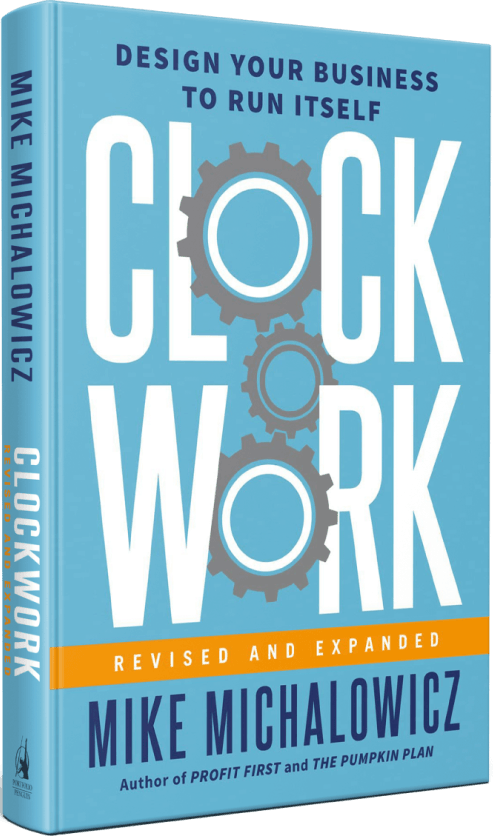
Clockwork addresses the owner who remains essential to every daily decision. Mike's revised edition organizes the work into Align, Integrate and Accelerate, including the Queen Bee Role, time analysis, system capture and a planned absence as a test of the organization. The revision builds on the original 2018 book; the foreword is by Gino Wickman.
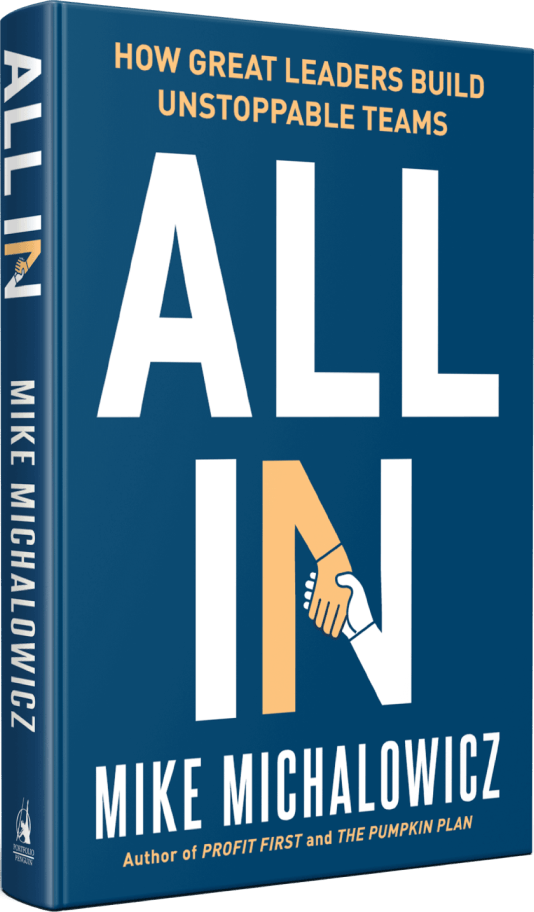
All In examines why employees contribute, stay and take responsibility for their work. Mike's FASO model covers Fit, Ability, Safety and Ownership, with applications to hiring, development and the work environment. The intended reader is a leader building a committed team rather than trying to motivate every employee through pay or pressure alone.

Mike uses the Business Hierarchy of Needs to help owners decide which problem deserves attention first. The five levels are Sales, Profit, Order, Impact and Legacy. The book is aimed at entrepreneurs who spend their time responding to whatever feels urgent and need a way to identify the constraint beneath those symptoms.

Get Different focuses on marketing that earns attention from a particular audience and leads somewhere useful. Mike explains the DAD framework - Differentiate, Attract, Direct - as a test for the message, its appeal and the requested next action. The examples are intended to help business owners design and test a distinctive approach instead of copying a competitor's promotion.
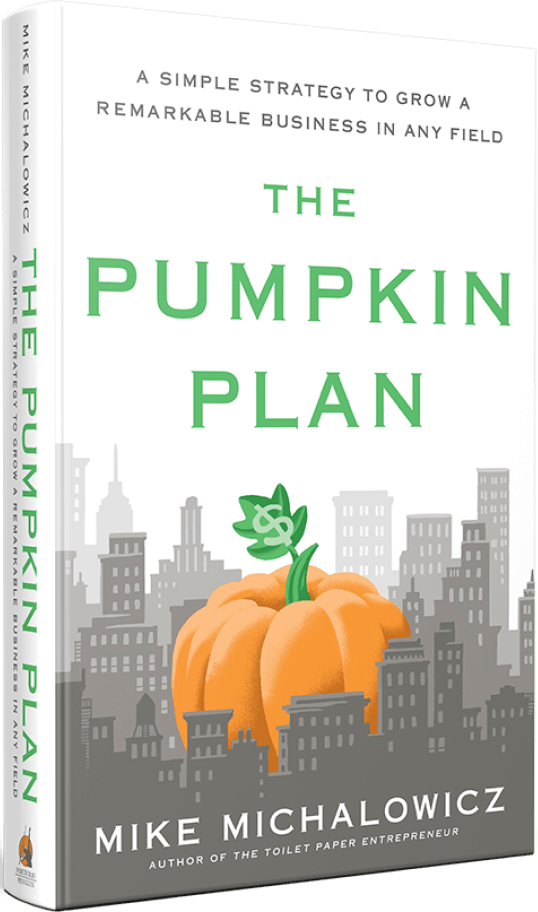
Using the analogy of growing a giant pumpkin, Mike examines which customers, offers and processes deserve more of a company's attention. The practical focus is the intersection of top client demand, a unique offering and a systematized process. It is a book for owners trying to grow without accepting every possible customer or pursuing every possible service.
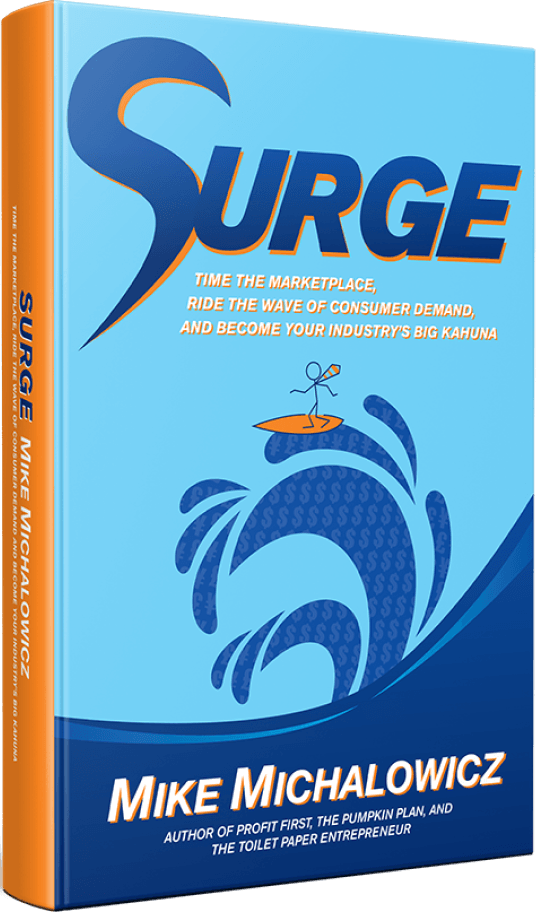
Surge examines how a business can recognize and respond to demand within a focused market. Mike organizes his approach as Separate, Unify, Rally, Gather and Expand, moving from a defined niche to understanding its common needs, building interest and responding to demand. The book connects market selection with timing and customer behavior rather than treating growth as simply doing more promotion.

Mike's early book addresses starting and running a business with limited resources. Its planning tools include a Prosperity Sheet for direction, a Quarterly Sheet for near-term objectives and a Daily Metrics Sheet for the work that supports them. Alongside its informal style, it asks entrepreneurs to narrow their focus and turn a larger ambition into decisions they can act on.

Mike adapts the cash-allocation idea into a story for children. Sophie learns to divide money between a bigger dream, everyday experiences and helping others, rather than spending everything as it arrives. The book gives families a way to discuss earning, saving, spending and generosity through a shared story.

Mike's crisis guide considers how a small business responds when customers, cash flow and expectations change suddenly. It brings together explanations of a downturn with practical business responses. The related public resource page provides worksheets on cash flow, customer communication, priorities and changes to an offer.

Debra Cassera and Sabrina Pelech apply the cash-management method to chiropractic practices, using client cases and practitioner interviews. Their book addresses regular owner pay, business overhead and cash flow; Mike contributes the foreword.

Shawn Van Dyke translates Profit First for construction businesses. He examines the craftsman cycle of urgent work, financial statements, markup, margin and a cash-management routine that fits contracting. Mike wrote the foreword; Shawn is the author of the industry-specific book.

Christian Brim addresses creative entrepreneurs who feel forced to choose between the work they want to make and the bills they need to pay. The book connects cash flow, pricing, common implementation difficulties and the use of profit. Mike supplied the foreword, while Christian wrote the adaptation.

Drew Hinrichs and Barbara Stackhouse adapt the system for dental practices, including the difference between the dentist's compensation and profit from ownership. Their book uses practice examples to examine operating costs and debt. Mike wrote the foreword to their guide.

Cyndi Thomason focuses on inventory, reliance on debt, understanding financial data and maintaining focus in an online retail business. Her adaptation translates Profit First into the cash-flow demands of ecommerce. Mike's introductory contribution is credited as the foreword in the publisher's sample; Cyndi is the author.

Christeen Era examines the financial side of lawn care and landscape companies, including expenses, cash flow and plans for growth. The book's industry tools are designed for owners whose technical work and busy schedules are not producing adequate profit. Mike wrote the foreword; Steven A Rigolosi edited the book.

RJon Robins applies the allocation approach to law-firm management, connecting owner profit with the decisions behind staffing, overhead and professional work. Mike wrote the foreword to RJon's industry-specific guide.

John Briggs adapts Profit First to small fitness businesses, with attention to owner pay, team costs and keeping a gym financially sustainable. His examples draw on client work and his own gym experience. Mike supplies the foreword; John wrote the gym-specific book.

Susanne Mariga writes for minority business owners who are generating sales without keeping the income they expected. Her adaptation connects the Profit First method with pricing, expenses and the realities of growing a minority business enterprise. Mike wrote the foreword to Susanne's book.

Rachel Siegel adapts Profit First to optometry practices through client stories and interviews with optometrists and business professionals. Her book focuses on practice cash flow and regular owner pay. Mike contributes the foreword.

Venus Michael applies the method to photography businesses, covering a tailored banking structure, cash-flow decisions, underpricing and overspending. Client stories help connect the numbers with the realities of creative work. Mike wrote the foreword; Venus is the author of this adaptation.

Damon Yudichak addresses real estate agents whose commission income is uneven and whose costs continue between transactions. His adaptation separates the work of earning money from the system used to retain and manage it. Mike wrote the foreword to Damon's guide.

David Richter adapts the method for investors managing irregular deal income, operating costs, payroll and taxes. The book explains a cash-flow system alongside the systems investors already use to find, renovate, rent or sell properties. Mike supplies the foreword; David wrote the real estate investing guide.

Kasey Anton translates the approach for restaurant owners dealing with payroll, vendor bills and changing food costs. Her book examines a restaurant's cash-management system, business model and expenses, using examples from the hospitality industry. Mike wrote the foreword to Kasey's book.

Ronit Enos applies the system to salon, spa and barbershop ownership, addressing debt, overwork and cash management. The book uses examples from owners in those businesses. Mike contributes the foreword.

Julie Herres adapts Profit First for private practices, from solo therapists to groups with multiple clinicians. The book addresses clinician compensation, spending at different stages of growth, implementation mistakes and financial systems. Mike wrote the foreword; Julie wrote the practice-specific guide.

Katie Crismale-Marshall translates the approach for Australian trades businesses. The guide considers business foundations, hidden cash-flow problems, financial routines and implementing Profit First in manageable stages. Mike supplied the foreword to Katie's industry adaptation.

Dave Cava and Shawn P. Walsh adapt The Pumpkin Plan for managed service providers. They examine client fit, profitable services, team development and preparing an MSP for an eventual exit. Mike wrote the foreword; the authors' signed excerpt explains how the adaptation handles time-consuming, unprofitable customer relationships.
| Date | Type | Show / event / publisher | Topic | Link |
|---|---|---|---|---|
| September 21, 2026 | Podcast appearance | Before The Bestseller podcast | The Money Habit, money routines and the work behind developing the book, with Alex Strathdee | Open ↗ |
| September 15-17, 2026 event listing | Speaking appearance | Small Business Owners Community Conference | Organizer-listed keynote, VIP Q&A and Idea Slam in Brookfield, Wisconsin | Open ↗ |
| February 2, 2026 | News appearance | The Get at Neo Financial | Interview with Rosemary Counter on personal money patterns and The Money Habit | Open ↗ |
| Video published September 19, 2025 | Speaking appearance | Premiere Speakers | Mike Michalowicz Speaker Reel 2025 | Open ↗ |
| October 17, 2017 | Podcast appearance | Marketer of the Day | Business efficiency, useful work and the Profit First habit | Open |
Mike explains the behavior behind Profit First and the difference between doing more work and designing a company that needs less intervention from its owner.
Marketer of the Day · Episode 421
Mike and Robert discuss efficiency versus personal productivity, delegation without abandoning the work an owner enjoys, and turning profit into a recurring business habit. Mike explains the Profit First formula and distinguishes owner compensation from profit. Clockwork was still forthcoming when they recorded this conversation.

The Becoming Self Made podcast is Mike's interview show with Relay, centered on the experiences behind building a business. Its guests describe turning points, setbacks, decisions, identity and the people who helped shape their companies. The published interviews include Caroline Weaver on independent retail and community, David Stark on creative-business growth, Tiffany Aliche on financial education, Amy Porterfield on building a course business and the Beekman 1802 founders on growing a consumer brand. This is a place for a founder's specific experience, with room for decisions that did not work out as planned.
Caroline Weaver explains the move from running a specialist pencil store to building The Locavore Guide and a locally focused variety store. The episode examines what independent shops contribute to a neighborhood, the cost of pursuing growth that changes a business's original purpose, and the care involved in building customer relationships. Mike and Caroline discuss community and the owner's definition of success as well as the business itself.
15 episodes and trailers available. First listed publication: November 4, 2025. Latest episode: August 4, 2026. Latest episode found: How Caroline Weaver Is Supporting Small Businesses In New York City With The Locavore.

The Don't Write That Book podcast is primarily a conversation between Mike and writing coach AJ Harper on the work behind prescriptive nonfiction. They discuss the reader's needs, shaping an idea, writing, editing, choosing a publishing path, launch decisions and keeping a book useful after publication. Most episodes are conversations between the two hosts. A recent bonus interview with Brian Herriot follows his Time Freedom book from its original idea through publication and continuing promotion, showing an occasional guest format alongside the regular discussions.
Mike and AJ interview debut author Brian Herriot on developing Time Freedom. The publisher describes a discussion of how the idea became a book, the commitment needed to finish it, creating a lasting contribution and continuing to market after launch. It is a bonus guest interview within a feed otherwise dominated by Mike and AJ's discussions of writing and publishing.
155 episodes and trailers available. First listed publication: October 25, 2023. Latest episode: October 19, 2026. Latest episode found: The Craft of Becoming an Author: A Deep Dive Interview with Brian Herriot.

The Grow My Accounting Practice podcast serves accountants, bookkeepers and business coaches with business-development conversations: pricing, sales, advisory work, hiring, leadership and running a firm. Mike is a credited host in the archive alongside other Profit First Professionals hosts. Earlier interviews include Jason Snider on remote teams, Laura Shwaluk on advisory work, Sara Connell on storytelling and Darren Cioffi on marketing. The two latest Guide Chats are discussions between Erin Moger and Liz Szporn, so the current format and interviewers differ from those earlier Mike-hosted entries.
Erin Moger and Liz Szporn discuss moving from ad hoc AI experiments to repeatable systems inside an accounting firm. The episode description focuses on shared knowledge, internal playbooks, staff access and a process for making tools useful to the team. It is a Guide Chats conversation between the hosts, rather than an outside guest interview.
Latest episode: October 15, 2026. The current Guide Chats are hosted by Erin Moger and Liz Szporn. Latest episode found: GMAP Guide Chats: Stop Experimenting with AI. Start Building Systems..

The Profit First Nation podcast applies the cash-management method to owner-operated businesses through teaching, implementation discussions and business-owner interviews. Its publisher credits Danielle Mulvey and Mike as hosts, while the latest published interviews are led by Danielle. Restaurant owner Laura Magu and fitness business owner Kerrie Genes describe operational and cash-flow decisions in their own companies. The interviews are useful examples of how the method meets a particular industry's expenses and routines, alongside solo teaching on maintaining it over time.
Danielle interviews Laura Magu of the Rev Bistro restaurant in Lafayette, California. The publisher frames the conversation around a restaurant's use of Profit First, including the reality of managing cash and owner pay while operating a hospitality business. The latest episode is an implementation story led by Danielle rather than a newly verified Mike-hosted recording.
172 episodes and trailers available. First listed publication: April 20, 2020. Latest episode: May 11, 2026. Latest episode found: Ep. 166- Profit First Journey with Laura Magu: The System That Gives You Peace of Mind.

The Entrepreneurship Simplified podcast combines Mike's business lessons with conversations involving people who work directly with owners. Published episodes cover Profit First implementation, marketing, the relationship between a visionary and an operator, and Mike's process behind his books. Examples include Billie Anne Grigg on bookkeeping and Profit First, Sara Nay on marketing and Greg Eckler on operating a business. Its practical emphasis is the choices and systems that make entrepreneurship easier to manage; the latest episode found was published in November 2025.
The latest episode found features Billie Anne Grigg on Profit First and the bookkeeping perspective behind putting the method into practice. Its publisher description connects the conversation to separating cash for different purposes and using financial routines in a small business. This is a practitioner conversation in a series that also includes Mike's own business teaching.
29 episodes and trailers available. First listed publication: November 5, 2024. Latest episode: November 4, 2025. Latest episode found: How Profit First Transforms Bookkeeping: Insights from Billie Anne Grigg.

The Mike Up In Your Business podcast combined entrepreneur interviews, operating advice and conversations involving Mike's team. Its feed explicitly identifies it as the successor to the Entrepreneurship Elevated podcast. It began as the Profit First Podcast in 2014 and later used the Entrepreneurship Elevated podcast name. Later guests include Dorie Clark on long-term choices, Catherine Jablonsky on data and process improvement, and Minnie Lau in a practice-focused business makeover. The final entry, Our Final Episode, closes the series in January 2022.
Our Final Episode is Mike Up In Your Business's closing entry. It ends the series after interviews and business-development conversations with Mike and collaborators. The preceding guest interview is Dorie Clark's discussion of long-term strategies for business and life, which provides a clearer example of its interview format than the closing announcement itself.
Published from November 2014 through January 2022. Earlier titles include the Entrepreneurship Elevated podcast and the Profit First Podcast. Latest episode found: Ep 94: Our Final Episode of The Mike Up In Your Business Podcast.
Mike Michalowicz - Keynotes and speaking inquiry ↗ · Mike Michalowicz - Office and inquiry forms ↗ · Checked October 19, 2026
Mike Michalowicz is a business author, entrepreneur and keynote speaker. He wrote Profit First, Clockwork, The Pumpkin Plan and The Money Habit. His work covers cash flow, business focus, team responsibility, marketing and reducing a company's dependence on its owner.
Mike Michalowicz - Complete official book catalog ↗ · Mike Michalowicz - Official biography and media kit ↗
Mike's current speaking catalog covers business cash flow, leadership, marketing differentiation, owner-independent operations and personal money habits. These talks draw from Profit First, All In, Get Different, Clockwork and The Money Habit. His official speaking page provides examples and an event inquiry route.
Mike Michalowicz - Keynotes and speaking inquiry ↗ · Gallery ↗
Mike changes the allocation sequence from Sales - Expenses = Profit to Sales - Profit = Expenses. His system separates income, profit, owner compensation, taxes and operating expenses. In his conversation with Robert, he distinguishes profit from the paycheck an owner earns for working in the business.
Clockwork examines how work and decisions move through the company. Mike's revised edition uses Align, Integrate and Accelerate, including the Queen Bee Role, the four types of work and system capture. A planned absence is used to reveal where the team still depends on the owner.
Clockwork ↗ · Mike Michalowicz - Revised Clockwork excerpt ↗
Mike's worksheet brings together Top Clients, Unique Offering and Systematization. The point is to select customers and work that fit the company, then build a repeatable way to deliver it.
DAD stands for Differentiate, Attract and Direct. Mike separates earning attention, making the message appealing to its intended audience and asking for a clear next action. The framework can be used to inspect a single marketing campaign and identify which part needs work.
Mike Michalowicz - Differentiate, Attract, Direct worksheet ↗ · Get Different ↗
FASO stands for Fit, Ability, Safety and Ownership. Mike uses the four areas to examine the conditions that support a committed team. The model addresses culture, learning, physical and emotional security, and responsibility for the work.
All In ↗ · Mike Michalowicz - Fit, Ability, Safety, Ownership overview ↗
The Money Habit focuses on a person's or household's money, while Profit First organizes business cash. Mike's personal-finance system separates purposes such as needs, wants, dreams, future or corrective work and emergencies. Both books examine how visible account purposes can work with existing habits.
Money Habit ↗ · Mike Michalowicz - Interview with Rosemary Counter ↗
The industry adaptations have their own authors. For example, Cyndi Thomason wrote Profit First for Ecommerce Sellers, Shawn Van Dyke wrote Profit First for Contractors and Julie Herres wrote Profit First for Therapists. Mike's contributions are credited separately as a foreword or introduction, including on the covers shown here.
Profit First Professionals - Industry book catalog and covers ↗ · Therapists Book ↗ · Contractors Book ↗
Mike wrote My Money Bunnies, a story that adapts his interest in money allocation for children. Sophie learns to keep money for a bigger dream, everyday experiences and helping others. The story gives parents and children a shared way to talk about saving, spending and generosity.
Mike hosts the Becoming Self Made podcast with Relay and cohosts the Don't Write That Book podcast with AJ Harper. His archive also includes Grow My Accounting Practice, Profit First Nation, Entrepreneurship Simplified and the ended Mike Up In Your Business series. The show listings distinguish current interviewers and publication histories.
Podcasts ↗ · Becoming Self Made podcast - Relay ↗ · Don't Write That Book podcast - Publisher feed ↗ · Grow My Accounting Practice podcast - Publisher overview ↗
Mike explained why improving a company's efficiency differs from making its owner more productive, how delegation can preserve work the owner enjoys, and why profit needs a recurring allocation habit. He also discussed Profit First and the then-forthcoming Clockwork. The appearance section links directly to the full conversation and video.
His current offers include the Better Call Mike membership, on-demand courses, the Edison Collective mastermind and individual coaching. The Prosper Group separately offers an operating partnership for qualifying established companies. These options differ in audience, involvement and delivery, which are described in the services section.
Better Call Mike membership ↗ · Mike Michalowicz - On-demand courses ↗ · The Edison Collective mastermind ↗ · Individual coaching with Mike Michalowicz ↗ · The Prosper Group - Engagement and implementation details ↗
Use Mike's official speaking or contact inquiry forms. His public office contact page also lists 888-244-2843 and The Offices of Mike Michalowicz, ATTN: Carly Simon, 716 Main Street, Ground Floor, Boonton, NJ 07005. The contact section links to those public routes and his official social profiles.
Mike Michalowicz - Office and inquiry forms ↗ · Mike Michalowicz - Keynotes and speaking inquiry ↗