Pause before reacting
Make space to step back from the immediate pressure and look at what needs attention.
Creative judgment, practical systems and steady learning as the tools change.

"Choose one thing you can do in the next 30 minutes to move forward. Make a rough prototype, share it, and use the feedback to keep going."
Reviewed
Pete Gosling is a creative agency founder and AI strategist who helps B2B teams connect marketing strategy with practical production. He leads Gosling Design Studio, which creates sales materials, presentations, campaigns, video and event artwork, and founded DesignTech AI, a platform for producing business content from existing sources. His work also includes Marketing Blueprint completion and a Pete-led strategy option. In his Marketer of the Day interview with Robert Plank, he explains how to keep learning through small experiments and weekly momentum loops. His book project, Relentless Impact, explores continuous adaptation; its official site currently offers preorder details.
Pete Gosling is a creative agency founder, AI strategist and the founder of DesignTech AI. He leads Gosling Design Studio, the B2B creative-services studio operated by Gosling Media. His work connects the business question behind a campaign with the design, copy, video and systems needed to produce it. He brings experience across animation, advertising, creative direction and marketing, with a focus on useful execution alongside strategy.
GDS works as an extension of B2B marketing teams. Its current services include ongoing studio support and specific packages for sales sheets, reports, presentations, LinkedIn ads, product demos, motion graphics, social clips, event materials and campaign variations. Clients supply a clear brief and relevant source material, agree the scope and review the work before receiving their files. Pete's agency also advertises AI-roadmap and workflow-automation projects.
DesignTech AI is Pete's separate business-content production platform. It uses existing business sources, shared brand context and an editing-and-approval workflow to create marketing and sales materials. Its Marketing Blueprint guides users through their audience, positioning, messaging, proof and campaign assets. Professional completion is available for part or all of the Blueprint. In the Pete-led option, he completes it himself between a kickoff session and a review session with the client.
Pete's Marketer of the Day conversation traces the changes he has experienced in creative work. He recalls studying puppet animation, doing two weeks of work experience on Bob the Builder and moving into Flash advertising. His examples distinguish a particular production technique from the creative judgment and industry knowledge a client still needs. He recommends testing an AI-first approach against one campaign outcome, then learning from the result before expanding it.
In the book project Relentless Impact, Pete develops his approach to continuous adaptation and momentum loops. His weekly routine combines an internal review, useful outside information and one small prototype to share for feedback. The official book page presents the cover subtitle The Momentum Framework for Continuous Change and currently advertises preorder. His public interviews also address delegation, leadership and continuing through unexpected business setbacks.
In his Marketer of the Day conversation, Pete explains a weekly learning routine built around review, observation and action. He describes adapting a pause-and-observe practice to business, then using small experiments to keep moving while client work continues.
Make space to step back from the immediate pressure and look at what needs attention.
Consider your own work, the business and the projects that need to move forward.
Keep relevant articles and videos in one place so a weekly review produces something useful.
Choose one thing you can try in 30 minutes, share the rough result and use the feedback.
The practical unit is a rough first version: a short outline, a few slides or another useful way to show an idea. The routine gives the next experiment a place in the week.
Pete connects creative production with business context. The current GDS project packages make that connection concrete: a sales sheet starts with product facts and buyers, a demo starts with supplied footage, and event artwork starts with the required specifications.
Explain the audience, message, intended use and the action the material should support.
Confirm the source material, brand files, deliverables, review stages and deadline for that particular project.
Use the sample layouts, key frames, outline or first piece appropriate to the package before producing the rest.
Give feedback against the agreed scope, then receive the final formats and editable files where included.
DesignTech's Blueprint completion service follows a separate path inside the client's account. The Pete-led tier includes a kickoff, his completion work and a review session to decide the next moves.
December 13, 2025 | Episode 1503
Pete traces the changes from puppet animation and Flash advertising to today's AI workflows. He explains why strategy and domain knowledge matter, describes small weekly experiments and recalls the setbacks that shaped his approach to running an agency.
Distinguish knowing one tool from understanding the audience, message and business outcome.
Choose one specific result and test a workflow around it before expanding the approach.
Review what is happening inside the business, collect useful outside information and choose a small next experiment.
Explain the task, context and desired result when working with people or AI tools.
Connect strategy with the sales sheets, presentations, videos and campaign assets the team needs.
Clarify the buyer, positioning, voice and proof that guide the next deck, page or campaign.
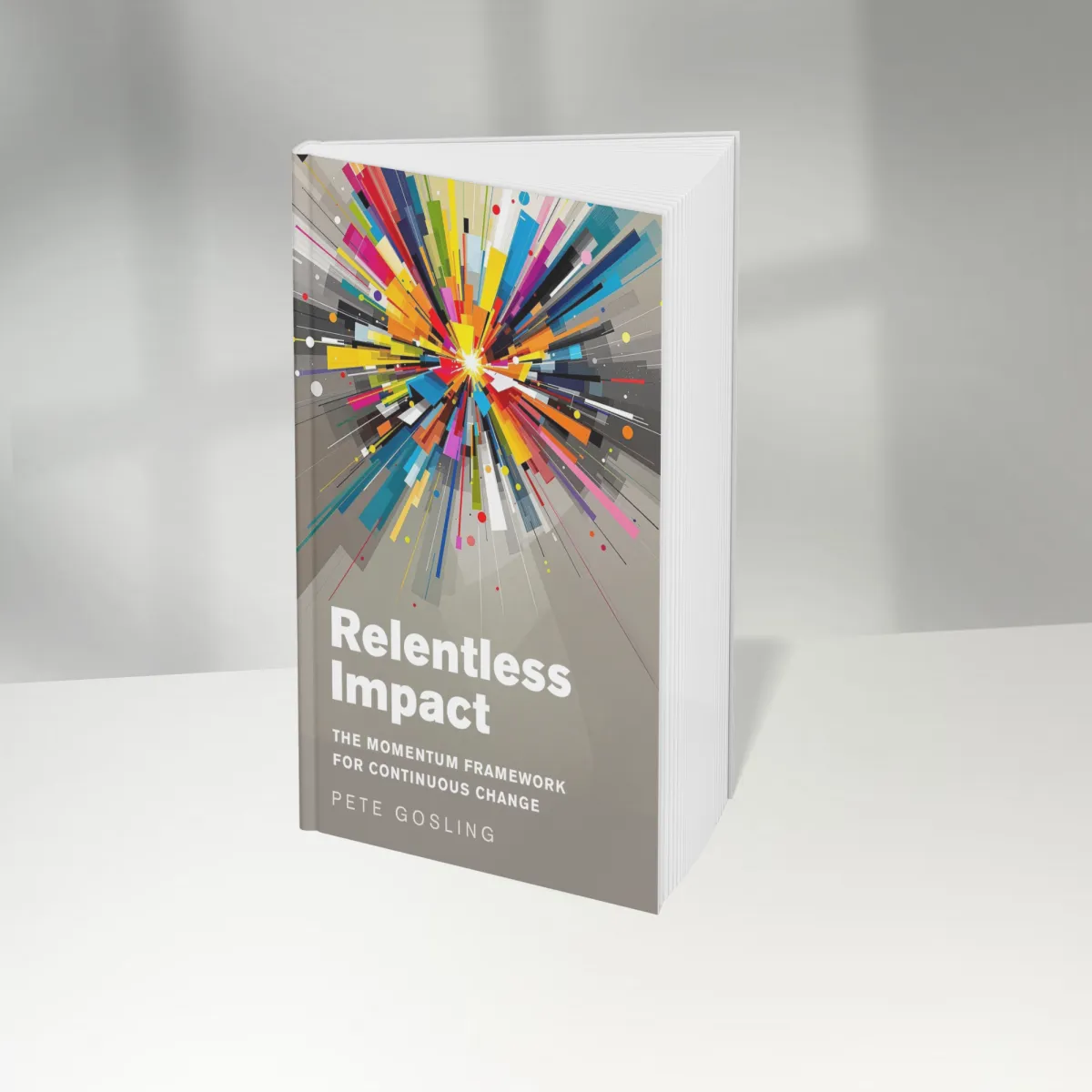
Relentless Impact explores continuous adaptation, creative judgment and a repeatable process for making progress through change. The cover presents the subtitle The Momentum Framework for Continuous Change. Pete connects the ideas with weekly observation, practical experiments and the work of leading through shifting tools and expectations.
Gosling Design Studio supports B2B marketing teams that need creative production beyond their internal capacity. Clients submit work through its platform, email or a shared Slack channel, receive an agreed scope and delivery date, review designs and access source files. Ongoing studio support covers advertising, sales and event materials, web and email assets, illustration, video and animation.
GDS writes and designs a one-page sales sheet from the client's product facts, buyer information and brand materials. The project includes copywriting, branded design, one round of revisions and final files for sharing. Printing, extra branding and larger sets are scoped separately.
GDS edits supplied interviews, webinars, event recordings and other usable footage into branded marketing videos. The team agrees the story outline, length, formats, review rounds and schedule before editing. Filming, music, stock footage and licensing are included only when named in the project quote.
GDS designs an approved manuscript of up to 40 pages as a branded ebook, guide or report. The team presents two sample layouts, applies the chosen style throughout the document and includes one revision round. Copywriting, longer manuscripts and extra chart work require separate scope.
GDS turns one report, webinar, case study or article into five LinkedIn single-image ads. It selects five points, writes a headline and caption for each, designs the set and supplies source files with one revision round. The package covers creative production; media buying, targeting and campaign management are separate.
GDS reviews supplied slides or content, organizes the order and emphasis, and designs an agreed deck for sales, events, investors or internal use. The workflow includes sample slides, a feedback round, an editable file and a presentation-ready export. Copywriting, reusable templates and chart work are included only when scoped.
GDS edits up to 10 minutes of supplied screen footage into a branded product-demo video, using the client's timestamps and brand files. It offers two sample cuts, one revision round and a final MP4. Recording the product, voice-over, subtitles and longer source footage are separately scoped.
GDS develops motion graphics from an approved script, message or storyboard. Clients approve the visual style, storyboard or key frames before animation. Duration, complexity, audio, review stages and output formats are named in the quote; voice-over and additional aspect ratios are not assumed.
GDS edits supplied webinars, interviews or other footage into a set of branded short videos. The brief establishes platforms, lengths, opening, pacing and style. Captions and platform-specific reframing are included when scoped; filming is not assumed. The team supplies final files after a feedback round.
GDS designs coordinated artwork for the panels and surfaces in an existing booth specification. Clients supply fabricator drawings, dimensions, brand files and approved messaging. After design review and a feedback round, GDS delivers production files to the fabricator's requirements. Construction, printing, materials and installation remain with the fabricator.
GDS designs an agreed set of event invitations, agendas, signage, handouts, presentation graphics and social materials. It establishes the look on a lead piece, applies it across the set and delivers print-ready or digital files after feedback. The schedule works backward from event and print deadlines. Printing is not included.
GDS adapts an approved overview for named industries using the client's approved facts, terminology and use cases. It agrees the depth of copy and design changes, completes one industry version for approval and delivers the remaining files in batches. New industry research and expert interviews require separate scope.
GDS turns one approved master ad into a specified set of messages, audience versions and platform sizes. It agrees a variation matrix and sample set before producing and organizing the final files. The service does not include a new campaign concept, ad setup, media spend, optimization or performance testing.
Gosling Media advertises work with business leaders to identify AI and automation opportunities, develop a strategic AI roadmap, implement custom AI solutions and automate workflows. The current agency page describes the broad scope; specific technical deliverables, integrations and outcomes are agreed for each engagement.
DesignTech AI turns existing business source material into marketing and sales assets, including documents, presentations, images, email, web content and video. Shared brand and business context guides production, with sources, editing, review and approval built into the advertised workflow. Its Marketing Blueprint provides a guided foundation for audience, positioning, proof and campaign materials. This is software, separate from the company's done-for-you completion services.
DesignTech offers professional completion of the Foundation chapter or the full four-chapter Marketing Blueprint in the client's account. A separate strategy tier has Pete complete the full Blueprint himself between a one-hour kickoff and a one-hour review session. Outputs remain editable in the client's workspace. Running campaigns, ad spend, channel publishing and ongoing agency work are excluded.
| Date | Type | Show or publisher | Subject | Source |
|---|---|---|---|---|
| February 19, 2026 | Podcast interview | Embracing Digital Transformation | AI Workflow Automation Augmenting Marketing Teams | Open source |
| February 4, 2026 | Podcast interview | PR 360 | The 'Relentless Mindset' Approach to Navigating Change with Pete Gosling | Open source |
| December 13, 2025 | Podcast interview | Marketer of the Day / Robert Plank | Creative work, AI and momentum loops | Open source |
| December 12, 2025 | Podcast interview / author recap | Future Fuzz / Pete Gosling | The quiet crisis in leadership | Open source |
Pete Gosling is a creative agency founder and AI strategist who helps B2B teams connect marketing strategy with practical production. He leads Gosling Design Studio, which creates sales materials, presentations, campaigns, video and event artwork, and founded DesignTech AI, a platform for producing business content from existing sources. His work also includes Marketing Blueprint completion and a Pete-led strategy option. In his Marketer of the Day interview with Robert Plank, he explains how to keep learning through small experiments and weekly momentum loops. His book project, Relentless Impact, explores continuous adaptation; its official site currently offers preorder details.
Gosling Design Studio provides creative services for B2B marketing teams. Its current work includes ongoing studio support and individual projects for sales sheets, reports, decks, LinkedIn ads, product demos, animation, social clips, event artwork and content variations. The team agrees the brief, scope and review stages before production.
DesignTech AI is Pete's business-content production platform. It turns existing source material into marketing and sales assets using shared brand and business context. Its advertised workflow includes source support, editing, review and approval. The Marketing Blueprint provides a guided path through positioning, buyer information, proof and campaign materials.
DesignTech offers professional completion of the Foundation chapter or the full four-chapter Blueprint. The Pete-led strategy option includes a one-hour kickoff, Pete completing the full Blueprint himself and a one-hour review session. Deliverables stay editable in the client's account. Running campaigns, media spend and channel publishing are outside that service.
Relentless Impact: The Momentum Framework for Continuous Change is Pete's book project on adapting to technological and business change. The official book page currently advertises preorder. It presents a pause, review, observe and act approach, with practical experiments intended to create continuing momentum.
In his Marketer of the Day interview, Pete describes a weekly routine for reviewing internal needs, collecting useful outside information and choosing one action he can prototype in 30 minutes. He shares the rough idea for feedback instead of waiting for a complete plan. He describes adapting a pause-and-observe practice to this business routine.
Pete argues that tools and individual production techniques will keep changing. In his interview, he points to strategy, experience, creative orchestration and knowledge of the client's industry as continuing sources of value. His practical recommendation is to experiment against one campaign outcome rather than change the whole business at once.
Use Gosling Design Studio for B2B creative work, DesignTech AI for the platform and Blueprint services, or Pete's verified LinkedIn profile to connect with him. The official Relentless Impact page provides current book and preorder information.