Media Appearances / Hacks & Hobbies
You can be a Nicolas Cage fan and still have plenty of his movies left to watch. I used that comparison with Junaid Ahmed on Hacks & Hobbies. He'd seen a substantial portion of them, and there were still more.
Your own audience has missed things too. You remember recording, editing and sharing the interview. Someone who likes your work may never have encountered the answer they needed.
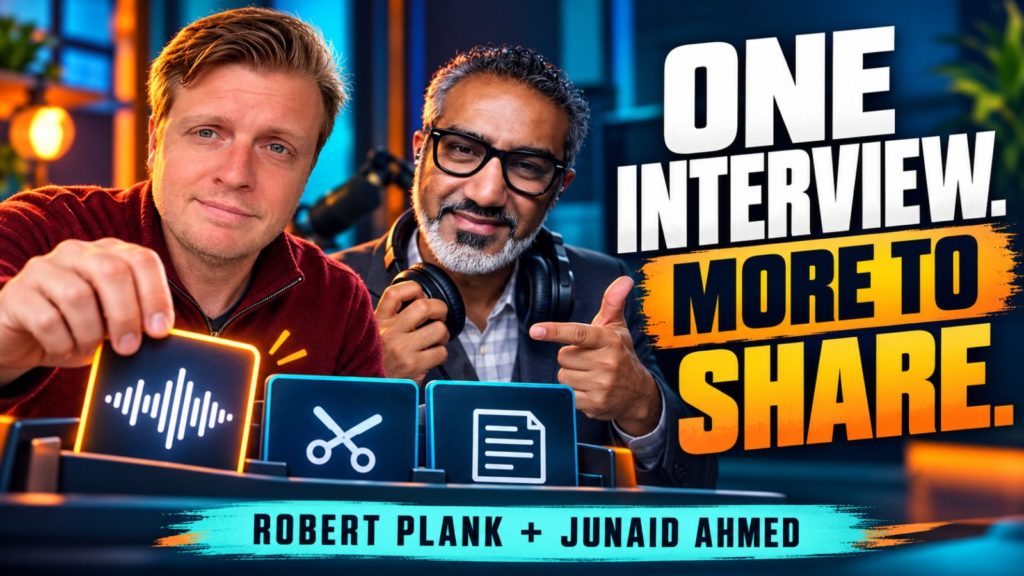
Junaid invited me back for a tactical second conversation about making more use of an interview. Below, I use three passages from this actual conversation to show what a small publishing plan could contain. First you need a moment worth giving another chance.
The Nicolas Cage comparison starts at 1:29 in my second Hacks & Hobbies interview. Watch that passage, then use the three selections below to plan a clip, graphic and post from the conversation. You can find the full series on Junaid's show.
Someone Interested in Your Work Can Still Miss the Episode
As I told Junaid, 'I think it starts with realizing that not everyone is going to watch or listen to all your content.' The time you've spent with an interview can make it feel overexposed to you. That doesn't tell you who actually saw it.
A short excerpt can answer one question. A written post can help someone who has time to read but can't play a video. Give each enough context to be useful even if the person never reaches the full conversation.
Choose the Excerpt Before Choosing the Tool
Start by finding a few moments that answer a question your audience actually has. Listen for an explanation someone could use, a comparison that makes a difficult idea understandable, or a lesson that comes through clearly. Once you've found something worth sharing, you can decide how to present it.
I suggested to Junaid that an interview might contain three to five strong moments for short clips. You could add captions and share those excerpts where your audience watches video. The same conversation might also contain several short, distinctive sentences for quote graphics, along with explanations you can develop into text posts from the transcript.
Choose as many moments as the recording supports. If one answer is the strongest, finish that piece before spending time on weaker excerpts.
For each moment you select, keep a short note:
Timestamp: Where does the passage begin?
Speaker: Who said it?
Intended reader: Who would find it useful?
Point: What should that person understand after seeing it?
That note helps you return to the original and gives an editor a specific assignment. It also makes you explain why you're making the piece before spending time on captions, crops, or design.
Use the speaker's exact words on a quote graphic. If you rewrite them, present the sentence as a paraphrase. Check the surrounding answer too; cutting the qualification can change what an accurately copied sentence means.
Decide Where Each Post or Clip Will Go
My first choices are YouTube and LinkedIn. That's where I spend time and where my audience spends time. I tend to browse YouTube for longer videos and use LinkedIn for shorter clips and written posts. That's why I put my attention there.
Start with where the people you want to reach already pay attention. If they watch videos on another platform or prefer reading posts, account for that before creating a stack of assets. Junaid also pointed out that learning a platform helps you notice which subjects get a response, giving you a better basis for choosing what to explore next.
The full video, podcast audio and social excerpts have separate publishing steps. Choose the destinations first, then assign the files and accounts needed for each.
For each selected idea, ask which format carries it well and where that format belongs. A demonstration might work as a short video. An explanation might become a text post. An exact, useful sentence might suit a quote graphic.
Upload the clip or write the point into the post so the person browsing can use it there. Include the full interview link for someone who wants the rest.
Keep Enough Context for the Answer to Make Sense
Junaid asked which tools my team used. In that interview I named Descript and Otter for transcription, and tools including Veed, Opus, and Canva for working on clips and graphics. I also mentioned Castmagic for title and keyword ideas, with ChatGPT as a frequent place to develop the written material from the transcript.
Those were parts of the workflow I described, rather than a requirement to sign up for every tool before using a recording. The tools could suggest clips, graphics, titles, or posts. Somebody still had to decide whether the choice represented the conversation and would help the person seeing it.
My writing examples were concrete: give the tool the actual transcript and ask for a LinkedIn post about the episode, or a promotional email for subscribers. The original answers gave the draft information and phrasing to work with. Review the output against those answers before treating it as yours.
I connected that with Why, What, How To, What If. My example was a video on tying a tie. First give the viewer a reason to watch. Then explain the type of tie and what you're about to demonstrate. Show the steps with enough room to follow them. Afterward, a relevant next action might concern the job interview or choosing the rest of the outfit.
Each part has a different role. Mentioning the tool or the type of tie doesn't replace demonstrating the action. A hook doesn't replace the answer it promised. A shorter format still needs the parts that let a new person understand the point.
Start With a Five-Minute Recording if You Need Material
If you don't have an interview to use, try three to five minutes on your phone. Explain something you learned or how you helped a friend. Play it back to check whether the voice and picture are clear enough to follow.
Junaid had started recording in his car. I compared buying all the equipment at once to furnishing a house before you know how you'll use the rooms. A few recordings show you what needs improving. Make the explanation, then fix the limitation you can actually identify.
Plan What to Publish From One Conversation
Choose one recording and give a few selected pieces a place on your calendar. The three destinations I discussed with Junaid were YouTube, podcast listening platforms, and social media. For your plan, decide where the complete conversation belongs, then schedule useful excerpts on the channels you've chosen.
Keep the full episode in the plan, including its watch or listen link. For this conversation, a small schedule could look like this. The timestamps locate the relevant speaker turns, so check the precise excerpt boundaries against the recording.
First Monday: My movie-fan comparison, beginning at 1:29. A captioned LinkedIn clip explaining why followers still miss your content.
First Thursday: My tool discussion, beginning at 8:59. A LinkedIn quote graphic using my exact words, "They won't do all the work for you," with accompanying text explaining the need to review suggested material.
Following Tuesday: My phone-recording example, beginning at 13:52. A written LinkedIn post explaining how to start with a short recording.
Keep the recording, transcript, selection notes, episode link, and finished pieces in a shared source folder. Before anything goes out, review names, captions, quotations, and links. Watch the opening of each excerpt as someone encountering the subject for the first time. Include enough context to understand the answer, and preserve qualifications that affect its meaning.
This is the selection and publishing work behind DFY Podcast's production service. The three passages give an editor something concrete to work from: the source, the point and the intended format. Choose the next piece from the plan, finish it, and keep Junaid's full interview link with it.
About Robert Plank
Robert Plank hosts Marketer of the Day and owns DFY Podcast. He helps business owners record conversations and turn them into published episodes, written content, clips, and graphics.
Original Conversation and Resources
- Original Hacks & Hobbies conversation with Junaid Ahmed: Robert's second conversation with Junaid, focused on repurposing an interview into useful marketing content.
- Hacks & Hobbies: Junaid's show and episode archive.
- Robert Plank's Media Appearances: More conversations featuring Robert as a guest.