A client payment lands. For a moment, the business looks healthy. Then payroll, software, suppliers, and the bills you forgot were coming take their turns. You made the sale, did the work, and somehow you are still waiting for the business to pay you.
That is the problem Profit First asks you to confront: what happens to the money after it arrives? Mike Michalowicz’s approach makes profit a deliberate cash habit instead of a hope that something will remain. Put that habit beside sound pricing, a useful offer, and a repeatable financial review, and you have a better question than “How do I sell more?” You can ask, “What does this sale actually leave the business able to do?”

Make Profit a Habit Before You Chase the Next Sale
In episode 421, Mike describes selling companies, losing money as an angel investor, and having to rethink what business success meant. His lesson was uncomfortable: past success had not made him immune to poor decisions. Revenue and confidence were both unreliable substitutes for a habit of keeping profit.

Mike Michalowicz · Episode 421, 25:53“We need to build systems around how we naturally behave, and not try to change ourselves.”
Build a cash-management routine around the habits you already have.
The familiar formula is sales minus expenses equals profit. Profit First changes the order of attention: sales minus profit equals expenses. The arithmetic has not changed. The behavioral constraint has. Instead of spending from one apparently available balance, you make a deliberate allocation and work with the operating money that remains. The publisher’s book description explains this shift.
Think of the difference between a promise and an appointment. “We will save something when this busy season ends” can move forever. A defined review forces you to face the numbers while there is still time to make a decision. The point is to notice a problem before it becomes another urgent sales target.
Give Collected Cash Five Distinct Purposes
Mike’s official cash-flow overview describes five foundational accounts. Income collects the revenue; planned allocations then move to the other four accounts:
Profit First · Five foundational accounts
Collect in one account. Allocate to four.
Collected business revenue lands here.
Allocate planned percentages on a set schedule.Use Real Revenue after applicable materials and subcontractor costs.
Profit
Return for owning the business. Reserve it first.
Owner’s pay
Compensation for the work you do in the business.
Tax
Money set aside for tax obligations.
Operating expenses
The operating budget. Pay business bills from here.
Income collects the cash; the other four accounts give it a job. Choose percentages for your business—box sizes do not show allocation amounts.
Percentages should reflect the business’s financial situation and change over time. Use the official Instant Assessment worksheet with your financial professional rather than copying another company’s targets. Its “Real Revenue” calculation deducts materials and subcontractors from income; it does not deduct employee labor there. This matters when a large share of sales passes through to suppliers or subcontractors.
An allocation is not the same thing as an expense in your books. Moving money between your accounts does not create an accounting profit, settle an unpaid bill, or establish the correct tax treatment of an owner payment. Keep reconciled records and a forecast of upcoming obligations alongside the allocation routine. The SEC’s guide to financial statements explains why earnings and cash flows answer different questions.
Start With a Manageable Change
In the 2017 interview, Mike gives a starting-small example: reserve 1% of a $1,000 deposit, or $10, to begin building the habit. That is an example from his conversation, not a universal allocation target. The remaining $990 still has other jobs, including owner compensation and taxes; it is not all spending money.
Before opening or reorganizing accounts, review the practical details with your bookkeeper or accountant: obligations already incurred, bank fees, account access, transfer approvals, and how the records will reconcile. A system that looks tidy on paper but nobody can maintain will not help much. Choose a routine you can carry out and check.
Ask What Growth Leaves Behind
A bigger business can produce a bigger workload and a thinner cushion. That is why the next sale should have a purpose beyond increasing a revenue number. Is it supporting reliable owner pay? Funding delivery without scrambling? Creating room for a team member? Building a reserve? Those are different outcomes, and they call for different decisions.
In episode 1265, Searchbloom founder Cody Jensen recommends Profit First while discussing service businesses and growth. He also talks about looking beyond rankings to the economics of a customer’s sales, including product costs and the agency fee. His recommendation connects marketing to what a sale leaves behind; it is not evidence of a particular Profit First implementation at his company.

Cody Jensen · Episode 1265, 17:47“Make sure that your profit is built into your service, your product, your solution first.”
For your next offer review, write down the price, the work promised, the direct delivery costs, and the likely cost of acquiring the customer. Include revisions, support, and the owner’s time in the conversation even when the cash payment happens later. If every sale demands an exception, the price on the sales page is only part of the story.
Cost control also requires judgment. A tool nobody uses is different from quality control that prevents expensive mistakes. Before cutting a cost, ask what result it supports, how you will know whether the cut helped, and what failure it could introduce. Spend less where you can; preserve the ability to deliver what you sold.
Margin and Cash Timing Can Tell Different Stories
Kelly Meyer’s episode 1060 adds an important business-model comparison. Looking back on his gym and brewery experience, he describes collecting gym memberships before opening, while brewing required more cash to make additional batches before selling them. These are his experiences, not rules for every gym or brewery. The useful question is when your business has to pay relative to when it gets paid.
I bring up Profit First in that conversation. Kelly’s story is a lesson in costs and timing, not a claim that he used the method or that it would have prevented his loss. No arrangement of accounts can make an uneconomic offer profitable by itself.
$100 sale
− $60 direct materials / subcontractors
− $25 acquisition cost
= $15 before overhead, taxes, and other obligations
Before payment: $85 of costs are due.
Day 30: customer pays $100.
Temporary funding need: $85, assuming no opening cash or other inflows.
Separate those questions when you review an offer. First, does the price cover the resources required to deliver it and contribute to the rest of the business? Second, can the business fund the interval between paying those costs and collecting from the customer? A deposit, different payment terms, smaller production run, or revised delivery sequence might change the timing. Each has consequences for the customer and the agreement, so assess the actual situation.
Then ask what happens when volume doubles. Does the business need to buy twice as much inventory before collecting? Does another client require another subcontractor immediately? More demand can increase the cash needed to operate. Plan for that need instead of assuming a busy calendar will take care of it.
Build an Offer People Want to Keep Buying
John Meese is an economist turned entrepreneur who had built three businesses from scratch when he joined me for episode 813 in September 2021. Our conversation connects financial discipline with the work that creates revenue: understanding customers, offering a useful result, and making it easy for them to buy. John specifically mentions Profit First while explaining how marketing, sales, and finance need to work together.
His book, Survive and Thrive: How to Build a Profitable Business in Any Economy (Including This One), grew out of his own business experience and 30 interviews with business mentors, including Mike Michalowicz. He started writing while the pandemic temporarily closed his coworking space, looking for principles that could help business owners adapt when their customers’ needs changed.
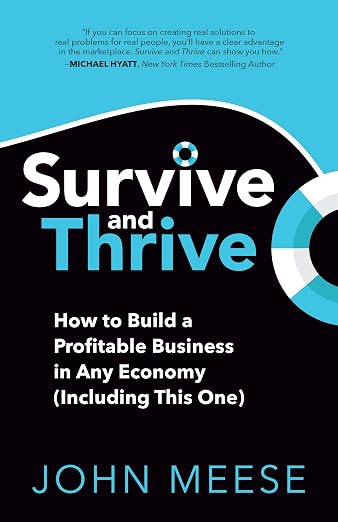
Survive and Thrive
How to Build a Profitable Business in Any Economy (Including This One)
View on Amazon ↗John organized the book around marketing, sales, and finance. He initially put cash management first, then moved it to the final section because a business also needs revenue to manage. The connection to Profit First is practical: create an offer that supports profitable delivery, then give the cash you collect a deliberate purpose.
John’s starting point is “a real solution to a real problem for real people.” He explains three kinds of offers that give customers a clear path through a business:
- Gateway: a straightforward first purchase that lets someone experience a useful result before making a larger commitment.
- Continuity: an ongoing product or service that keeps earning the customer’s business by delivering recurring value.
- Flagship: the fullest version of the transformation your business offers, giving customers a clear picture of what they can work toward.
These are offer categories, separate from Profit First’s bank accounts. For a subscription, John’s test is the value customers keep receiving. More content on its own does not create a stronger reason to renew; the ongoing product should keep helping them make progress.
Put that idea to work by walking through your own purchasing and delivery experience. Where does a customer stop because the next step is unclear? Which question do they ask repeatedly? What do they actually want to accomplish? Removing a real obstacle may be more useful than adding another feature or another discount. After making a change, check whether it improves the customer’s experience and the economics of delivery.
This is where profit and service belong in the same conversation. If the promise requires endless unpaid custom work, it becomes hard to keep. If you cut away the part customers value, they lose their reason to buy. A clear promise, a price that supports delivery, and a sensible boundary for the work can support both sides of the relationship.
Make the Financial Routine Repeatable
A cash plan should survive a busy week. David Jenyns’s prepared presentation in episode 663 describes documenting core processes, putting team members in place, and stepping back from daily agency operations. His 2019 account includes finance among the business functions that need systems. It illustrates process design; it is not evidence that he implemented Profit First.
His useful pattern is to have someone who knows a task demonstrate it, capture the steps, and let another person repeat the work. Applied to a financial review, that suggests a short procedure with a named owner, clear inputs, an approval step, and a way to raise exceptions. This application is a proposed routine, not a financial setup David tested on the episode.
- Inputs: reconciled balances, collected revenue, outstanding invoices, bills due, and known upcoming commitments.
- Action: compare the agreed allocation plan with actual available cash and obligations.
- Responsibility: name who prepares the review and who approves any transfers or changes.
- Exception: flag a shortfall, missing records, or an unusual expense before proceeding as if the plan still fits.
- Record: note the decision, the reason, and the next review date.
The procedure should also say what happens when its usual owner is away. Where are the records? Who can review them? Which decisions need the business owner’s approval? Documenting the routine does not mean sharing passwords or giving everyone account access. Give the right person enough information to do the assigned job and keep appropriate controls around the money.

For the wider question of building a service business that can operate beyond its owner, pair this with my Built to Sell guide. A documented cash review is one useful process; the business also needs repeatable sales and delivery.
Run a One-Month Cash Review Before Changing Everything
Before changing bank accounts, map one recent month. Record what came in, what the business spent, what you paid yourself, and what remained for taxes and profit. Bring that picture to your bookkeeper or accountant and choose a practical first change. Use the next review to compare the plan with what actually happened.
- Gather the actual records. Separate invoices issued from payments collected. Reconcile the balances so the starting picture is dependable.
- List the money’s commitments. Include bills not yet paid, payroll, tax obligations, debt payments, refunds, and less frequent costs that are approaching. A bank balance can look generous while already being spoken for.
- Inspect one offer. Compare price, direct costs, acquisition cost, and the timing of collection. Identify whether the problem is margin, timing, unnecessary spending, or a combination.
- Agree on one change. That might be an allocation habit, a clearer payment milestone, a price review, or removal of an unused recurring cost. Document the assumptions and get the relevant professional input.
- Assign the next review. Put a person and date beside it. Compare expected results with actual results before expanding the change.
If you are already using Profit First, look for the exception that keeps repeating. Are you raiding a reserve? Does a certain service always demand extra work? Do annual bills keep surprising you? Treat the repeated exception as information about the plan. Reclassifying a transfer or working harder does not explain the underlying gap.
Leave the review with one written decision: “We will change ___, because the records show ___, and ___ will review it on ___.” That is concrete enough to revisit. More sales, better margins, and better cash discipline are related jobs. Give each its own attention.
Book, Episodes, and Further Reading
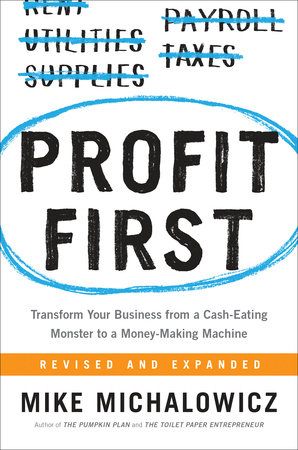
Profit First by Mike Michalowicz offers the full cash-management framework behind this guide. The linked edition is the revised and expanded book. Publisher and edition details. See the site’s disclosures for purchase links.
- 421 · Mike Michalowicz — the author on cash habits, efficiency, and the purpose of growth.
- 1265 · Cody Jensen — connect marketing decisions with business economics.
- 1060 · Kelly Meyer — a retrospective on entrepreneurship, business models, and cash demands.
- 813 · John Meese — build useful offers and then manage the business they create.
- 663 · David Jenyns — document and repeat the processes a business depends on.
Browse all resources · Find more Profit First mentions in Explore. Episode stories describe what the guests shared at the time of recording; they are not claims about their current companies or results you should expect.
About Robert Plank: I host Marketer of the Day and run DFY Podcast. These conversations connect practical business ideas with the decisions entrepreneurs face. More about Robert and the show.
Give Your Next Cash Review a Clear Job
Choose one recent month, gather the records, and identify one decision to review with the person who handles your books and taxes. You do not need to redesign the whole business to take a useful first step.
Start My One-Month Cash Review
Already have a routine? Use the review to find the recurring exception that deserves your attention next.