You can rank your priorities, touch every project, and still finish the week with the most important work undone. The missing decision is often which result gets your time first—and what you will allow to wait.
The ONE Thing by Gary Keller and Jay Papasan gives that decision a useful test: choose work that makes what follows easier. These seven separate podcast conversations show how to turn that idea into a meaningful accomplishment, a realistic calendar block, and a plan for the responsibilities that still need attention.

Gary Keller Keeps Bringing Geoff Woods Back to the First Priority
Geoff Woods brought a one-page business plan with three priorities to Gary Keller and Jay Papasan, but Gary kept bringing him back to the first one. The annual goal sat at the top, with the priorities ranked beneath it. Geoff talked through number one, answered their questions, and moved to number two. Partway through, Gary had more questions about number one.
Geoff answered those and continued. When he reached number three, Gary returned to the first priority again. Eventually, Gary asked whether Geoff needed to accomplish number three to do number two, or number two to do number one. Neither was a prerequisite. Gary suggested drawing a line between the first priority and the others, or even ripping the page in half, so Geoff could give number one his attention.
Geoff told me this story in our February 2018 conversation, when he was working with Gary and Jay to build a business around their book, The ONE Thing. He had put the priorities in order, but he still felt responsible for advancing all of them. As he explained, “because I was dividing my focus, I wasn’t actually finishing anything.” You can listen to Geoff’s account of that planning conversation or watch him explain the priority lesson.
I recognize that problem. I’ve looked at a day when I touched a bunch of projects and told myself I got plenty done. In my conversation with Carey Bentley, I admitted that I used to think I could handle 10 or 20 things in a day. Eventually, I became more honest about how little progress on each one added up to a collection of unfinished work. Having everything in motion can make it surprisingly hard to notice what never gets completed.
Gary Keller and Jay Papasan’s idea becomes useful when you can identify what finishing the first priority would actually change. Maybe it removes a decision that keeps holding up your team. Maybe it gives you a way to test an offer before building the whole thing. The work deserves attention because of what completing it makes possible, not simply because you can cross it off quickly.
My separate conversations with these guests give that decision some practical shape: a weekly accomplishment with room for surprises, an annual project tested with customers, a business capability worth developing, and calendar space to carry the work through. Choosing what comes first also means deciding what happens to everything else. Customers still need delivery, promises still matter, and some appealing ideas will have to wait.
Choose the Work That Changes What Comes Next
Posting a job sounds like something you could cross off before lunch. When I asked Geoff about his weekly priorities, he explained what that outcome actually required: finalizing the job description, meeting with his partners, researching comparable salaries, and working with HR. He needed a community manager who could create content, engage members, and manage the content process. One priority can contain substantial work, and naming the outcome doesn’t eliminate its prerequisites.
The Focusing Question from Gary Keller and Jay Papasan’s The ONE Thing asks more of you than picking the shortest item on your list: “What’s the ONE Thing I can do such that by doing it everything else will be easier or unnecessary?” It connects an action to what follows. Preparing a job description matters when an undefined role is preventing you from finding the person your business needs. Rearranging your desk might be easier to finish, but it won’t resolve that problem.
Geoff illustrated this with Deb, a mother of three building a business from home. Her initial answer was to grow the business, which was too broad to tell her what to do next. Working backward, the conversation moved through selling more, making more calls, having a contact list, and finally writing down five names before bed. Preparing the names removed a specific obstacle to starting the next day’s calls. Geoff reported that her business improved as she followed through, but preparing a list still needed to lead to actual conversations.
For a podcast production example, suppose every episode stalls because the team is waiting for the owner to decide who approves the edit. Mapping and testing one approval process could make later handoffs easier. That work only deserves priority if approvals are what’s holding up delivery. If the delay actually comes from missing recordings, you need to address that prerequisite instead of improving a process nobody can use yet.
Geoff also made an admission that keeps this practical. His highest priority that week was finding the community manager, yet he was spending time talking with me. “It matters that I honor those obligations,” he said. Our interview also supported his annual objective of growing the audience and email database, even though it wasn’t his leading weekly priority. You can listen to Geoff explain priorities and competing commitments or watch his discussion of The ONE Thing in a real working week.
Once Geoff identified his priorities, he questioned the appointments already on his calendar instead of assigning important work whatever time remained. My practical version is to identify appointments that support the chosen outcome, commitments you must honor or renegotiate, and meetings that could become shorter updates. Then reserve time for the work that currently has none. The interview example matters here: an appointment can serve a longer-term goal even when it takes time away from the week’s most pressing work.
Geoff described Goal Setting to the Now as working backward from a future direction through five years, this year, this month, and this week, without requiring perfect certainty about the distant future. The 411 connects annual, monthly, and weekly priorities, while ordinary tasks can still live on a separate list. The official goal-setting guide explains that relationship. The next prerequisite should serve the larger outcome, so your week doesn’t fill with easy accomplishments that leave the important obstacle untouched.
Choose a Weekly Accomplishment You Can Finish
Carey Bentley’s test for a weekly priority is whether you could finish it by Tuesday if you had full focus and nothing went wrong. That leaves the rest of the week for what usually happens: unexpected requests, work that takes longer than estimated, and responsibilities that don’t disappear because you made a plan. Leave room after the expected finish. If your accomplishment requires every available hour through Friday afternoon, one interruption can push it into next week.
Carey calls that accomplishment a champagne moment, her adaptation of the Focusing Question from The ONE Thing. She asks you to identify something that would make the week worth celebrating because it moved your business or life forward. Tuesday is her scope check, not a deadline prescribed by Gary Keller and Jay Papasan. If your workweek follows a different schedule, preserve the room for surprises rather than the particular day. You can listen to Carey explain her champagne moment and Tuesday-sizing advice or watch her discussion of weekly priorities and planned downtime.
Here’s how I’d apply that to client onboarding. “Work on onboarding” could mean opening a document, rewriting a welcome email, or spending two hours comparing software. A more useful finish would be a tested set of instructions that gets a new client from payment to submitting the information your team needs. That matters if missing information keeps delaying delivery. Define what will be different when you’re done, including who can use the result without asking you to explain it again.
That entire process might still be too large for your week. In that case, choose a smaller complete piece, such as testing the intake form and its confirmation message so a client knows what to submit and what happens afterward. Estimate the writing, setup, and testing involved. A milestone should leave something usable or answer an important question, rather than simply give you permission to count another afternoon of unfinished work.
Finishing early doesn’t mean you stop doing useful work. Carey explained that someone could complete the first champagne moment on Monday and then choose another. In her words, “it’s just that you’re choosing the one thing you’re gonna do first.” You get to use the remaining time without reopening five projects before the first accomplishment is complete.
Protecting that accomplishment requires decisions about availability. You might close email during the work period, agree with your team on what qualifies as urgent, or arrange coverage for a responsibility that cannot wait. Carey strongly emphasizes ownership of time. I take the practical part to be finding the choice you can make, whether that means narrowing the deliverable, preparing a handoff, or renegotiating a deadline. You can do that while acknowledging that some interruptions are outside your control.
Carey also described scheduling afternoon activities when she and her husband were visiting a new place. Having somewhere they wanted to go gave them a reason to finish and close their laptops. The same principle can apply to dinner with a friend or a family commitment: give the work a real endpoint. Put a specific accomplishment before that endpoint, with enough room to handle a complication, so Friday doesn’t become another day of explaining why the priority is almost finished.
Give the Annual Goal a Testable Next Step
Joe Sanok interviewed 20 ideal clients before putting much infrastructure behind his new membership community. They wanted training, feedback, and a connection with other people starting a private practice. Those conversations gave him something specific to offer and test. He could learn whether prospective members wanted the combination enough to join before building everything he imagined the community might eventually become.
In our February 2018 conversation, Joe directly credited The ONE Thing with helping him structure an annual goal that would make other work easier. That year, his priority was the supportive membership community. He had already offered one-on-one consulting, mastermind groups, and conferences, and wanted a way to provide training and support to more people. The membership goal determined what he needed to learn from prospective members before deciding what to build first.
Joe sketched a landing page, invited people onto a waitlist, and opened a limited number of places. He reported that the launch filled 50 spots, but the more useful detail is how he approached the attempt: either response would give him information. Interest would tell him something about the offer, and a poor response would give him something to investigate. You can listen to Joe explain his annual focus and customer-informed experiment or watch his conversation about testing ideas and making room for them.
Even with interested buyers, the launch ran into trouble. Sales stopped at 42 because the payment setup had mistakenly capped availability there instead of at 50. Joe was still telling people that places remained while the system prevented them from buying. That mistake required a correction, but it wasn’t evidence that the entire membership idea had failed. A test needs interpretation: a broken purchase path and an unwanted offer are different problems.
There was also the less exciting work of making room to run what he sold. Joe described automating onboarding and recurring resources, and having an assistant handle tasks that didn’t require him. He still needed to show up for his mastermind groups. The opportunity was to remove avoidable administration around those commitments so a new project didn’t simply lengthen his working day. As he put it, entrepreneurs often “add more to their plate without taking things off that plate.”
An assistant used scripts to answer recurring email questions, marked messages that needed Joe’s judgment, and texted him when something especially important arrived. She replied as herself, identifying her role, rather than pretending to be Joe. The handoff preserved a route back to him while allowing ordinary requests to move forward without his personal attention. That takes more preparation than telling someone to handle the inbox, but it gives both people a workable boundary.
Joe also put existing paid and promised work ahead of treating every new idea as an immediate assignment. Like Geoff keeping our interview commitment, he was choosing within obligations he had already accepted. His annual goal guided where to invest additional effort. The customer experiment and communication handoffs show how he made that direction workable in his own business.
For your annual goal, identify the uncertainty you need to resolve next and a small useful test that addresses it. That could mean talking with prospective customers and offering a limited first version, if those steps fit what you’re building. Then identify one recurring responsibility to simplify or hand off, including what still needs your judgment. Put the customer test and that handoff on the same plan, so a successful experiment has somewhere to fit.
Focus on a Capability the Business Can Use
A viewer who recognizes Ben Heath may be more likely to choose his video about Facebook advertising. If the explanation helps, that viewer has another reason to trust his advice. When Ben mentions that his agency can manage the advertising, the invitation comes from someone whose work the viewer already knows. In our May 2025 conversation, Ben described how that familiarity could help at several points, from choosing a video to making an inquiry and considering the agency’s services.
His priority was building that recognition through useful content about his field. He wasn’t trying to become a celebrity everyone recognized. He wanted the people who needed help with digital advertising to know his work well enough to consider doing business with him. One sustained investment could help several later decisions, although it took time and effort to build.
Ben described asking what he could do well enough to make other work easier or unnecessary. He said he had heard the idea through Tim Ferriss and wasn’t sure of its earlier origin. I connected it to The ONE Thing during our conversation. His answer at that stage was to develop the recognition that made it easier for prospective clients to find and consider his agency.
Ben explained that a team and business partner allowed him to concentrate heavily on content creation. His focus depended on other people handling work the agency still needed to perform. Without that support, the same content commitment would compete with client delivery and the other responsibilities of running the business. You can listen to Ben explain his personal-brand focus and our book connection or watch his discussion of the content and team behind his agency.
That extends Joe’s point about making room before adding work. If teaching your audience deserves more of your attention, client delivery still needs an owner. You may need to document a recurring task, train someone, or narrow the amount of content you intend to produce. Account for the work you personally handle before copying the schedule of someone supported by an established team.
Ben’s focus also accommodated different kinds of videos. A beginner searching for instructions might spend an hour following a detailed tutorial. Someone already familiar with the advertising platform might prefer a shorter explanation of a new feature. Both serve the same broader purpose, but they answer different needs. Choosing one priority doesn’t require making one identical thing indefinitely, and Ben’s particular video lengths aren’t a prescription for every audience.
He described improving his work by watching existing explanations, noticing what they covered well, and identifying what they left out. Audience questions gave him further material to address. Over time, that practice helped him judge which subjects deserved a video. The useful discipline is connecting the next piece of work to an actual audience need, rather than treating every possible topic as equally deserving of production time.
Ben also said he returns to the question as the business reaches another level. His answer can change, and he was clear elsewhere in our conversation that advertising creates an opportunity to sell, not guaranteed sales. If useful content is the capability your business needs, specify whose question you’ll answer next and what a finished answer must include. Make that answer worth the viewer’s time before expanding the publishing schedule.
Choose the Opportunity and Make Room for It
Brandon T. Adams described a difficult version of the focus problem: he liked the opportunities competing for his attention. Speaking, podcasting, events, and film could all serve his larger mission. During our conversation, he acknowledged that he was still working on focus. An opportunity can fit your purpose and still need to wait, especially when accepting it would delay something you’ve already committed to finish.
Within that broader conversation about Think and Grow Rich, Brandon recommended The ONE Thing and described John Lee Dumas’s progression from a daily podcast to subsequent journal projects as an example of sequencing. He also credited teams with helping him handle his businesses and described reviewing what he had actually accomplished during the week. My application is to give a promising idea a later review date, using something like Joe’s someday list, instead of immediately opening another project. You can listen to Brandon discuss focus and project sequencing or watch his conversation about opportunities and delegation.
Start With a Useful Small Action
Once you choose a direction, the starting point may be modest. Mike Schindler explicitly endorsed The ONE Thing while discussing micro wins, such as taking a walk around the block instead of planning an immediate physical overhaul. He connected those actions to what a meaningful year would look like across mental, physical, spiritual, relationship, and financial areas. Those are prompts for considering your life, not five assignments competing for the same hour. You can listen to Mike connect meaningful goals with small actions or watch his discussion of purpose and micro wins.
Mike also admitted that his own habits had slipped during a demanding film project and that he had to work on them again. My test would be to identify a practice that has slipped and one realistic action to restore it. Smallness alone doesn’t make an action important. Choose the action for what it helps you resume or accomplish, then make space to do it.
Protect Work and Leave a Buffer

Damion Lupo made his choices visible on the calendar. He directly credited The ONE Thing for arranging work into planned windows, while separately crediting Hal Elrod’s The Miracle Morning for his morning practices. He also reserved open time and described adding a day between returning from travel and resuming his schedule. His particular buffers aren’t requirements for everyone, but they show that protecting time can include leaving it unassigned. You can listen to Damion explain time-blocked work and buffers or watch his discussion of scheduling and open time.
Build Your One-Priority Plan
I’d bring these examples together on one sheet using the following prompts. This is my synthesis of the conversations, not an official 411 template or a reproduced worksheet from the book. Fill it out for a specific period so a distant ambition doesn’t become an impossible assignment for this afternoon.
- Outcome and reason: What accomplishment matters during this period? What will it make easier, or remove?
- Next finish: What will tell you this step is complete? List its prerequisites and the realistic effort required.
- Calendar space: When will you work on it? Leave a buffer and protect time away from work.
- Support and obligations: Who can handle part of the work, and what instructions do they need? Note what still requires your attention and where you will keep deferred ideas.
- Review: Set a date to record what finished, what became easier, and what interrupted the work. Decide whether to continue, adjust, delegate, or postpone the next step.
Put the Chosen Priority on the Calendar
Choose one accomplishment whose completion would make a meaningful difference to what happens next. Write down what will count as finished and what must happen before you can get there. If it needs every spare minute you hope to find, reduce it to a useful milestone and leave room for interruptions. Then open your calendar, account for commitments that need you, and arrange the support required to keep them. Name the actual outcome in the work period so you know what you intend to complete when that appointment begins.
Geoff’s one-page plan already had the priorities in order. The difficulty was letting that order determine where his attention went. Gary’s suggestion to separate number one from the remaining initiatives addressed the work Geoff kept trying to advance alongside it. The other priorities still existed, but dividing attention among them had kept him from finishing the first. Your page can hold the same distinction, with later work recorded and the chosen accomplishment given room in an actual day. Draw the line beneath the first priority, then give it an appointment on your calendar.
About Robert Plank
Robert Plank is a podcaster, author, entrepreneur, and host of Marketer of the Day. He interviews entrepreneurs about how they find customers, make decisions, organize their work, and build business relationships. His conversations explore the practical details behind their approaches, including experiments that failed, responsibilities they delegated, and choices that helped them finish important work.
Robert also owns DFY Podcast, helping entrepreneurs start and maintain podcasts. His team handles audio and video editing, show notes, transcripts, publishing, and promotional materials so clients can concentrate on their conversations. His perspective on productivity draws on his own business experience and separate interviews with guests who use different methods to choose priorities and manage their time.
Resources
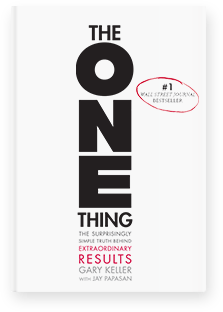
- The ONE Thing on Amazon by Gary Keller and Jay Papasan.
- The ONE Thing official free resources, including planning tools and templates.
- A Kick Ass Guide to Goal Setting, the official guide connecting longer-term goals, weekly priorities, and calendar planning.

Continue with The 12 Week Year to plan a shorter execution cycle, or The Miracle Morning for the morning routine Damion discusses. Browse the Resources library and find more book mentions in Explore. For editions, visit the official book page.
Give Your First Priority an Appointment
Name the finish, account for the prerequisites, and reserve time with room for surprises. Use the five prompts above to make the decision concrete.
Build My One-Priority Plan