Define the challenge
Clarify the opportunity or threat before settling on a solution. Ask what is driving it and what must actually change.
Keynote speaker, author and board director on making difficult decisions.

"As a leader, you have to make the decision, but you also have to manage the decision-making process."
Rick Williams is a keynote speaker, author and board director who helps leaders work through difficult decisions. His book, Create the Future: Powerful Decision-Making Tools for Your Company and Yourself, sets out five steps supported by leadership-team whiteboard exercises. Rick draws on his experience in physics, management consulting with Arthur D. Little, founding The Equity Company and serving on technology-company boards. His speaking covers making difficult decisions and turning a board into a value accelerator. He hosts the Create the Future podcast, where leaders discuss consequential choices, and offers training for leaders, coaches and advisors.
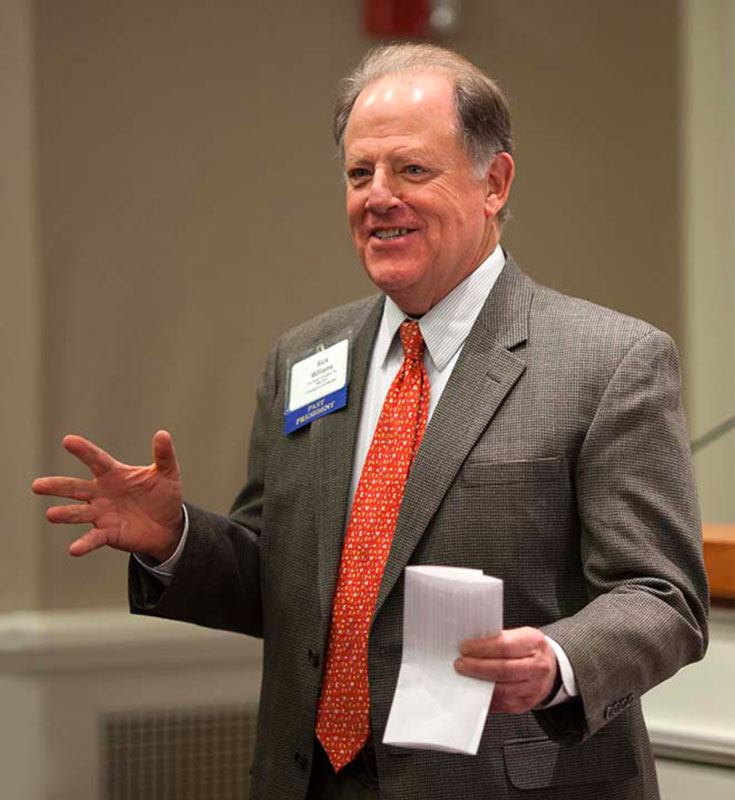
Rick Williams is a keynote speaker, author and board director whose work focuses on the choices that shape an organization. He helps leaders define a challenge, consider different perspectives and make decisions that reflect their goals, risk preferences and values. His book, Create the Future: Powerful Decision-Making Tools for Your Company and Yourself, brings that work into a five-step process with whiteboard exercises for a leadership team.
Rick is a physics graduate of the University of Pennsylvania and a Harvard Business School graduate. He began his career developing space- and defense-related optical systems at Itek Corp., then spent ten years as a management consultant with Arthur D. Little. He later founded and led The Equity Company, a real estate investment and development business. That combination of technical, advisory and operating experience informs the questions he brings to leaders and their teams.
His board work centers on technology companies, particularly in the B2B market. Rick advocates a board that contributes independent experience, sets expectations and helps the CEO succeed while retaining responsibility for oversight. In his conversations with Robert Plank, he describes the board as both boss and coach and explains why being an excellent operations leader does not automatically make someone the right CEO for a company's next stage.
Rick's speaking topics include Making Difficult Decisions in a Time of Change and Make Your Board of Directors into a Value Accelerator. His separate Create the Future leadership training offers team exercises and decision-making tools through seminars, leadership programs and workshops. His podcast, Create the Future, brings in leaders to explain a consequential choice, how they weighed their options and what they learned from the result.
Sailboat racing gives Rick another way to explain leadership. He races his J 130 sailboat, CHARIAD, from Marblehead, Massachusetts, and has competed in races to Bermuda and Halifax. He connects preparing the boat, recruiting a committed crew, choosing a strategy and making decisions as conditions change with the work of leading a company. His newsletter also brings together leadership observations and his photography.
Open the original speaker reel | Speaking topics and inquiries
In his conversation with Robert Plank, Rick explains the decision process behind Create the Future. It is designed for leaders facing a serious opportunity or threat, with exercises that bring a team's information and different perspectives into the room.
Clarify the opportunity or threat before settling on a solution. Ask what is driving it and what must actually change.
Describe the outcome you want, including how the organization will compete and operate. Revenue alone may not define success.
Bring different experiences and ideas into the discussion. Give the team room to consider possibilities before narrowing its choices.
Examine whether the team can execute each option, what could prevent it and what a failure would mean.
Select a path that reflects the goals, risk preferences and values you have made explicit. The leader remains responsible for the choice.
Rick distinguishes creating ideas from judging them. In the interview, he encourages leaders to allow unusual suggestions first, then test what the team can realistically carry out. His example of an unnamed Chicago consulting client shows why a reusable decision process can matter even when the eventual choice differs from the consultant's recommendation.
Watch Rick explain the process | Read the official book and exercise overview
Rick describes a board that helps a company succeed through independent experience, clear expectations and useful questions. He challenges leaders to think beyond filling seats with familiar people and to ask what perspective each director contributes.
In his return conversation with Robert Plank, Rick distinguishes governance and oversight from running day-to-day operations. The board hires and evaluates the CEO; the CEO and leadership team operate the company. He also describes coaching and advising the CEO as part of a board's contribution.
His discussion of selecting a CEO focuses on the company's needs at its current stage. An effective operations leader may bring different strengths from the person the company needs to work with customers, investors and the public.
Explore Rick's board-service approach | Listen to the board-effectiveness conversation
Define the challenge, describe success and compare realistic options before committing to a path.
Discuss independent perspectives, clear expectations and the board as both boss and coach to the CEO.
Make room for different views, encourage creative options and examine execution barriers with a team.
Consider the experience and strengths a company needs at its current stage, rather than assuming that success in another role guarantees a fit.
Examine how those three considerations affect a consequential business or career choice.
Connect preparation, crew selection, strategy and decisive action under changing conditions with leading an organization.

A practical guide for leaders facing consequential choices. The five-part process moves from defining the challenge and imagining success through creating options, evaluating barriers and choosing a path. Leadership-team whiteboard exercises help surface different views, compare execution risks and consider goals and values. Rick draws on work with companies, nonprofits and government agencies.
Book details and introductory chapter | Publisher and author information
Rick speaks at leadership conferences and executive retreats on making difficult decisions and turning a board of directors into a value accelerator. His decision-making presentation draws on Create the Future and gives leaders a practical process to use with their teams. His board presentation addresses how directors and company leaders can make the board a useful contributor to the company's work.
Rick offers independent board service for middle-market B2B technology companies. He combines governance and performance oversight with coaching and advising the CEO within the director role. His official page emphasizes clarifying goals, bringing outside experience and helping leaders work through consequential decisions. This is board-director work rather than a separately advertised executive-coaching subscription or a promise of an available board seat.
Rick's Create the Future leadership training is for leaders, advisors, coaches and consultants who want to use its decision process and team exercises. The official page advertises seminars, leadership programs and workshops covering strategic planning, imagining success, choosing an organizational path and using CTF exercises with a leadership team. Visitors can register their interest; the page does not establish a current cohort date or fixed duration.
The Create the Future podcast brings leaders into a conversation about a consequential choice: what made it difficult, what options they considered and what they learned. Guests include founders, executives, nonprofit leaders and other people with firsthand leadership decisions to discuss.
Recent conversations include Sam Eitzen on changing Snapbar's business model, Joe Patneaude on leaving a corporate identity behind and Claire Hayek on responding to pressure. The publisher feed shows an original guest interview on October 18, 2026.
Listen to Create the Future | Rick's hosted podcast in Podcast Library | Guest information and application
Rick races CHARIAD, his J 130 sailboat, from Marblehead, Massachusetts. In his conversations with Robert Plank, he discusses races to Bermuda and Halifax and draws parallels with leading a business.
The work begins before the start: prepare the boat and its systems, recruit a committed crew and decide on a strategy. Once racing, conditions change and people depend on the skipper to make decisions. Rick uses that experience to discuss preparation, teamwork and the leader's responsibility to act.
Rick discusses boards as contributors to company value, selecting a CEO, his outside analysis of a Tesla compensation proposal and leadership lessons from sailboat racing.
Rick explains defining a challenge, creating options with a team and evaluating risks and values. His Chicago consulting story shows a client reusing the process while reaching a different decision.
| Date | Type | Show or organization | Subject | Source |
|---|---|---|---|---|
| December 9, 2025 | Podcast interview | Marketer of the Day / Robert Plank | Boards, difficult decisions and sailing | Open source |
| August 13, 2025 | Podcast interview | Marketer of the Day / Robert Plank | Five-step decision process and team creativity | Open source |
| Date not listed | Speaking testimonial | Massachusetts Marine Trades Association | Making difficult decisions at its annual conference | Open source |
| Date not listed | Speaking testimonial | Latinos in Bio | Two leadership-development program appearances | Open source |
Rick Williams is a keynote speaker, author and board director who helps leaders work through difficult decisions. His book, Create the Future: Powerful Decision-Making Tools for Your Company and Yourself, sets out five steps supported by leadership-team whiteboard exercises. Rick draws on his experience in physics, management consulting with Arthur D. Little, founding The Equity Company and serving on technology-company boards. His speaking covers making difficult decisions and turning a board into a value accelerator. He hosts the Create the Future podcast, where leaders discuss consequential choices, and offers training for leaders, coaches and advisors.
The five steps are define the challenge, imagine success, create options, evaluate barriers and choose the future. Rick uses leadership-team whiteboard exercises to make the process practical. He encourages leaders to compare options against explicit goals, risk preferences and values.
The leader is responsible for making the choice and for creating a useful process around it. Rick describes inviting different perspectives, giving people permission to suggest ideas, acknowledging their contributions and checking whether the options can be executed. He discusses this distinction in his first Marketer of the Day conversation.
Rick argues for directors who bring independent experience and different perspectives. He describes a board that sets expectations, reviews performance and helps the CEO succeed. In his explanation, the board provides governance and oversight while the CEO and leadership team operate the company.
His keynotes address leadership audiences at conferences and retreats, with topics on difficult decisions and board effectiveness. His Create the Future leadership training is a separate seminar, program or workshop offering for leaders, advisors, coaches and consultants who want to work with its team exercises and decision process.
Rick hosts the Create the Future podcast, where leaders discuss difficult organizational and career choices. Recent conversations include Sam Eitzen on changing Snapbar's business model, Joe Patneaude on leaving a corporate identity and Claire Hayek on responding to pressure. The publisher feed shows an original guest interview on October 18, 2026.
Their first conversation explains the five-step decision process, inviting creative team input and a consulting assignment where the client valued the process more than the specific recommendations. The return conversation focuses on board effectiveness, choosing a CEO, an outside analysis of Tesla's compensation proposal and leadership lessons from sailboat racing.
Use Rick's official speaking page to describe an event or leadership retreat. His board-service page provides a separate inquiry route, and his leadership-training page accepts expressions of interest. His website also provides his professional profile, newsletter and podcast guest-application form.