1592: Grounded science fiction and faith-driven storytelling with Barry J. Spaulding
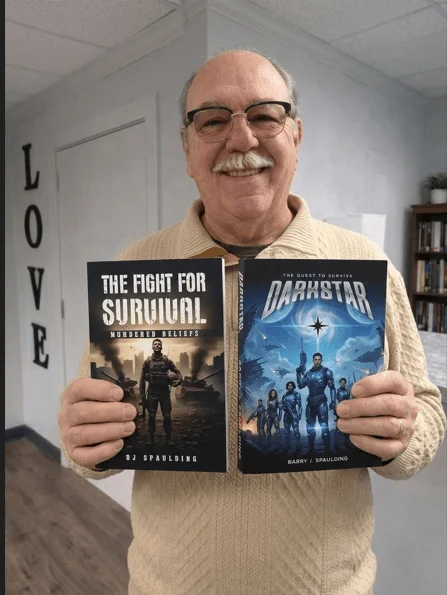
BJ Spaulding covers Military Science Fiction in this Marketer of the Day episode. Barry J. Spaulding shows how life experience can become grounded fiction that helps readers rethink blame and responsibility. After 32 years in federal law enforcement and military service, he returned to stories he had carried since his teenage years. Dark Star took about 15 years to develop, using military tactics, survival pressure, flawed heroes, and believable space warfare. Who's to Blame came together in about two months around George's conversation with God about loss, prayer, heaven, and choices.
Many people don’t lose their love for reading and deep thinking; they just get buried under responsibilities, distractions, and endless screens until their imagination quietly slips into the background. Today’s guest, Barry J. “BJ” Spaulding, a former federal law enforcement officer and military veteran turned science fiction author, shows how stories can pull us back into wonder, responsibility, and faith. After 32 years of service, a divorce, retirement, and the pandemic, Barry finally returned to his teenage dream of writing, and the result is a growing catalog of books, including Dark Star, The Fight for Survival, and Who’s to Blame.
In this episode of Marketer of the Day, Barry shares how his background in the Army, law enforcement, and Dungeons & Dragons helped him build believable universes, flawed heroes, and grounded military sci‑fi. He explains why Dark Star took 15 years to fully come together, how he weaves real-world tactics, emotional trauma, and survival decisions into epic space battles, and why he refuses to write “perfect” heroes. His stories blend science fact, combat experience, and speculative fiction in a way that still feels human and uncomfortably honest about what people do when the stakes are life and death. Barry also dives into the deeply personal inspiration behind Who’s to Blame, a story about a man named George who spends his life blaming God for every tragedy, until God finally brings him to heaven for a direct, no-excuses conversation. Through that lens, Barry explores blame, loss, faith, and personal responsibility, asking hard questions like: What part did I play in what happened? and Do we create our own heaven and hell? If you’ve ever wondered how modern faith, free will, and suffering could be explored through a compelling story instead of a dry debate, this episode lays out a powerful blueprint.
Along the way, Barry and Robert talk about why reading and writing are more important than ever in a tech-saturated world, how books slow your mind down, force you to visualize, and create a private dialogue between the words and your soul in a way movies and social media can’t match. Barry shares practical insights into his writing process, why he often writes without an outline, how reader feedback sharpened his character development, and what’s coming next (including a twist-filled vampire novel, a heartfelt story for his daughter, and a Dark Star prequel and sequel). If you love science fiction, military thrillers, faith-driven stories, or need a nudge to pick up a book, and maybe a pen. Again, this conversation will rekindle your imagination and remind you why stories matter.
Quotes:
"I wanted to create a believable universe. I didn't want it to be just things appear, things are there, and there's no real explanation behind it."
"I will tell people over and over again: don't stop reading. Technology is wonderful, but it can't replace a good book on a quiet evening."
"When you're reading, it's between the words on the page and your soul. You envision what's on the pages. You can't do that in a movie theater."
Contact Details:
- Visit Barry J. Spaulding's Official Website
- Discover The Fight for Survival available now on Amazon
- Read Who’s to Blame today available now on Amazon
- Explore the thrilling world of Dark Star available now on Amazon
Podcast: Play in new window | Download (Duration: 31:00 — 42.6MB) | Embed
Subscribe: Apple Podcasts | Spotify | Amazon Music | iHeartRadio | Podchaser | RSS
Transcript
Download transcript (.txt)After 32 years in federal law enforcement and military service around the world, divorce, retirement, and a pandemic reset, Mr. BJ Spaulding finally returned to the dream he had as a teenager, which is telling stories that wrestle with blame, loss, faith, and personal responsibility. And his latest book is called Who's to Blame, where this guy, George, he goes off on some adventures, and he revisits some life choices, and he asks this question: Why did this happen, and what part did I play in it? So, BJ, Mr. Barry J. Spaulding , he's here to tell us about what it's like being a published author and what his books are about. So, Mr. Barry J. Spaulding , how are you?
I'm doing fine, thank you. And yourself?
I'm wonderful and happy to be talking to you, because it's fun to geek out with authors sometimes, and especially like science fiction, it's great to use the power of your imagination, right? There's so many books that are about everyday situations, but personally I like the things that I'll never experience, right? Like teleporting in space in the future, like that kind of gives me an escapism, and I guess everyone gets different benefits from reading books, don't they?
They certainly do. Yep.
Well, so what benefits do they get from reading your books? Like, what is kind of your, your niche? What do you like to write about?
I, I got hooked on writing when I was a teenager. I started in high school, took journalism. A friend of mine turned me on to paperback novels from Robert Howard and Heinlein and some of the great science fiction writers, and I just, I fell in love. I grew up watching Star Trek on, you know, the original series, and then right out of high school I went and joined the army and ran off to see the world, but I kept writing because deep down inside I wanted to do just what you said, you know, things that I could never do, and write about it, so I kind of kept those in the back, hidden away, got married, raised a family, eventually rotated from the military to law enforcement, I kept writing, and just putting the stories aside. I was an avid DND player, so all of my friends, my kids, my brother, and his friends, we played a lot of that, and you know, between the fantasy world and science fiction, it kind of stuck there, so long story short, I retired in 2020 just before Covid hit. Ended up sitting at home with two young granddaughters playing distance learning for the next couple of years, and but I kept writing. I also kept a journal, so I journaled a lot of my experiences, but about a year ago I got divorced, moved off on my own, and I got up one morning and said, you know what, it's time to tell these stories. I contacted an online publisher, within a week Dark Star was born, and a couple of months later, my second sci-fi story was published, and right after that, Who's to blame came out. Who's to blame was a thought that came to me right after I moved out about my relationship with God, and you know how how contemporary people see it, and it just became an interesting idea. So I sat down one day at the computer, I started writing, and next thing I know, I had a story sitting in front of me. So, I, I really enjoyed it. I had a lot of fun writing it, and you know, we all get to a point where we wonder, you know, the good and the bad in life, is there a greater power that dictates it, or isn't there? And if there is a God in heaven, um, what would He be like in 2025 So that's how it came about.
Oh, that's fun, and I like that, because it's like, you know, a lot of these big deep questions. We don't have the answers, right. We'll never know, and even exploring it in that straightforward fashion, that's really boring. But to have these like speculative stories, that's, you know, that's that's a lot of fun. And I mean, even in Star Trek, right, there's like Trelane, and there's there's Q, and there's the people with the eyes turn silver when they cross the galactic barrier, and they have superpowers, right. It's always just like fun to just explore all the godlike, like I guess tropes, but then you're kind of expressing some of the.
One of my favorite.
Yeah.
One of my favorite episodes was Who Mourns for Adonis, yeah, the fact that the Greek gods were actually space travelers, it's a cool idea. Yes, absolutely. You know, ancient people made up gods and goddesses to explain everything that they couldn't explain to science, so Who's to say what's real and what's not real. We're only now discovering some of the most unbelievable things in the galaxy.
Yeah, yeah, like I was watching the other day about, like, the voids. There's more, I mean, their space is already really empty, but there's voids of, like, you know, like hundreds of 1000s of light years, never mind just the size of our galaxy, but like it's it could fit, you know, millions of galaxies inside this void, just because the way gravity draws things together, like you're not going to really stay in a, an object passing through a void will keep going through and it'll cluster around a star system or galaxy, but these these voids are just like it hurts your brain as far as the weirdness of space, right? And they say, like, there's probably more rogue planets in our galaxy than planets around stars, and it's like, what a just, what an unlimited, like treasure trove of, of, you know, possibilities that are out there, and even like what's really silly is that like Rod Serling from The Twilight Zone, he used a lot of his like war time experience to write stories, like Gene Roddenberry was a cop, right, and then Harlan Ellison one time said like, well, Star Trek was the cop show, right, because if you think about it, like they show up on a planet, something, some crimes happen, or some, you know, someone's died and they have to like decode the mystery. It's like that's kind of silly, how the, the real world, and maybe some of the logic and the action that you see, then you can make it more fantastical, and it becomes like a really like pleasurable, fun final product I think.
It really does. Yeah.
And so, speaking of that I was looking on your webpage, where they talk about, like, you have science fiction, but it's, it's grounded, right, it's not too wild and crazy, so we can have the larger than life, but it also makes sense, so can you, can you explain that, like, in the fight for survival and Dark Star, and these things, like, what about your writing is grounded in real, and as far as the science fiction.
When I rose, when I was writing Dark Star, and, and Dark Star is a product of probably 15 years of work, I wanted to create a believable universe, and I didn't want it to be just things appear, things are there, and there's no real explanation behind it. So, using some of my military experience, and some, you know, things that I've read in my travels, I tried to create a believable universe, believable good guys and bad guys, and you know, at the same time, I wanted it to be a spectacular adventure, I wanted to have enough realism in there, emotional problems, you know, the main character is definitely a flawed character, because he went through trauma as a child, and he's his whole motivation is revenge, so you know he's not the perfect hero, and I don't think there are any. In reality, there is no perfect hero, because at some point you, you cross a line, and that's reality. Any, any, any veteran who's been in combat will tell you that that they had to cross a line, what they believe, what they were taught, what we grew up believing in that moment when you have to take a life or defend yourself by taking a life, it changes. You, and regardless of right, wrong, or indifferent, it's survival, and that's what life is all about. It's survival, it's making through every day, and we're, we're wrong if we try to blame the survival situations on someone else, you know there is no, no divine plan that says, well, you're going to be born, you're going to do this, and at a certain point you're going to die. We make our own choices, and that's what God put us on this planet to do, was to live our lives, make the best choices based on what we know is right and wrong.
I like it. That's, that's deep, right? That's, you've thought this through, and I like how you like, you have these ideas, which, like, on their own, like, we've, like, maybe heard some of these things, but you have these ideas, and you bring them to life in a story, and then you revisit them, and then now it's like, hey, now you've explored this whole, like, universe for me, and so you say that, like, dark, you said that dark start took like 15 years to write, and then once you came to the publisher, they put it out, or like, how, how much time and work did these take?
It's all based on what you know gets floating around the gray matter. Some stories didn't take long at all, because they were interesting. I, they, they flowed well. I don't normally create like an outline when an idea hits me or when a when a story idea comes to me. I sit down and for the longest time I did it longhand, so I have, you know, notebooks and loose leaf binders and things that were my go-tos, but recently, you know, I mean, everything's on the computer now. So I sit at the computer and I just type. Every great writer will tell you that in order to be a good writer, you just simply have to write. You don't worry about content at the beginning, you just write what's in your mind, what's in your heart, what's in your soul, what the story brings to you, and then after you're finished, then you go back and play with it, and you know, fix it up or change things or do that, so who's to blame? Probably two months from the first inkling in my brain until I wrapped it up and said, gee, I like that, and you know, I, the when the idea hit me, it was okay. So, if God got tired of me moaning and groaning about every little thing that goes wrong every day and brought me to heaven, what would He say to me? And you know that's the whole premise behind the book. I'm hoping that when people read it. Number one, enjoy the story, because it is - it's a story about a guy who, you know, he grew up in a normal situation, he had loving parents, he had a brother who was, you know, that they were, they were like freaking frac, but along the way he lost his father, and eventually lost his brother, and business kind of got to him, and he let things influence him. He started to blame God for everything that went wrong, and when he prayed, you know, I mean, he prayed that his father would be okay, and unfortunately his father passed away, and the first thing he does is he looks to the sky and says, gee, God, why'd you do that? So he, he started to let himself use that excuse that, okay, something goes wrong, it's got to be God's fault, and eventually, you know, once he's grown up and a man, God says, "Hey, it's time you and I had a talk. So he brings him to heaven, and most of the story revolves around George's experience with God in heaven. So I hope the readers enjoy it. The one thing of it is, is, is God says everyone creates their own heaven and their own hell. So that's the premise behind the story.
Yeah, that's very cool. And it's, I'm sure it's, it was fun for you, because I mean, we've all had these thoughts, right, of. Like, well, you know, what? How long will my life be? What will happen at the end? Will I, will I go to heaven or hell? What would that be like? And it's, it's this is fun to, and, but it's like one thing, just have it, as you said, floating in the gray matter, and it's, it feels more solid than it is, right? If you're just kind of like daydreaming in your head, it's, it's not really, it's not really set in stone, right. And then it kind of gets caught in a loop there, but you write it down, and then it forces you to actually like make decisions, and then it kind of like become, then it becomes something. And so it's this is fun to think about, like what might God be like in the present day, and heaven and hell, and will it be of our own creation, and, and it's all very cool, and so, and it's always fun to hear about someone's writing process, because I'm hearing this more and more, like it used to be, like, oh, you have to have an outliner, they taught us that in school, but then I talked to some of these authors, and there's a lot of just, they kind of just go with the flow, and it, you know, it works for them, and especially when you don't have to write it by longhand, if you don't want to, and you don't have to use the typewriter, you can just kind of use it with the computer, so it's not that bad, it seems to go with what worked for you, and you don't have to have a rigid outline.
That's true, because you know, I mean, if you're doing something like nonfiction, or you know, along that measure. Sure, it's great to have an outline, especially when you're doing research for it, but the only time I ever actually took that time was when I would get to a point, like in Dark Star, where I'm trying to, you know, okay, how would this warship look in space? How would it be propelled? What weapons would work and what wouldn't? So there's a little bit of that in there, and you get to where you say, okay, let me go on Wikipedia, or let me go to, you know, the library, or wherever we go to search for these things, but you know what, I tried to do was create enough science fact to explain what we were doing, so you know that's that's the thing that I like about Dark Star, is, is there's, there's some, some science fiction that is actually very believable, unless you know for a fact that, yeah, it can't be that way. I don't have any special knowledge, you know, I mean, I, I do my research the same way most other people do. I go to books, I go to other publications, and you know, I take it from there, but my military fiction, the tactics, the battles themselves are based mostly on normal military tactics, so anyone who likes military science fiction will probably enjoy it. I even throw in a little bit of, you know, ground survival, so that there's a little bit of that element in there, so it's not just about massive space battles, but there's soldiers on the ground having to duke it out too, so it does, it presents action in different ways to kind of keep the reader engaged.
Yeah, and I think that's when you think about the, like, like, the, you know, I think men always, always fantasize about wars, right? We think about, oh, what, what would happen if I was in, like, the Revolutionary War, and I think, like, like World War Two is probably, like, the most fun war, right, because you figure, well, like, the, the present day wars, there's like lots of drones, and in the, if you get too far in the, in the past, it's just like swords, or like the bayonets, or they had to stuff the cotton balls down, and World War Two was a nice mix of, they had, like, you know, the ships and the planes and the submarines, and the, and the ground, and the tanks, and it's like that's that's what makes it a lot of fun, is just like all the different modalities of it, and so it's great that you included, there's the space aspect, but also the ground wars, and it sounds like so much fun, and so I'm curious just about anything that you think might be missing in our conversation here, because we talked about, you have your books, there's Dark Star, the fight for survival, and who's to blame about these different subjects, and there's always things to talk about, about, you know, what's the next book, or what do you have planned, but you tell me, do you think there might be a missing question in our conversation that I should be asking you? I just don't know to ask you.
I'm not done, I have, I have a plethora of stories, some are heroic fiction. There's a vampire story coming that is, it's got some interesting twists in it that people might not even see coming. I have one book that is, it's going to be dedicated to my youngest daughter, because it's a story I told her when she was a kid, and I wrote it down, and I said, someday I want to publish this, so you know, I was one of those dads that when we did story time every night, I read the books in character, so you know they grew up hearing the voices and the inflections and enjoying those stories, so storytelling was as much fun for me as it was for my kids, and now my grandkids. So, yes, I'm there's more coming. Dark Star is sparking a prequel as well as a sequel, so Dark Star is not done yet, but I, I don't want to, I don't want to be just a science fiction writer, I want to, I want to tell stories about different genres, like you said, you know, putting people in ancient history into medieval history into places where they may not themselves go, and hopefully reading some of my books will spark them that way. The one thing that that keeps me going is something my grandfather said to me when I was a kid. God made it so we have to grow old. He never said we had to grow up.
I like that. That's great to think about, and especially this, we're so lucky to live at this period of time, right? If you and I lived in, in 1440 AD, in China, on a farm, that's the only life we'd know, right? We probably wouldn't exactly yet, and if you're lucky, maybe you go off to war and you get killed pretty quick, but here you can read a book and experience that whole thing, and, and not have to put your life at risk, and so it's great to hear about just even the life lessons that you've come across from learning about how, like, being fun and playful and experimenting, and how there's that that cool duality as well, where like your writing gives you pleasure, but it also like helps out others, right? There's like the reading the kids' stories, and you can only imagine who is having a lot of fun reading Dark Star, and is looking forward to that prequel, so that way it's, it is about you a little bit, but it's also more about just helping out that audience, and they want to be entertained with more of your writing and what you have to share with them.
That's it, and you know, I mean, I, there have been about a half a dozen books that I have read over my lifetime that I could not put down. The writers were that prolific, that engaging, that descriptive in the way they wrote, that kept me going. One of my favorite books of all time is The Killer Angels. It's the story of Gettysburg, and when Michael Sherrod wrote it, he wrote it in such a way where it never slows down. It had me engaged from the first page to the end, so you know it just, it drew me, and I, I will tell people, you know, over and over again, don't, don't stop reading, I don't, you know, technology is wonderful, but it can't replace a good book on a quiet evening.
Right, and I think I got that from you at the beginning of our conversation, the idea of the persistent discipline of how just like stay in practice, right, a little bit, and even I'm sure I mean cops write reports all the time, right, and so then they scribble down, and then they go and revise it later on, and it might not be as exciting as the Galactic Adventures, but, but still, you have to articulate, and it's definitely a muscle that you can let atrophy, or you can keep it in shape, and you can figure out what you like to write about, and what, what you can provide to others, and especially like, like not definitely not copy, but but reproduce some of those same feelings that excited you, and you said, "My gosh, like I couldn't put this down for you to give someone else that feeling, like, boy, what a gift that you've developed.
You know, and as you. At, you know, technology living in the times we are in is fantastic. The only downside is, when was the last time you wrote somebody a letter.
That was not AI-generated?
Yeah, well, that's it. I mean, we text, we talk to text, we do all kinds of things, but when you are writing, it slows your mind down because your hand can't move as fast as your brain, and writing is a way of expressing yourself in a calmer fashion, but in a more thoughtful fashion, and I think that you know, I mean, in schools, you know, it's.. it's English is becoming a lost art, it's.. it's more about, you know, talk to text than anything else, but still, you know, there's enough technology out there to make books available, and you know, anyone who wants to feel an emotional rush, find a good book, a horror story, a love story, whatever, but think about it, you know, people who've seen the Lord of the Rings trilogies that went back and read the books, people who watched Harry Potter, and then went back and read the books. The books are better than the movies, and not to, not to, you know, say any cast any dispersions on the movies, but when you're reading, it's between the words on the page and your soul, you envision what's on the pages. You can't do that in a movie theater. You can only see what the, what the producer or the director put in front of you. When you're reading, you're actually putting yourself into it.
That's deep. I like that. That's such a good lesson to end our conversation with that reading is important because it slows you down, slows down your mind, and then writing slows it down even more. But what an important experience, because with a movie, 90 minutes is, and it's over, you don't really work your mind that well, you just kind of see what they put in front of you, and versus a book where you can, like, you know, revisit that and take your time and go slow, and that's a lot, a lot more helpful to the soul, I believe, and so as far as someone checking out you and your website and your books and having some next steps, if they say mr. Barry Spaulding, the author of these books, Dark Star and who's to blame and the fight for survival if they say I have to read his books right now. Where should they go?
They're all available on Amazon electronically or as paperback. They, Dark Star is going global, so it's on numerous other platforms, Barnes and Noble, things like that. If you just Google the topics or the titles, you can find them, but the easiest way is just Amazon, you know. It, I would love for people to read the books, and then go to my website and tell me what they thought of them, because that's the biggest thing, is is interaction, you know, when people, when people come to you and say, oh, I read your book, and you know what, I really liked it, but you need more character development, that helps me in the long run, because it gets me to think more about that than the actual action, but you know that again, you know, just, just Amazon, find them, read them, and then you know, go to my website and post a comment, because I, I'm more than happy to engage with anybody who's interested.
Very good, the feedback loop is so much fun as an author, isn't it? You can get, give me more character development. Okay. Well, then I'm off to write the next book.
Yep, the first person who I know read Dark Stars, she texted me two days into reading it, and her comment was Dark Star Rocks, nice. So I was, I was thrilled, and you know, she's finished the book now, and she's, she can't believe it, and so you know, she said, "Wow, this was like non-stop action. So I'm, I'm hopeful.
Very nice. What a good feeling. And so, if you want to be a similarly entertained and inspired, go to Amazon, search BJ Spaulding, and those books we mentioned, there's Dark Star, The Fight for Survival, and Who's to Blame, and we'll have direct links to those books underneath this podcast as well, but if you're just listening, then Amazon search BJ Spaulding and find his books, you'll read them, you'll love them. And then, as he says, when you want to go and give that feedback, go to author barryspaulding.com. You can go there, and you can find his links, find his text number, his email address, contact him, leave a comment, and let him know what you thought, and that that helps everyone involved, right? And inspires him to go in and write some more. So that's author barryspaulding.com and BJ Spaulding on Amazon, author of Dark Star, The Fight for Survival, and more recently, Who's to blame? So, thanks, Mr. Barry, for showing up, stopping by, and for giving us so many life lessons, and giving us a glimpse into your author world. I'm really glad that we did this, and thanks for being here.
Thank you very much. It's been, it's been a joy.
Subscribe
If you enjoyed this article, subscribe to receive more just like it.


