Recent Updates
All You Need is Six E-Mails: The R.A.T.G.U.M. Blogging Strategy that Obliterates Writer’s Block
Quick update on the 30K month: I left it in a blog comment but here it is again. The launch of WordPress Crusher (how to make your own WordPress plugins using my fill-in-the-blank PHP templates) made me $6500 in 24 hours, income for the past 4 days is now over $7000 (so I'm very close to hitting my goal for the week).
Three more quick things: the sales letter converted at 16 percent, all I did was send one e-mail & make one forum post, and I'm awesome.
$30,000 is a very significant number for me because it's about what I make per year at my day job, after taxes and deductions.
Speaking of day jobs and numbers, did you ever watch the 1960's TV show The Prisoner? It starred Patrick McGoohan (who just passed away a couple weeks ago) as a spy who quit his day job...
... Only to be abducted minutes later and sent to a remote island which looked like a retirement community. They played mind games on you to figure out why you quit. He never revealed why he quit, because he didn't know if "The Village" was run by the East or the West.
It was the wackiest show ever. They had cordless phones (in the 60's!), cameras hidden in statues, helicopters that flew on autopilot, and mechanical chairs that came out of the floor. Nobody had a name, only numbers. I think maybe four people in all 17 epsiodes actually had names. The main character was Number 6. You never met Number 1, and he hired a new Number 2 to run things every week.
You didn't know who was good or bad.
If you tried to escape, a giant weather balloon chased you.

Six is a very important number because that's the minimum number of blog posts or follow-ups you need. You know how your prospects need to see your message 7 times on average before they buy? They see your page, that's the first time, then get on your list and get 6 more follow-ups, that makes 7 total.
If all you need is 6 things to tell your subscribers, that's not very hard at all. Think of 6 tips off the top of your head, schedule them as blog posts a couple of weeks apart, you've got a few months of content... you don't have to blow your wad with just one post.
Got a post-sale list to fill? Think of 6 skills they should have learned from your book, and which page number they should be on, then quickly write those 6 e-mails (no longer than 2/3rds of a page each), saying... flip to this page and do this and this. Here's something extra you might not have thought about just from reading the book.
Or, even easier. Share 6 URLs on your niche with them. Go to Digg.com and type in your keyword, or even look at your own bookmarks and figure out what applies the most... make sure to stick the call-to-action to buy your product in every e-mail.
If you schedule those follow-ups about one week apart, you can just about make it to the end of the refund period AND make it seem like you keep "checking up" on your customers to see if they're ok. Plus it's a chance to upsell them to another time-saving solution they need...
That's what I'm scheduling for the follow-up content for WordPress Crusher... 6 really awesome resources for WordPress plugin developers, I send a quick e-mail and add my two cents in there. Like, did you know that item #3 on this guy's blog post could also be used for this... I bet he didn't think of that. ("He didn't think of that" e-mails and tips are my favorite kind.)
I consider The Prisoner to be one of my favorite TV shows of all time... it was like if "Lost" had aired in the 1960s and was British.
Example of a typical plot: The Village finds Number 12 (guest star), an agent who looks extremely similar to Number 6 (main character). Number 2 (who runs the village) tells Number 12 that his job is to replace Number 6... so that Number 6 comes home and finds Number 12 eating his food, using his shower and so on, so that he will doubt his identity, crack under the pressure, and reveal everything.
Number 12 doesn't do a very good job. Number 6 challenges Number 12 to a fencing match, a soccer game, and so on but Number 6 wins them all. Then... plot twist... it turns out that Number 12 (the infiltrator) is actually the real Number 6! They've already brainwashed him into thinking he is Number 12, on a mission to become Number 6. The "real" Number 6 is really Number 12, and he's working for the baddies trying to brainwash Number 6! Confused yet? Me too... and I love it!
There's another lesson to be learned here. As crazy and creative as this show is, you could really only create two types of episodes for it: one of Number 6's latest attempt to escape, and the Village's latest attempt to brainwash Number 6.
If you think of writing e-mails, sales letters, blog posts, solo ads, and so on, with this "categorized" thinking... it's a lot easier to come up with ideas. I probably shouldn't give this away as a blog post, but here are my categories to come up with content... it's called RAT GUM:
- Rant: Go on a tangent about something that makes you happy or angry.
- Affiliate Review: Review someone else's product.
- Tutorial: Explain how to perform a step-by-step task.
- Guest Survey: Ask your readers what they think about something.
- User Feedback: Spin a new blog post based on one of your commenter's suggestions.
- Monthly Summary: Talk about what you did this month.
I based those categories off of the 65 posts I already have on RobertPlank.com. Now, when it comes time to write that next blog post, it's a lot easier to say... I want to write this kind of post, and THEN think of the idea, than think about the idea from nothingness.
Just as I'm sure when Patrick McGoohan wrote an episode of The Prisoner (he wrote most of them), he first thought about what type of episode he was going to write, before writing it.
Exactly the same as the writers on "Lost" do now... pick a character, decide if it'll be flashback or flashforward, then write. Even in the current episodes where they have changed up the format of the show BIG TIME, they still have to categorize before they do anything.
Just like WordPress Crusher shows you 7 different types of plugins you can create in 20% or less time than it would normally take. If that wasn't enough, gives you real life working WordPress plugins created from those fill-in-the-blank WordPress plugin templates... that do everything from import articles and RSS, give prizes for comments, automate the ten comment rule... and so on...
Be seeing you... make sure to comment below. Do you have a different type of blog post that doesn't fit into the RAT GUM formula?
$30,000 in 28 Days?
My question to you today is: What's your goal for next month, as in how much money do you plan on making?
Is it consistent with your previous months?
In 2008 I logged several $10,000 months and several $15,000 months. But I've only broken above the $20K per month glass ceiling once or twice... so when we were in Hawaii, I said to Jason, "Let's make sure that in February 2009, we both make at least $30,000 profit that month."
Do you think I'll fail or do you think I'll succeed?
I don't want to reveal too much, but here's what my personal plan is:
- Co-host two e-classes, one at the beginning and one at the end of that month.
- Launch one new product per week.
- Launch one new resale rights offer per week.
- Re-launch one existing product per week.
I've never been that great at pay-per-click, joint ventures, recruiting affiliates or any of that good stuff, so the above plan will have to do.
I already have product #1 for the month finished, now I'm busting my butt to get a bunch of trivial stuff out of the way, so it dosen't take up my time during the $30K Month. Here's what I have to get out of the way in the next 48 hours:
- Record the rest of my weekly Daily Seminar videos... through the end of December 2009. (I only have content scheduled up to September 2009).
- Solve all the issues people are having with Action PopUp conflicting with other plugins. (Don't want to be overwhelmed with customer support next month.)
- Get Daily Seminar listed for sale on SitePoint. (I don't want to have to wait until March to put it up for sale.)
So, will I meet my goal? $30k per month is just $1071 per day. What is your goal for next month? Comment below and please be honest. No one will make fun of you if it's only $3k or $1k or $300...
Don’t Read This Blog Post
Whatever you do, don't read this blog post.
While you're at it, do your best NOT to think about a giant, fuzzy polar bear. Standing on a tiny little iceberg. Floating in the ocean. Drinking a bottle of Coke.
You can't do it? (At least most of you can't.) Most of you probably pictured a polar bear... and even if you couldn't you thought about what that polar bear, standing on the iceberg, drinking a Coke, would look like.
Your subconscious cannot process negatives. If you have a sales letter with phrases like, "Don't delay" ... guess what... people are going to think about delaying BEFORE they can think about what the opposite of that means.
Jason and I are both marketing nerds but he is definitely way more of a copywriting nerd than I am. When the four of us were in Hawaii having dinner, he blurted out, "By now, you must be wondering..."
Great copywriting phrase. Not only does it make people think "by now" ... it makes sure they read the copy before that sentence. It focuses the selling on "them" and reminds your prospect that you are thinking of them.
In that same conversation we also nailed the fact that the subconscious can't process negatives. So, something you can do today in 5 minutes or less is: open up the sales letter for your most popular product... search for negative words like not, don't, can't, cannot, couldn't, wouldn't, shouldn't, stop... and rewrite them quickly.
I'm definitely not over agonizing over sales copy, but this is a quick way to increase conversions.
The other day somebody bought one of my high ticket ($97) and we talked a little bit back at forth over e-mail. His signature link led to a killer non Internet Marketing niche squeeze page with a walk-on video, great headlines, perfect heatmap positioning... all the right stuff.
The walk-on video did a very good job of convincing me to opt-in and I was about to, just out of curiosity. But one of the very last sentences in the video was: "There's no reason you shouldn't sign up."
Oops... I processed the phrase, "You shouldn't sign up" ... didn't feel quite right, and left the page seconds later.
Want to know something funny? In my Fast Food Copywriting sales letter, I used to have the word "not" in the copy 14 times, "don't" 7 times, and "can't" 3 times. I just spent 60 seconds editing them all out. I never said I was perfect, just that I can write average sales copy very quickly.
Can you take a second to check your own sales copy, and see how many "nots" "don'ts" ... "nevers"... and other negative words you have in your sales copy? (A quick way is to paste your sales copy into a text file and replace the word " not " (not including the quotes but including the spaces) with nothingness just to see how many results show up.
You're probably too embarrassed by that number to post below, aren't you?
Learn Some Self Control!
Keep reading for a 10 second exercise that will boost your productivity...
I bought a laptop before the Hawaii trip, because I've been on planes before to go to seminars and hate the waiting on the plane, where you're not able to move around much. I'd have so many ideas for articles, but all I could do was write down the chapter titles on a piece of paper. I definitely wasn't going to write out articles by hand and retype them... total waste of time and easy way to get bored.
So, I bought a laptop for the flight.
If you've met me at seminars you've probably never seen me with a laptop. That's because for me, seminars were my only downtime from computer. I don't take nights and weekends off, I sure as heck wasn't going to do MORE marketing during my only vacation. I'd queue up lots autoresponders and e-mails before the trip so my business wouldn't take a hit.
I like to sit down at my computer, get my marketing work done, then get off the computer.
So why did I buy a laptop? Wouldn't that wreck that system?
Nope... because I'm making an effort to exert some self control. I set a simple rule in my head that I'm only going to use the laptop in 14 minute spurts, to either write articles or whip up PowerPoint presentations for videos. No browsing forums or checking e-mails.
How do YOU get self control?
It's simple. Pick a task that takes up most of your time and kills your productivity:
- Checking e-mails, MySpace, Facebook, Twitter, etc.
- Reading forums.
- Watching TV or playing computer games.
- Leaving the computer too much.
- Incoming phone calls.
Then choose one thing you wish you did more every day:
- Write one blog post or article.
- Write one chapter of an e-book.
- Write one sales letter.
- Write autoresponder e-mails.
- Send a joint venture proposal.
Now you're not allowed to do that one habitual productivity-killing task at ALL (the number you chose), until you do the thing on your wishlist (the letter you chose).
If you chose "1" and "A" then your 1A productivity task is to write one blog post before you even check e-mails. You turn your compulsion into an advantage... uh oh, someone might have e-mailed me something important. There might be a pressing customer service issue waiting... better write up a blog post and PUBLISH or SCHEDULE IT (important... finish what you start) before you can check that e-mail.
Sure, you tell yourself you're only going to check for new e-mails, but you'll start deleting and archiving some, replying to others, and the next thing you know it, 30 minutes have been wasted and you still don't have that article.
Or if your big habit is checking the forums, and you have a sales letter to write, then you need to be on a 2C schedule today. Finish that sales letter and have it live on the page with the order button, or submitted to your client (whichever applies) before you check the forums.
Multi-tasking is a productivity killer. Switching gears is a productivity killer. Be aware of this, like I was when I bought my first ever laptop.
Seven Things #7: Day Job Quitting Plan
Finally, in 2008, I decided to quit my day job. I haven't quit yet because there are a few things I need to do, but I answered Eric Holmlund's day job quitting questionaire, and in the Daily Seminar I've already scheduled a video explaining the way I determined scientifically when I should quit my job.
Now on to the questions... you should answer these questions too, if you need to know if it's time to quit yet!
1) Is your job hurting you?
No, actually it includes a training budget which has beefed up my resume and is giving me the initial 3-5 years of experience I'll need if I fail and need to get another job.
2) Do you have a vision and a solid plan for your business?
Definitely. I won't go into detail but I have a few high ticket items and webinars mapped out.
3) Do you already have a written goal for quitting your job?
Yes. I'll be out after March 2009, but before the end of June 2009. I want to have $60K in savings by then but even $30K will work.
4) Are you committed to the business? (Required)
The past five years would say so! I have been working on my business during my lunch break at work, after work, and every day on weekends. My girlfriend helps motivate me, and my accountability partner motivates me.
5) What do you have to lose? (If you have little or nothing to lose, it’s a good time to quit)
Not much to lose. It might be tough to get re-hired somewhere else. I could lose my house but I have savings. Worst case scenario, I could sell off some resale rights. Worst-worst-case scenario, I could freelance to get some quick money.
6) How long will your savings last?
With my current lifestyle: 6 months. If I cut everything down to the bone, 8 months. So right now I could last till June 2009 or August 2009... just that fact alone makes it seem STUPID to keep working.
7) How much income is your business bringing in?
Last year, just over $100,000. My monthly expenses are under $4000, so I am making more than double what I need every month.
*Quit your job and go full time at the point where your business is bringing in the minimum that you need to make ends meet.
8) What are you willing to sacrifice?
I have no problem cutting back on the seminar travel or not going out as often. I
9) Do you trust your gut? (And is it usually right?)
I trust it, and it's almost always right.
10) Will you dare to do what others only dream of?
Yes. My day job makes me feel extremely isolated. I want to hang out with friends more often, I want to get a laptop and hang out with my nephew before he grows up.

Can you do me a favor and answer any of these questions for yourself? You don't need to answer every single question, just the one that's most important to you.
Sorry, But You’re An Idiot!
A while ago I dealt with a guy on a public message board (not the one I usually frequent) who said something along the lines of this:
I've never seen a sales letter actually implement any of this JavaScript or PHP interactive sales letter stuff.
Every time I see one of these sales pages, I check out the site for every person leaving a testimonial. The truth is that nobody is actually using this stuff... is it a case where the emperor has no clothes?
What a dumbass question!
What proceeded was, several of us replied to him but he seemed to be off in his own little world.
Guess what, if you go to the Clickbank marketplace and choose the top sellers in ANY niche... most of them use some sort of pop-up, lead capture, survey, peel away ad, walk on video, or chat agent setup.
Most of what goes on is invisible to you because they'll use all kinds of personalization, landing pages, dynamic autoresponder follow-ups, sublisting, and all that.
If you are trying to tell me that adding PHP has no affect on your sales, or hurts them? Gimmie a break!
You can still sell a product with good copy and no PHP and JavaScript tactics. But good copy plus PHP scripts? Unstoppable!
You could add an exit pop-up to turn lost sales into opt-ins. Or simply add a countdown timer or interactive sales letter... it's up to you.
Seven Things #6: Product Funnel
In the Daily Seminar membership site Jason and I launched yesterday, we're going to be opening up parts of our business that we don't like to give away for free...
Here is my long term business plan... otherwise known as a map of all my current upsells:

It's a slightly out of date map but you get the idea.
That chart tells me exactly what I need to work on next.
I update it regularly (using Visio) but I used to do the same thing with my whiteboard.
Each of those boxes represents a sales letter. When they try to order, the arrows represent the different upsells that I present to them. So they can either: yes, I want to order this package... or say, no, I want this bigger package, and get moved to the next box.
As you can see, the PHP in a Box, Full Blast PHP, and Guerilla PHP stuff is on the bottom. Three packages around $100, upselling into a $200 bundle and then up to a $300 bundle.
I've blurred out the stuff that's not released yet (most of it is very close to being released). Obviously it all points to a giant package in the middle that I will price at $1000.
The ovals represent surprise bonuses I still need to integrate into my products. I'm applying the Ben Prater Refund Reducing Formula on those as loyalty bonuses... autoresponder follow-ups timed a week or two after a purchase. I offer that bonus in exchange for a testimonial about the orignal product.
The dotted lines represent upsells that I haven't connected yet. If I was working and was in a copywriting mood, I should probably spend 30 minutes writing the 1 page sales letter that upsells Full Blast PHP into the PHP in a Box plus Full Blast PHP bundle.
The white boxes mean they are products without video. The red boxes mean those products do have video. Common sense tells me that if I am in product creation mode, I should finish up the videos for Simple PHP 1, 2, and 3.
Because THAT means I can upsell visitors to a $100 product, upsell those to a $200 product and finally a $300 product just by writing a couple more pages of sales copy.
If a box has an "F" letter it means I am satisfied with the number of automatic followups that buyers of that product receive. When I am in followup creation mode I take one quick look at this chart and work on followups for a box missing an "F."
If a box has a "T" it means I'm satisfied with the number of testimonials for that product. If I feel a product is lacking in testimonials I can blast a quick mailing to my sublist for that product, check my old threads or blog comments to canniblalize into testimonials. Maybe even single out some of my active buyers and interview them over e-mail, and turn that into a testimonial.
I teach in Fast Food Copywriting that the only reason you are after testimonials is for proof. You don't need testimonials to sell a product, only to give proof.
Each box also has a bount of the number of scripts, price, video running time, and download size so that I can easily total them up in any bundle to give a "thud" factor -- when I say a product has 2 gigabytes of content, people say, "Wow!"
Read a Sales Letter Aloud
Are you still participating in the daily video challenge?
If you missed out on it, the task is you just record one video every day. It could be a live-action video, it could be a Camtasia video. It could be just 5 minutes if you want it to.
Many many months ago, my friend Steven Schwartzman paid for someone to create a YouTube video out of his site... all he did was record a Camtasia video reading the sales letter for a few minutes.
Due to the rules of the Daily Video Challenge, you're not allowed to do that.
On the plane ride back from Austin, Texas in April... returning from the Warrior Event... I copied a few peoples' WSO sales letters by hand and it works like MAGIC!
Record a Camtasia video of you reading a sales letter aloud... a sales letter of either a competitor's product, or a product in a similar niche to yours.
It will also help with your speaking skills. At one point, recorded a PowerPoint Camtasia presentation for Kevin Riley's Recipe for Post Product Launch.
Guess what that means?
- I now have a web-based video presentation that I loaded into an autoresponder series. I'm using Ben Prater's method of sending out regular follow-ups to reduce refunds.
- I also have an audio product. Camtasia allows you to export just the audio of a presentation into an MP3. I separated the audo into two folders because audio CDs only hold 74 minutes of audio.
- I can easily produce the Camtasia files as a DVD if I want to.
I used it as an incentive for people to purchase from me as an affiliate. If it brought me in enough profits, it would justify buying resale rights... but it didn't, so I didn't buy the rights. That's a heck of a lot better strategy than simply blindly buying up rights.
When you buy up resale rights, you can stick in your own upsells, and create your OWN affiliate program...
In our Daily Seminar membership, we're buying up the best resale rights possible to teach you the basics... while the content we create ourselves, focuses on the more advanced stuff.
Hint: This month in the seminar, I'll be posting a very special paid version of the Daily Video Challenge, with actual step by step tasks for you to work on the entire month.
Leave your ten comments for me and Merry Christmas!
Seven Things #5: Continuity Not Memberships
Reminder: Daily Seminar still has seats available!
Although Dr. Mike Woo-Ming wasn't the nicest guy at the Warrior Event in Austin, he did have a lot of really good information.
He gave me a really cool AdWords idea: Instead of blindly bidding on a keyword, he chose the top ten sites in the Google search results for that keyword, then placed AdWords ads and limited them to appear on AdSense ads for those pages that appeared in the top 10.
Not just those domains... those exact pages.
At the end of his talk, Mike said, "I don't do memberships... I do continuity." He didn't explain himself and I had to ask him about it during the hotseat Q&A session on the final day.
Here's the explanation: Running a membership site is too much work. If you don't provide new content to a membership site every couple of days, people will complain and unsubscribe. If you want a recurring income you can still promote membership sites... as an affiliate. Don't be responsible for the membership content.
Before coming to the event, I was against starting a membership site. During the event I was ready to start my own membership... but that little bit talked me out of it.
Now, I'm back in! Why?
Jason and I have enough content. (I don't think I could start a membership site on my own.) We have a huge stockpile of content ready to go, we got a lot of practice pumping out products quickly from our Product University class.
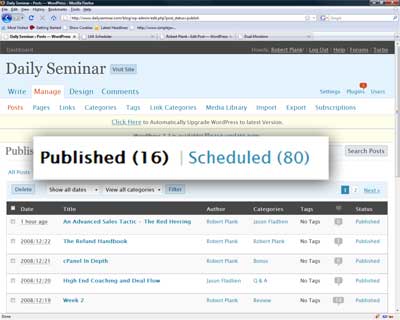
Look at that, 16 live posts and 80 scheduled posts... for a total of nearly 100 posts! I am finishing up March 2009 this week. That's the only way to do it... knock out one month completely, knock out the next month completely...
Our original plan was to kill ourselves and spend 1 week out of every month recording 25-ish interviews. That would have been stupid and would have burned up our content too fast.
Instead, we scheduled the interviews once per week. To fill out the rest of the week, Jason and I each recorded some 20-minute videos on our own. (When making the bonus materials for Product University we got a lot of practice pumping out 20-minute video products quickly.)
So, our formula consists of: Monday, a video by me... Tuesday, a video by Jason, Wednesday, one of our interviews converted into video... Thursday, some product we had secured the rights to... Friday, a question and answer session... and if we still had stuff to give, we'd fill up Saturday and Sunday too.
Why not join to see for yourself how we structured it?
We've filled up every single day of the month so far. Since it's all scheduled several months ahead of time, all we REALLY have to do is answer blog comments. We've had a couple minutes every day to fill up a Saturday or Sunday slot too.
We also know the demand exists. Our own product creaton low ticket items sold well. Our high ticket items sold well. Now it's time for the next step (recurring).
One last thing. You don't have to kill yourself when you make a membership site. Just figure out a way to schedule content to get released most days of the week (like on a blog).
We almost killed ourselves trying to come up with content the first time around. When we did the Product University class, we hosted TWO webinars per week when one would have been fine.
Heck, how much PLR or MRR content is sitting on your hard drive? Could you assemble some of that into a membership site?
Or maybe you just freelance. If you are a successful freelancer you know that your best business comes from repeat clients... so why not get them in a membership site? If you're a writer, guarantee a certain number of articles per month. If you're a copywriter, guarantee a number of autoresponders, solo ads, or sales letters per month. And so on. Why go to all that trouble of begging for money every month?
Add ten comments to this blog post for the next big thing I changed this year!
Seven Things #4: Joint Products
During lunch at the Warrior Event in April, I was with the group at a really cool Mexican restaurant and I sat next to an attendee who was an NLP copywriter.
No, it wasn't Steven Schwartzman, actually I can't remember the guy's name. He was new to the warriors but he really knew his stuff. (He taught coaching in the dating and hypnosis niches).
I explained to him that one of the weakest points in my business system is joint ventures. I am not a people person. Even though I have a large buyers list and people like Eric Louviere said I was a really popular, I didn't believe him because I don't have any really good contacts.
Some of those people on my customer list include Allen Says, Paul Myers, Willie Crawford, Marlon Sanders, Marc Harty, Mike Filsaime, Armand Morin, Tony Blake, Ewen Chia, David Valleries, Dave Miz, Kevin Riley, Paul Kleinmeulman... I could go on.
I'm still a nobody because these guys are flooded with joint venture requests... I don't offer any high ticket, high commission, recurring, multi-tier products. I still have a long way to go.
This NLP guy gave me a cool idea to start small... and that's to create joint products... but not in the usual way.
As Willie Crawford said in his talk about joint ventures at the seminar, you need to hand everything to them on a silver platter.
NLP guy's suggestion: Ask the joint venture "target" to ask his list for their best question about your topic... whatever topic you are an expert in.
Then, answer those questions and give it to that list owner as a product... that they have exclusive rights to... that ends in a call to action to buy YOUR product, with their affiliate link.
You could host a teleseminar or even just record a skype conversation where you discuss the answers. Maybe cut them up and make a podcast.
Transcribe them so you have an autoresponder series.
That's how you create a joint product.
That's what Jason Fladlien and I did later this year after the Philadelphia JV Alert seminar in June. We recorded a bunch of Skype interviews... and guess what... we'll be adding them to Daily Seminar every single week.
Have you created any joint products? Do you have any joint product tips to share?
Dual Monitors
One thing I forgot to mention the other day about my Camtasia PowerPoint process is that I now have a dual monitor setup:
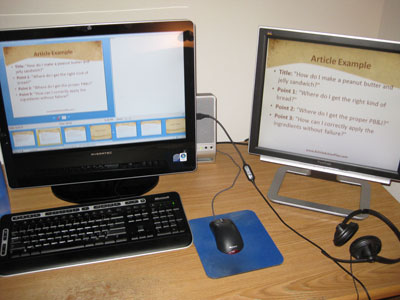
On the left is my new computer that came this week. It's one of those iMac ripoffs where the whole computer is contained within the monitor. It's an AVERATEC F1 D1002UHCE-1.
2.4 GHz Intel Core 2 Duo E4600, 2 GB DD2 memory, 320GB SATA hard drive, 22 inch monitor, Nvidia GeForce 8400 256 MB graphics card, built-in wifi, memory card, DVD burner, webcam, TV tuner. I upgraded from a Shuttle, little toaster shaped computer I bought a couple years ago.
I like tiny computers... less clutter.
But I plugged my 19-inch monitor from the old computer into the back and now I have a second monitor. Great for recordnig those Camtasia PowerPoints as you can see in the picture.
I configured PowerPoint to display the actual slide show on the right monitor, and show "presenter view" on the left so I can see what slides are coming up next.
Yep, if you go to "Set Up Show" in PowerPoint you can not only specify which monitor will display the presentation, but also what resolution to resize it to... I tell it to resize to 640x480 for the presentation.
What's more, if you use the REAL PowerPoint (not OpenOffice like some people named Jason) and you install Office first, then Camtasia, they will add a little button to the "Add-Ins" tab of Camtasia to start the slide show and start recording with one click.
I click ONE button, it resizes my second monitor to the low resolution for recording, starts the slide show, and starts recording. As soon as the slide show is finished, it resizes the monitor to the old resolution and asks where to save the Camtasia recording.
Super cool, right?
The one-click thing might sound stupid, but I'm recording so many videos for the Daily Seminar that I'm at the point where I need it.
I've used dual monitors at work for over a year now and it makes you way more productive in other ways. You can code in one window and read instructions in the other... edit graphics in one window and write in a document on the other. But Camtasia recording is by far my best use for dual monitors.
Do you have a dual monitor setup? If you don't, why not? What desktop setup do you have to get the most productivity?
Seven Things #2: Advertorials
In April 2008 I attended my very first real seminar. We socialized at the bar every night (Thursday night through Sunday night) and one of those nights, starting drinking in a group of people that included Bruce Wedding -- copywriter!
Bruce is slightly ahead of where I'm at (he does $4000 copywriting jobs) and he spoke a little bit about how he has been trying advertorials.
An advertorial is exactly what it sounds like: an ad that teaches some kind of information.
I wrote a sales letter a couple of days after returning from the event and it was an advertorial. I wrote it like an action-packed article and it ended up being a 20 page sales letter.
If you know my PHP products, I sell a package of seven scripts... each script contains source code, PDF instructions, and a how-to video.
I was able to split the long sales letter into seven sub-letters. There was an overarching story throughout the whole thing, but each sub-product had its own story.
I registered seven extra domain names (each for its own script), put each sub-page as its sales letter, put up an order button and upsold it all to the main product.
Don't forget, I also wrote solo ads and setup affiliate programs for each product.
A lot of work, but there you have it... 8 products!
Tomorrow, Jason Fladlien and I are launching the Daily Seminar where we give advice about how we create products quickly, write sales letters quickly, sell without selling, and more stuff... we give advice every weekday!
Gimmie ten comments down below and I will share the next tip with you.
PowerPoint Camtasias
I can't believe I haven't given away this procedure on the blog before. I think I've mentioned it in passing once or twice via comments, and explained it in the private Product University membership last month, but I'm sick of repeating myself, so...
Here is the formula to turn an audio product into a video product. It requires Camtasia ($299 with 30 day free trial) and Microsoft PowerPoint (OpenOffice is free, or you can get the downloadable home edition of Office 2007 for only $80 on Amazon).
Let's pretend you have an audio product that's 27 minutes long.
1. Open up a blank PowerPoint and start playing the audio in your MP3 player. (The default black and white theme will work fine for this.)
2. Fast forward to 1:00 (one minute) in the audio and start listening. Type in the main point of 1:00 to 1:59 as the headline of the slide, and type three quick bullet points of 1 to 6 words each. (Pretend you're back in school and taking quick notes).
3. When the audio passes 2:00, skip to slide 2 by hitting ctrl+enter. Type in your headline and three bullet points for 2:00 to 2:59 in this.
4. Repeat for the duration of the audio. The beauty of this is if you need to stop at say, 15 minutes, you can come back and you'll know exactly where you left off. By the end of this, your 27 minute audio now has 27 slides.
5. Insert a slide in front of all the other slides in the PowerPoint. Change its layout to title slide, and type in the name of the product and the author.
6. (Optional) Edit the master slide and insert your URL at the footer, that way your URL appears on all slides.
7. Select all slides. In PowerPoint 2003, go to Slide Show... Slide Transition. In PowerPoint 2007, there should be an Animation tab. UNCHECK the "advance slide on mouse click" box, and click the "automatically after" box, then type in 01:00 for one minute.
8. Resize your screen to 640x480 resolution, fire up Camtasia Recorder and set it to capture WITHOUT sound, full screen, at 1 frame per second.
9. Start the slide show and hit record (once you get good at this you can actually do it in one click with the "Add-Ins" menu but let's not get ahead of ourselves). Leave the computer, because if you click around on other windows, even if you have multiple monitors, it will mess up the slide show. Don't take too long of a walk because you'll want to be there to hit Stop as soon as the slide show goes black.
10. Stop the slide show, save the camrec, open up Camtasia Studio to edit your recording and import both the camrec video and the MP3 audio. Add a 2nd audio track and drag the MP3 in as the audio.
Congratulations, you've just turned your 27 minute audio into a 27 minute video, and it only took you 27 minutes to listen to the audio and about 2 minutes to get it into Camtasia Studio.
Now export it to an SWF 1 frame per second video if you want to show it on the web. If you want a downloadable version, I prefer to export to WMV. Camtasia 5 has a checkbox that will also export into an iPod version. Cool beans!
Guess what, you can also export the PowerPoint slides into PDFs as well. You've just given yourself an excuse to charge $10 or $20 more for your product.
Don't even have an audio product? Read your book aloud, word for word. Record it into Camtasia and export just the audio (I don't even bother with programs like Audacity).
This is how I make audio products. I'll record text word for word into audio, then PowerPoint it to make it a video.
Most of the time I'll do it backwards, and write PowerPoints where 1 slide = 1 page, then record the PowerPoint with Camtasia running, capturing audio as I read each page aloud, and change the slide when I turn the page.
Then export the PowerPoints into PDF, camrecs into WMV, MP3 and iPod... $17 e-book becomes a $47 video product.
For the products Jason and I are creating for the Daily Seminar, most of the time we don't even bother with the text... who has time to write when you are recording a 20 to 60 minute seminar every day? Just record Camtasia PowerPoints and export video plus audio plus slides. If people really want text, we'll transcribe them, but those costs really add up.
What are your thoughts? Do you use something similar to my PowerPoint Camtasia method? Do you have an even BETTER system than me? Please tell me to know, I'm dying to hear about it!
Seven Things I Changed This Year
Guys, I'm launching a membership site next Monday (December 15th) at 10:00 AM PST. Just wanted you to be aware.
2008 was my most important year in marketing. I changed a heck of a lot of things and actually took my marketing seriously.
The first thing I changed: a longer stream of upsells.
I've only started using upsells this year. An upsell is where you sell a low-ticket item for $27 and just as your visitor goes to order, you give them a choice to either pay the $27 or $97 for a higher ticket item.
Even better, get the $27 order first and on the thank you page, give people the choice between clicking over to the download or giving you the extra $70 for the full package.
Attending seminars made me realize how short sighted I was. Many of the attendees sell products in the $600 range and upsell coaching packages all the way up to $10,000.
As soon as I arrived home from my 4 hour flight and 90 minute drive from the airport, I changed many of my upsells that went from $27 to $97... to upsells that went from $27 to $97... to $197... and finally to $250.
I would bump the upsell to $500 or more but Clickbank has my price limit set at $250.
Do you have an upsell for your product? How many steps?
Please fill up this entry with ten comments so I can share the next big thing I changed this year...
What Membership Software Do You Use?
Do you run a membership site?
What software, plugins, and payment processors do you use for it?
I just setup a real recurring membership site. No more of this password protected blog stuff. I used aMember and WordPress, with Clickbank as the payment processor.
I was really surprised how many plugins are available for this stuff now. Even a year or two ago, you had to modify code and do custom scripting... "duct taping" the scripts together. Now you just install some plugins.
Pretty freaking cool!
I used a blog because I wanted to stockpile a bunch of content up. aMember has the most support (I'm a member of Membership Academy so that helps.)
And Clickbank? If you read my Membership Sites on Crack report, you'd know why I chose Clickbank. Affiliates (60% commission on a recurring product) plus the escape plan. If I can get enough content piled into that membership site so that I have a year's worth of content in advance, you better believe I'm selling it off.
Do you run a membership site? What software do you use to run it? Membergate, aMember, Visiongate? What processor... PayPal, Authorize.net, Clickbank, PayDotCom, 1ShoppingCart? How do you like it?
Please, show off the sales letter to your membership site as well since those can be tricky...
Recession?
What are you working on this week? I'm cranking out a bunch of content for a new membership site...
Lots of marketers the past couple of months are using the economic recession as a hook to sell their stuff. "This system will help you profit in a recession..." I'm sure you're tired of it. You can't have a Unique Selling Proposition if it's not unique!
It's not just the internet marketing niche either. I got this e-mail from Experts Exchange (a programming forum) a few weeks ago:
"If you had invested in the S&P 500 just before Thanksgiving 2007, and cashed out just before Thanksgiving 2008, you would have lost 41% of your money."
Boo-frickin-hoo. I lost $30k in cash to the stock market the first month of this year. The value of my home has dropped $137,000 in the past 5 months on a city block where at least 30% of the homes were in foreclosure when I moved in.
One of my relatives was laid off this month, and you know what he immediately did? He didn't feel sorry for himself -- he started looking for another job. He has a savings account that will last him a little while and doesn't have a ton of debt that will eat him alive.
Another friend of mine just bought a brand new car and a house for his wife and kid, neither of them are college educated, they work "average" jobs and they can actually afford the payments.
For my business partner and I, 2008 was our most profitable year ever. I just made close to $5000 selling a 7-pack of PHP scripts, and another $4000 before that selling a 23-page PDF report, using minimal outside advertising. It was almost 100% in-house e-mail marketing. He is close to $100k in income for the year.
We both bought homes this year, and we're both taking our girlfriends to Hawaii for New Years at the end of December.
I don't have to tell you about how there are more cars on the road, more people in lines at stores and in the movies now than ever...
The whole point of a "recession" is to weed out the weak businesses. You can either watch the news way too often, believe the world is going to end tomorrow, and let it depress and demotivate you. OR you can realize that there are people out there giving up (just because they hear bad news) and you can get ahead of them.
You might have already read the story below. It's "The Man Who Sold Hot Dogs!"
There was a man who lived by the side of the road and sold hot dogs.
He was hard of hearing so he had no radio. He had trouble with his eyes so he read no newspapers. But he sold good hot dogs.
He put up signs on the highway, stood on the side of the road and cried, "Buy a hot dog, mister?" People bought. He increased his meat and bun orders. He bought a bigger stove to take care of his trade.
He finally got his son home from college to help him out. But then something happened. His son said, "Father, haven't you been listening to the radio? Reading the newspapers?
"There's a big depression. The European situation is terrible. The domestic situation is worse."
The father thought, "My son's been to college, he reads the papers and he listens to the radio, and he ought to know." He cut down on his meat and bun orders, took down his advertising signs, and no longer bothered to stand out on the highway to sell his hot dogs.
His hot dog sales fell almost overnight. "You're right, son..." The father said to the boy. "We certainly are in the middle of a great depression."
D'oh!!
Do you belong to any clubs or memberships to network and get more ideas, do you know what you want in 2009 and do you know what you have to do to get it? Heck, what can you do differently in the next three weeks that hasn't worked for you this year?
Please comment below, and let me know what you are working on for the remainder of this year. And guys, PLEASE don't turn this into a political or economic discussion. The whole point is that politics and economics won't affect your business unless you let it. Your bad attitude will KILL YOU if you let it.
Hypnotic PHP
I just launched Hypnotic PHP on Thursday, so how did it do? $3,308 in 24 hours... and $4,574 in 48 hours, that's how it did!
Out of the 962 people who actually clicked through my e-mail, 211 bought. That's a 21.9% conversion rate on my untested, half assed full of typos sales letter that I wrote in a few hours.
From those $17 purchasers: 141 of them accepted my $7 upsell containing 7 more videos and scripts (Urgency Tactics) ... 66% conversion rate there.
So the grand total was 352 sales for a total of $4,574... $4,320.56 after fees, but the number of sidetracked sales of other products, made up for those PayPal fees.
So why the heck didn't I do a dimesale or anything like that for this launch?
You don't ALWAYS need to repeat the same freaking exact process when you launch a product!
I used to have people complain about my dimesales (because they couldn't get in at a low price fast enough), this time I had people complain about the LACK of a dimesale (because he's used to getting in at a low price).
I haven't given up dimesales, but the effort that goes into pre-selling my list a few days ahead of time is a lot more valuable than doing all the steps to make sure my dimesale works correctly.
You don't ALWAYS need a dimesale offer, just some kind of scarcity. Mine was really low-key... you get in now for $17, but after 48 hours it's $27. No countdown timer, no ticker counting the number of sales... just a simple offer.
If you were on my list you got the Email Marketing on Crack videos that explained it...
- Day 1: Tell your list something's going on sale at such and such date and time.
- Day 2: Explain the biggest benefit. (48 hour notice)
- Day 3: List out the rest of the benefits. (24 hour notice)
- Day 4: Tell them you launched it. (3 minute notice)
- Day 5: Tell them it's the last chance to get in before you close the doors or raise the price
That's it! It's not rocket science. I only started applying this after people told me the dimesales didn't give them time to read the sales letter.
But when I replaced the dimesale with standard scarcity, I still made the same amount of money with less customers -- which means less support.
I know some of you guys might cry and say, "Yeah right, you couldn't have done that without your big mailing list..." How do you think I built that mailing list up in the first place? Product launches on forums to build my list.
One final tip about pre-selling your list: Have the product ready to go before you start pre-selling it. I see lots of guys promote first and then end up having to push the launch date back.
But me, I used those few extra days to whip up an irresistible upsell offer (the extra $7 videos and scripts). 90 minutes of work netted me an extra $707 on that promo. 🙂
Am I Evil For Working At a Day Job?
My question to you today is: does working at a day job make me evil?
I have been balancing the day job and internet marketing thing for years. It's not that bad. I'm getting my first 3-5 year computer programming job on my resume, lots of free training that would otherwise cost $5000, really good health insurance, and a reason to get up in the morning.
I don't always work 9-to-5 hours. Some days I work 6AM to 2:30PM, or 10AM to 6:30PM. It's also not the most challenging job. I don't have to work overtime, I'm not on-call, I don't take my work home. So I'm free to do internet marketing stuff after work, during lunch, and on weekends.
Quick Story:
Sometimes I forget to pick up my paycheck at my day job. Last month when I went to the receptionist to pick it up, one of my co-workers, a really cool woman in her 40's, noticed I'd taken a while to pick up my check.
She commented, "Someone else must be making those Mustang car payments..."
I told her nope, I pay for my car, but I wasn't making payments on the car... I bought it for $20,000 in cash last year.
She was surprised. I shrugged and said I'd saved up some money. I forgot to add that I own a home at age 24, or that I pay double into my principal every month.
I also kept quiet the fact that I'd launched a product the night before, and made more in 90 minutes than she made in 30 days.
How about the fact that I dropped two months worth of pay at that job for a one week vacation in Hawaii during the winter break?
No one at work knows my secret, that I make more than my boss, his boss, and his boss. Out of 800+ employees at my place of work, the only people who take home more money than me are the president and his 10 vice presidents.
When do you think I should quit?
When I have a year's worth of income in savings? Don't give me that, "Quit when your internet job has replaced your day job" line. I did that years ago.
I'm not going to be one of those guys who quits without health insurance. When did you quit and do you have health insurance? Who is your provider?
Once you lost that "time crunch" to get back to your day job, did it kill your productivity?
I am completely lost here... I had planned on being self employed right out of college but this REALLY nice and easy day job fell into my lap. Some days it keeps my busy, some days I get bored and wish I could take a road trip or something.
Stay or quit? Please tell me in the comment box below. If I don't get ten replies maybe I'll just quit regardless.
Always Write a Report About What You Learned
I'm back from my trip from Affiliate Incubator 2008 Dallas.
 I learned a lot, and here's my tip for attending seminars: Take whatever notes you write down and turn it into a PDF report, that you NEVER show anyone else.
Not only does it train you to keep pumping out 5 to 10 page reports, the information becomes a part of you because you retyped it and revised it.
If I had a clone who wasn't able to attend the seminar, I could just hand this document over to him and he would have all the info without having to attend.
I'm a pretty rare note-taker. If you're a smart enough businessperson you know that 99% of what's being said doesn't apply to your business, but I still wrote about 10 pages of notes.
I took the best of Perry Belcher's AdWords tips, Ryan Deiss' continuity management, Mr. X's time management secrets, Frank Sousa's traffic tips, Russell Brunson's "moving the free line" and article marketing stuff, and Anik Singal's affiliate marketing techniques... plus some stuff I learned from chatting at meals and made it into an 8 page report.
To be honest, I walked out of all the other presentations to avoid information overload. There's only so much information you can absorb over a weekend, and with seminars I always avoid the newbie oriented stuff.
Now I've torn most of the pages out of my physical notebook and I have stuff to do for the next 30 days to keep me busy.
To be honest, looking back over my report, I'm going to ignore about half of the tips on there because I know I just won' t have time for them.
Knowing what NOT to change on is even more important than knowing what to change in your business.
Anyway, my friend Jason Fladlien wrote up a quick report of his own about the 8 mistakes he saw being made at these seminars.
Some of these are truly classic, like the SEO guy and the "60 Second Rule." If you can't make a decision about something, give yourself exactly 60 seconds to decide.... even if it's the wrong choice.
P.S. No, I didn't get to meet Russell, but I did meet Stu McLaren, Joel Christopher, Big Jason Henderson, Blake Milton, Bobby Walker, and more. It was great to see Eric Louviere again, and Marc Harty talking about mini-days.
P.P.S. I'm also on an article writing frenzy, setting aside one hour per day to write 7 articles... before I come off this seminar high.
Today's Question: What's your best post-seminar productivity tip? How do you get back on track, and maintain that seminar high?
I need my ten comments... if I don't get them, I'm never attending another seminar ever again.
Affiliate Incubator Part 2
The other day we went over some stuff you can do to promote products as an affiliate, but what can you do to get others to promote YOUR affiliate products?
As of this writing, I sell 48 different products from one Clickbank account. Affiliates only account for about $1,000 per month of my income, but hey that's a free $12,000 per year on top of everything else so it's definitely worthwhile.
I'm sure the seminar will have some kind of non-disclosure agreement, so I don't want anyone to think I'm passing on something from the seminar... which I haven't attended yet. Let's get my affiliate MANAGING tips out in the open right now.
Affiliate Management Tactic #1: Offer High Commission or Recurring Commission
I joined Amazon.com's affiliate program, the first BIG affiliate program on the net, in 2000. They offered 15% commission on DIRECT sales (if you linked right to that product) or 5% on SIDETRACKED sales (you link to that product and the person buys something else on Amazon.com).
Screw that. If you are running a pay per click ad campaign, the sales letter you're promoting converts at 1%, the product costs $30, and you get 50% commission, your maximum bid would have to be 15 cents just to break even. 10 cents per click if you even want 50% profit.
Likewise, if that same vendor offered 75% commission, you could bid up to 22 cents per click. If they offered a $297 upsell, and 10% of buyers took the upsell, that brings the "average" product price up to $56.70 and means you can bid up to 42 cents per click.
Introduce backends: upsells or one-time-offers, thank you page offers, recurring commissions, anything to give your affiliates more money... and they'll be able to afford sending the serious pay-per-click and targeted traffic your way, instead of the usual "setup a blog and post to forum" half-assed effort.
Give free access to the product after a certain number of sales. Incentives for the top affiliates... plasma TVs and MacBook Airs... but only if it's a big launch. Russell Brunson gave an H3 Hummer to his top affiliate once! Show affiliate leaderboards to get people clawing for the top spot.
Affiliate Management Tactic #2: Provide Banners and Solo Ads for Affiliates
When I give affiliates something to promote, I create a page for them where they can fill in their ID and it shows them their affiliate link and a solo ad branded with their ID. I do this using JV Plus.
A solo ad is simply a quick e-mail your affiliate can cut and paste to send to his list. It doesn't have to be long, just 250 words. Find the best bullet points or the biggest benefit/takeaway and write a SHORT article about it. Tell affiliates they can post it on their blog, submit it as an article, send it as an e-mail, do whatever they want with it.
468x60 sized banner ads are also popular but for me (not being a graphics-oriented guy), the solo ad is most important.
Affiliate Management Tactic #3: Remove Distracting Links
Remove opt-in forms, squeeze pages, offsite links from pages affiliates will send traffic to. I just had this argument with Ben Prater about an opt-in form he had on a sales letter I was promoting as an affiliate.
If I'm sending affiliate traffic to someone else's site... it's not leading to a sale... and it's building someone else's list without giving me credit, I'm GIVING away subscribers. Your list is your baby... your affiliates value their own lists as well.
What's your TOP TIP for getting affiliates to promote your products? Give me ten comments, below and I'll increase the affiliate payout on ALL my products across the board from 50 percent to 60 percent.
Affiliate Incubator Part 1
I'm attending the Affiliate Incubator seminar next week (Sept. 25th - 27th 2008) in Dallas, Texas. I'll probably learn lots of things about promoting stuff as an affiliate.
Affiliate marketing is pretty cool, you don't need to worry about product creation or customer support, you just send traffic to the vendor's page and then get your commission.
My own products sell the best to my list ($2000 to $4000 launches all the time) but I have been known to send $500 e-mails on a regular basis. Recently, I promoted the legendary Ben Prater's "iPhone Secrets Exposed" package.
That landed me 8 sales on a $397 product with 50% commission. You do the math... that's 1500 bucks from a couple of e-mails, probably 20 minutes of work writing the follow-ups. Those e-mails were so good that Ben incorporated them into his sales letter.
Let me empty out my brain with what I know about affiliate marketing already...
Affiliate Tactic #1: Have a List Already
It's simple, you can't expect any big profits unless you have a list of leads you've built yourself and more importantly, qualified buyers. Write up a quick 10 to 20 page report, record at least 20 minutes of videos and price it at $7 to get lots of buyers. Make sure to capture an e-mail address after the sale.
If you can get just 100 people to buy that $7 report, you can safely assume you'll score one affiliate sale... if you promote a complementary product to that list.
Affiliate Tactic #2: Think of Something They Didn't Think Of
I learned this one watching Todd Gross promote affiliate products. He promoted a product called "Floating Action Button" ... it's just what it sounds like, shows a hovering box that moves as you scroll. My Action PopUp script does the same thing.
Instead of giving people the usual sales pitch about popups, he showed how cool it was to place a YouTube video on the floating button, giving your sales pitch in the corner WHILE they read your sales page, and you urging them to click the order button.
All I see Big Jason Henderson do when he promotes affiliate products... records a video of himself (either screen capture or talking head) going over the benefits, then he watermarks his affiliate link to the bottom of the video and blasts that video out to YouTube, Revver, Vimeo, all the video sites.
When I promoted "iPhone Secrets Exposed" I just thought of what Ben left out of his sales letter...
E-Mail #1: You should be in a SPECIFIC profression... i.e. iPhone programmer instead of a regular programmer. No URL yet, just warming them up.
E-Mail #2: Code iPhone apps to get a recurring income on subscription fees... I just looked at Ben's bullet points and asked myself, "WHAT'S IN IT FOR ME when I create an iPhone application?"
E-Mail #3: Are iPhones an untapped resource? What would you do if you invented YouTube, MySpace, before anyone else. If you don't code an iPhone app is it like letting the next Facebook pass you by.
E-Mail #4: Statistics to blow them away. There are this many iPhone users, this much profit from the AppStore, this many applications (low competition).
That's it. I could have fired that off as one e-mail but I spaced it out into several.
This tip goes without saying: Don't promote the same launches as everyone else and don't use the samea cut-n-paste affiliate messages as everyone else.
Affiliate Tactic #3: Proper Redirects
Don't promote your naked affiliate link. Get a simple script to send traffic from a link like http://www.robertplank.com/recommends/some-affiliate-program so it's not totally obvious you're using an affiliate link.
Actually what I really prefer is, I register a .com domain and use that as a redirect. It's only 8 bucks, and I've got some really good ones. For example, Jason Fladlien's 7 Minute Article product is on a domain name called "InstantContentCreation.com" ... but I grabbed up 7MinuteArticles.com and redirected it to my affiliate URL.
I'm sure Affiliate Incubator will have a lot of newbie-oriented info like, promote recurring products... how to calculate the Clickbank refund rate or statistically decide if a product is worth promoting... how to make a squeeze page and a viral report. How to add your own crazy bonuses "Gary Ambrose" style.
But if I can find out just one thing I don't know, the trip will be worthwhile (just like everything).
What's your FAVORITE affiliate marketing tactic? I mean marketing AS an affiliate, not MANAGING affiliates... we'll get to that later.
I need ten comments on this post... add yours below... or I might stop creating products for good, and only promote affiliate offers.
Barack Obama Follows Robert Plank on Twitter!
You know you're popular when one of two Presidential candidates personally goes out of his way to add you as a friend on Twitter...

Okay, just kidding. Senator Obama is following 70,000 people on Twitter including me... his account automatically subscribes to YOUR updates when you subscribe to his.
Twitter is a social networking site where you can provide brief, up-to-the-minute updates about yourself -- you are limited to 140 characters so that people who subscribe to you can receive updates via text message.
It sounds like a big waste of time if you use it incorrectly (just like anything else)... and lots of people leave updates like:
(8:35 am) Went to the bathroom.
(9:36 am) Waiting in line at McDonald's...
(10:59 am) Leaving to do errands...
No one cares about that but people do care if you have a relevant discussion going, if you're launching a new product they would like, you have a new blog post, you're going to a seminar, or have a quick question... Twitter is a nice and easy way to build a (non-email) list.
Just about every day his Twitter update says: "In Albuquerque, New Mexico. Discussing the need for equal pay. Watch this discussion live at (url to watch the streaming video)" ... The city, state, and topic change.
That's perfect. You know what he's doing every day but there aren't a ton of annoying promotional messages, and there aren't any useless messages either.
My question to you:
Do you use Twitter?
Is it a waste of time?
Will spammers ruin Twitter?
What's your BEST Twitter marketing tip?
Please! Take 27 seconds to leave your comment below so I can get the ten comments I need to keep updating this blog...
Google Alerts
Do you happen to use Google Alerts to track what people are saying about you and your products?
I have been using it for several months. I wish I'd used it sooner. In the past I have used a combination of Awstats (to see what other sites link to me, including search engines) and WordPress Psychic Search to see what search phrases bring people to my sites -- and what they search for when they get there.

(I once joined a $60/month membership site just because their private message board was sending traffic to one of my products and I wanted to see what people were saying.)
It's saved me a ton of time. I don't need to hop on Google to check and see if any new affiliates have popped up or if anyone has reviewed my products, I just get an "as-it-happens" e-mail... usually within the first few hours.
Just today I got an e-mail alert when someone mentioned my new Action Optin script, and I was the first person to leave a comment on his blog post.
Now that the Warrior Forum is search engine friendly I know right away if someone mentions me.
(This is BIG as it keeps me out of forums... which are huge timewasters for me.)
What's even more powerful: entering the names of all your products as Google Alerts... and your competitors' products... and the names of your competitors!

I have also found discussions about my products and new affiliate sites when my name was not even mentioned.
I got that idea when some people were badmouthing an internet marketer on a message board, and they were very careful about misspelling his name and product names on purpose... just in case he had a Google alert set.
As luck would have it, one of the forum commenters spelled his product name correctly just ONCE, and the product creator found his way onto that board.
Google Alerts have been around for 4 years, but almost no one uses them... do you? Do you use it to spy on your competitors, track your products, stop plagiarism, jump on blog conversations, or something I haven't thought of?

